The short answer
Surah Nasr, also called Surah An-Nasr, is the 110th surah of the Quran, with three verses. Quran 110:1 to 3 (surah 110, verses 1 to 3) describes people entering Allah's religion in groups, then tells the Prophet Muhammad, peace be upon him, to glorify his Lord and seek His forgiveness.
What is Surah Nasr?
An-Nasr is chapter 110 of the Quran. The Tanzil metadata gives it three verses, the English name Divine Support, the class Medinan (from after the move to Madinah), and a place in juz (part) 30 (1). In the al-Salama edition, Ibn Kathir opens his commentary on it with the heading that the surah is Madani (2).
Surah Nasr in Arabic and English
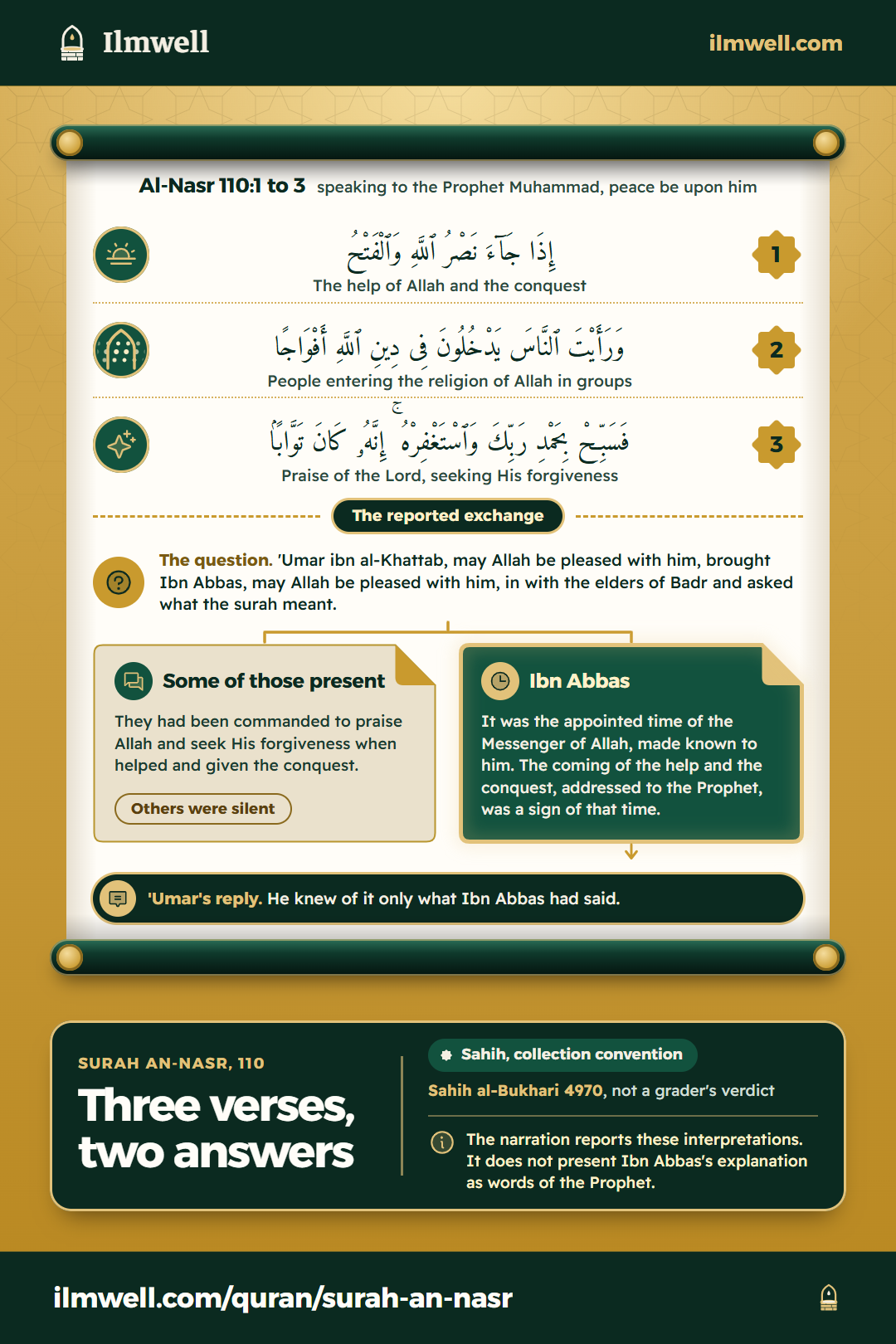
Al-Nasr 110:1 to 3
إِذَا جَآءَ نَصْرُ ٱللَّهِ وَٱلْفَتْحُ ١ وَرَأَيْتَ ٱلنَّاسَ يَدْخُلُونَ فِى دِينِ ٱللَّهِ أَفْوَاجًا ٢ فَسَبِّحْ بِحَمْدِ رَبِّكَ وَٱسْتَغْفِرْهُ ۚ إِنَّهُۥ كَانَ تَوَّابًۢا ٣
Each verse below has its Arabic, its English from the adapted Pickthall translation, and a plain note on the wording.
- 1
إِذَا جَآءَ نَصْرُ ٱللَّهِ وَٱلْفَتْحُ
When Allah's succour and the triumph comes.
The verse names the help of Allah and the conquest together. The English reads "When Allah's succour and the triumph comes", where "triumph" is this translation's word for what this page calls the conquest.
- 2
وَرَأَيْتَ ٱلنَّاسَ يَدْخُلُونَ فِى دِينِ ٱللَّهِ أَفْوَاجًا
And you see mankind entering the religion of Allah in troops.
The verse speaks to the Prophet about what he sees: the English reads "entering the religion of Allah in troops".
- 3
فَسَبِّحْ بِحَمْدِ رَبِّكَ وَٱسْتَغْفِرْهُ ۚ إِنَّهُۥ كَانَ تَوَّابًۢا
Then hymn the praises of your Lord, and seek forgiveness of Him. Indeed, He is ever ready to show mercy.
The English reads "Then hymn the praises of your Lord, and seek forgiveness of Him" and closes "ever ready to show mercy".
What do the three verses say?
Verse 1 names the help of Allah and the conquest. Verse 2 describes people entering the religion of Allah in groups. Verse 3 gives the response: glorifying the Lord with praise and asking His forgiveness. Use this sequence to recall the surah after reading it.
| Verse | What it says |
|---|---|
| 1 | The help of Allah and the conquest |
| 2 | People entering the religion of Allah in groups |
| 3 | Praise of the Lord, seeking His forgiveness, and the English closing "ever ready to show mercy" |
What did Ibn Abbas, may Allah be pleased with him, say the surah meant?
In Sahih al-Bukhari 4970, Ibn Abbas, may Allah be pleased with him, reports that 'Umar ibn al-Khattab, may Allah be pleased with him, brought him in with the elders of Badr, and that some of them resented it. 'Umar asked those present what the surah meant. Some said they had been commanded to praise Allah and seek His forgiveness when they were helped and given the conquest; others were silent. 3
'Umar then asked Ibn Abbas, who said it was the appointed time of the Messenger of Allah, made known to him. He gave Allah's words about the coming of the help and the conquest, addressed to the Prophet, as a sign of that time. 'Umar replied that he knew of it only what Ibn Abbas had said. 3
Grade: Sahih, by the collection convention for Sahih al-Bukhari, not a grader's verdict. 3
The narration reports these interpretations. It does not present Ibn Abbas's explanation as words of the Prophet.

What did the Prophet say in bowing and prostration?
In Sahih al-Bukhari 4968, 'Aisha, may Allah be pleased with her, reports that the Prophet often said, in his bowing and his prostration:
Sahih al-Bukhari 4968
سُبْحَانَكَ اللَّهُمَّ رَبَّنَا وَبِحَمْدِكَ، اللَّهُمَّ اغْفِرْ لِي
In our words, the supplication means: Glory be to You, O Allah, our Lord, and praise be to You; O Allah, forgive me. The report adds that he did this interpreting the Quran (yata'awwalu al-Quran).
Grade: Sahih, by the collection convention for Sahih al-Bukhari, not a grader's verdict. 4
The report does not name the surah. In Sahih al-Bukhari it sits under this surah's section of the Book of Tafsir, the commentary on the Quran. It gives no count of repetitions and does not say that the surah is recited in prayer. For the meaning of seeking forgiveness, see Astaghfirullah. For praise, see Subhanallah and Alhamdulillah.
How can you learn the three verses?
Learn one verse at a time, then join it to the next. Read the Arabic with a teacher or a recording by a qualified reader, then recall the sequence from the table above. This is a learning suggestion; it claims no count and no reward.
No audio is embedded or named on this page, and no transliteration is given.
I had recited An-Nasr for years as a short surah in prayer. Then a teacher told our class how it was linked to the end of the Prophet's life. I remember sitting on the mosque carpet, reading those three lines again and hearing them differently.
Try it: Surah Nasr in three questions
1How many verses does Surah Nasr have?
Answer: Three. The Tanzil metadata gives surah 110 three verses.
2Which verse says people enter the religion of Allah in groups?
Answer: 110:2. The English of this verse reads "in troops".
3In Sahih al-Bukhari 4970, who gave the reading that the surah is the Prophet's appointed time?
Answer: Ibn Abbas. 'Umar said he knew of the surah only what Ibn Abbas had said.
Questions people ask
Is Surah Nasr the same as Surah An-Nasr?
Yes. Surah Nasr and Surah An-Nasr are two spellings of surah 110. The Tanzil metadata gives An-Nasr as the transliterated name and Divine Support as the English name.
Is Surah Nasr Makki or Madani?
Tanzil and the heading in the al-Salama edition of Ibn Kathir's commentary both class it Madani, which is Medinan (source 1 and source 2).
Does reciting Surah Nasr bring a reward?
This page does not cover rewards, virtues or recitation counts for Surah Nasr, and it cites no checked report that gives one.
Is there a Surah Nasr transliteration?
No transliteration is given here. A full transliteration needs a qualified reader's check before it is published.
Sources
Every claim on this page comes from one of these. Gradings are reported with the scholar's name; we do not grade hadith ourselves.
- 1
Surah 110 has three verses, the transliterated name An-Nasr, the English name Divine Support, the class Medinan, and falls in juz 30.
Tanzil Project metadata, surah 110 CC BY 3.0. Record: data-tanzil-surah-110-meta.
- 2
Ibn Kathir's heading to his commentary on the surah reads that it is Madani.
Ibn Kathir, Tafsir al-Qur'an al-'Azim (al-Salama edition), vol. 8, p. 509, the heading; Ibn Kathir (d. 774 AH) Electronic copy: not checked against print. Book 8473 (al-Salama edition) on shamela.ws, read 2 November 2026. Record: scholarly-ibnkathir-110-madani.
- 3
Ibn Abbas reports the exchange on 110:1 to 3 with the elders of Badr, the appointed-time reading, and the words of Umar; graded Sahih by the collection convention for Sahih al-Bukhari, not a grader's verdict.
Sahih al-Bukhari 4970, Book of Tafsir al-Quran, Surah al-Nasr Electronic copy: not checked against print. Shamela.ws, Sultaniyya edition, vol. 6 p. 179, read 2 November 2026. Record: hadith-bukhari-4970.
- 4
'Aisha reports the Prophet often saying the supplication in bowing and prostration, and the report adds that he did this interpreting the Quran; the report does not name the surah; graded Sahih by the collection convention for Sahih al-Bukhari, not a grader's verdict.
Sahih al-Bukhari 4968, Book of Tafsir al-Quran, Surah al-Nasr Electronic copy: not checked against print. Shamela.ws, Sultaniyya edition, vol. 6 pp. 178 to 179, read 2 November 2026. Record: hadith-bukhari-4968.
- Q
Quran Arabic for An-Nasr 110:1 to 3 (the scroll and the verse list), and the English from the adapted Pickthall translation.
Tanzil Project Uthmani text, CC BY 3.0. English: adapted from Marmaduke Pickthall's translation (1930), modernised and checked against modern translations. Record: quran-110-1-3.
Next
Join the email list
New guides by email, now and then. No spam, and you can leave at any time.
Ilmwell is free and kept going by readers. See how to support it.