The short answer
The meaning of Subhanallah is "glory be to Allah": it declares Allah far above any fault. The words appear in the Quran, in As-Saffat 37:159. Muslims say it 33 times after each prayer, from a hadith in Sahih Muslim 597, graded sahih (authentic), and many also say it at surprising news.
How is Subhanallah written in Arabic?
Sahih al-Bukhari 283
سُبْحَانَ اللَّهِ
subḥāna llāh
Glory be to Allah
Two words, also spelt Subhan Allah. To copy and paste the Arabic, use the button under it.
What does Subhanallah mean?
Arabic reads right to left, so the first word is on the right.
- سُبْحَانَsubḥānaglory be to, far above any faultSubhan on its own is this first word. It comes from the root s-b-h (source 7).
- اللَّهِAllāhAllahThe one being glorified.
In his dictionary of word roots, Mu'jam Maqayis al-Lughah, Ibn Faris (d. 395 AH) says tasbih, glorifying Allah, is tanzih: declaring Him far above every evil. Tanzih, he explains, is putting something at a distance, and the Arabs said "subhana min..." to mean "how far it is". 7
سُبْحَـٰنَ ٱللَّهِ عَمَّا يَصِفُونَ
What does Allah subhanahu wa ta'ala mean?
Subhanahu wa ta'ala, often shortened to SWT after Allah's name, uses the same word: "glorified is He, and exalted". It comes in the Quran, for example at the end of Az-Zumar 39:67: "Glorified is He and High Exalted from all that they ascribe as partner (to Him)".
سُبْحَـٰنَهُۥ وَتَعَـٰلَىٰ عَمَّا يُشْرِكُونَ
How do you pronounce Subhanallah?
subḥānallāh
- ḥ is a breathy h from the throat, stronger than an English h.
- ḥā is long: hold the a, as in "father".
- The end of subḥāna runs into Allah, with a doubled l: subḥānal-lāh.
Listen and repeat. A recorded pronunciation by a fluent reciter is coming. We do not use a synthetic voice for Arabic.
When do Muslims say Subhanallah?
After each prayer
Subhanallah, 33 times
The Prophet Muhammad, peace be upon him, gave the count: glorifying Allah 33 times after every prayer, praising Him 33 times and declaring His greatness 33 times. The hundredth is "la ilaha illallahu wahdahu la sharika lah, lahul-mulku wa lahul-hamdu wa huwa 'ala kulli shay'in qadir". Whoever does this, he said, has his sins forgiven, even if they are like the foam of the sea.
In practice: Subhanallah, Alhamdulillah and Allahu akbar, 33 each.
1AuthenticSahih Muslim 597
The hadith names no way of counting. Fingers, beads or a counter app: if you have ever lost count somewhere around 20, you are in good company.
When descending
Glorifying Allah (tasbih)
Jabir ibn 'Abdullah, may Allah be pleased with him, said that when they went up they declared Allah's greatness (takbir), and when they descended they glorified Allah (tasbih). These are Jabir's words about what the companions did.
2AuthenticSahih al-Bukhari 2993
In reply to something you hear
Subhanallah
سُبْحَانَ اللَّهِ، إِنَّ الْمُؤْمِنَ لاَ يَنْجُسُ
Subhanallah, innal-mu'mina la yanjus
Abu Hurayrah, may Allah be pleased with him, kept away from the Prophet because he needed the full bath (ghusl), then bathed and came back. When he explained why, the Prophet replied "Subhanallah", and said that a believer does not become impure.
3AuthenticSahih al-Bukhari 283
At something astonishing
"Subhanallah!"
Say you turn a corner on a coastal path on holiday and the whole bay opens up below you. Many Muslims say Subhanallah at a moment like that, or at surprising news; it is a common habit, and we cite no hadith for it.
What does Subhanallahi wa bihamdihi mean?
It means "glory be to Allah, and with His praise". The Prophet said that whoever says it a hundred times in a day has his sins wiped away, even if they are like the foam of the sea.
سُبْحَانَ اللَّهِ وَبِحَمْدِهِ
4AuthenticSahih al-Bukhari 6405also in Sahih Muslim 2691
Subhanallahi wa bihamdihi, subhanallahil azeem
Sahih al-Bukhari 6682
سُبْحَانَ اللَّهِ وَبِحَمْدِهِ، سُبْحَانَ اللَّهِ الْعَظِيمِ
subḥāna llāhi wa bi-ḥamdihi, subḥāna llāhi l-ʿaẓīm
Glory be to Allah, and with His praise; glory be to Allah, the Great
The Prophet called these "two words" light on the tongue, heavy on the scale and beloved to the Most Merciful. This hadith gives no count: the hundred times belongs to the shorter wording above. Azeem is also spelt azim or adzim.
5AuthenticSahih al-Bukhari 6682also in Sahih Muslim 2694
What is the difference between Subhanallah and Alhamdulillah?
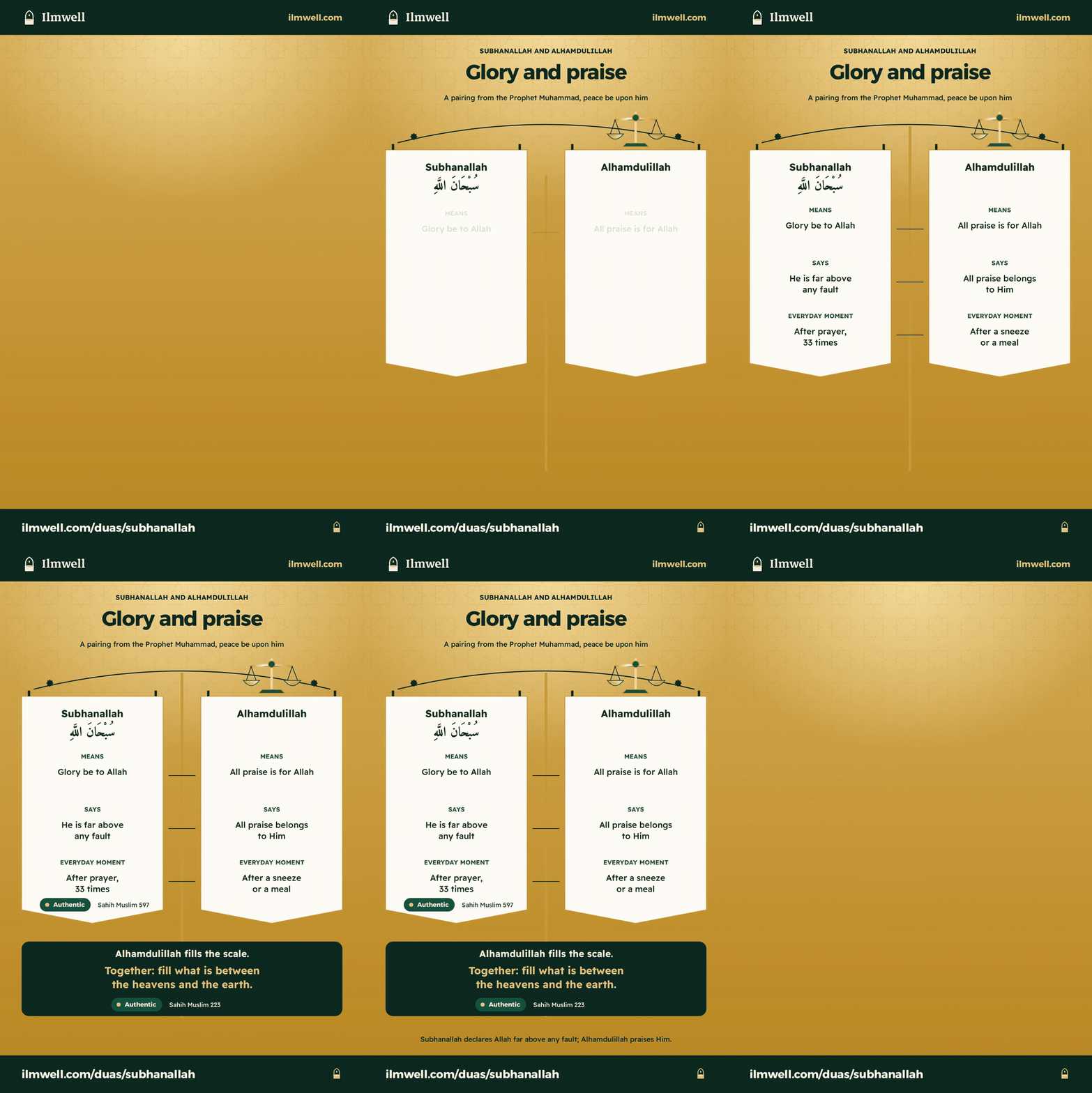
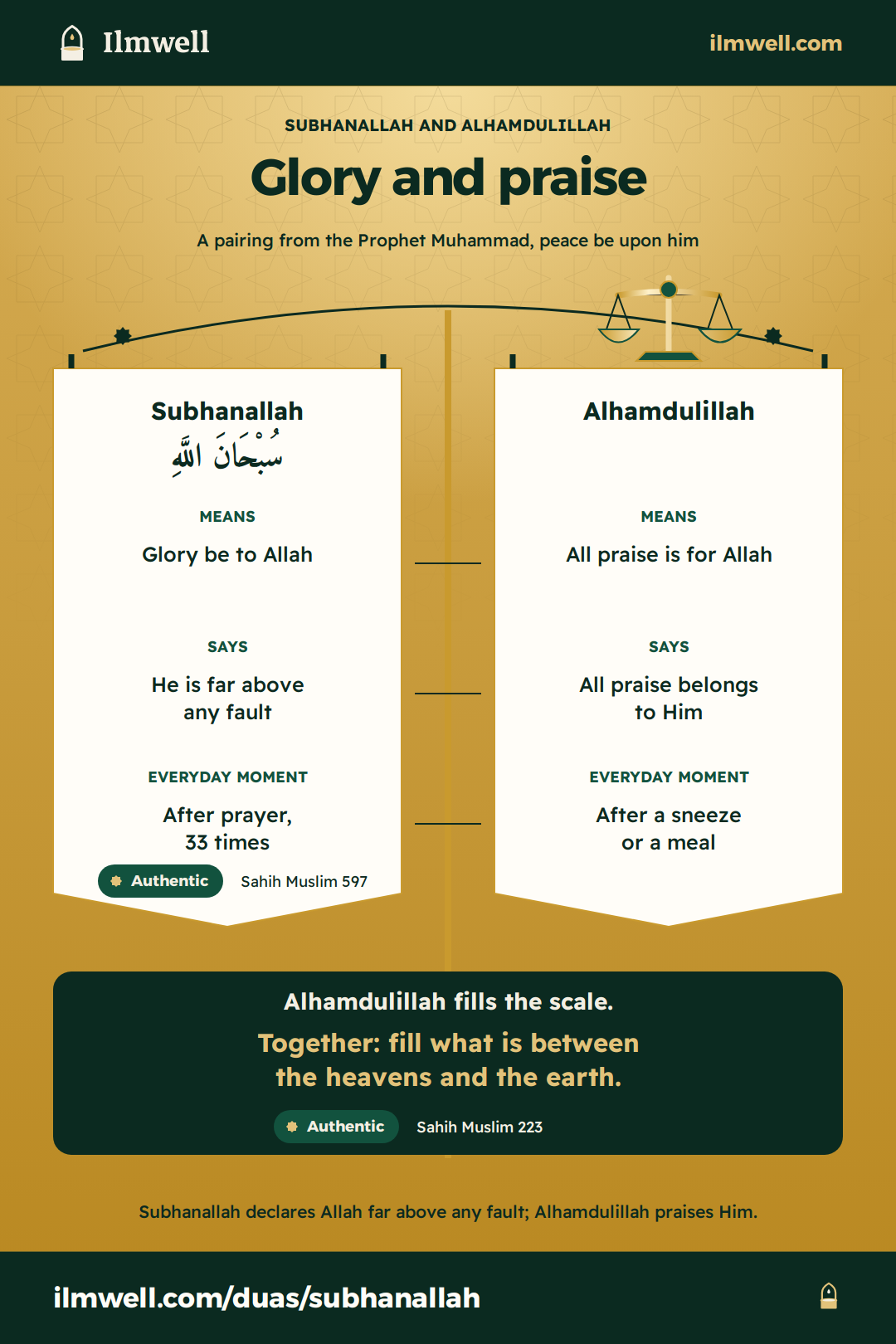
Subhanallah declares Allah far above any fault; Alhamdulillah praises Him. Mashallah is for admiring something good.
| Subhanallah | Alhamdulillah | Mashallah | |
|---|---|---|---|
| Means | Glory be to Allah | All praise is for Allah | What Allah wills |
| Says | He is far above any fault | All praise belongs to Him | This good is by His will |
| Everyday moment | After prayer, 33 times (Sahih Muslim 597) | After a sneeze or a meal (sources) | A new baby, good news (sources) |
One hadith pairs them: the Prophet said Alhamdulillah fills the scale, and Subhanallah and Alhamdulillah together fill what is between the heavens and the earth.
6AuthenticSahih Muslim 223
I was at the top of a hill in the Lake District with no phone signal when the whole group went quiet and then said Subhanallah almost together. That was the moment I understood it as a response to something bigger than you, not just a word.
Try it: what would you say?
Three quick questions. Pick an answer; each one explains itself.
1You have just finished a prayer. Which three phrases make up the count of 33 each?
Answer: Subhanallah, Alhamdulillah, Allahu akbar. Glorifying, praising and declaring Allah's greatness, 33 times each, then la ilaha illallah to make a hundred. Source 1
2Your cousin shares a photo of her new baby. Which phrase fits admiring something good?
Answer: Mashallah. Mashallah, "what Allah wills", is the phrase for good things you admire; the Mashallah lesson gives its sources. Subhanallah declares Allah far above any fault.
3Which hadith gives a hundred times a day?
Answer: Subhanallahi wa bihamdihi. The hundred times is for Subhanallahi wa bihamdihi. The two words hadith gives no count. Source 4
Questions people ask
What is tasbih?
Tasbih is the Arabic word for glorifying Allah, declaring Him far above any fault, which is what saying Subhanallah does. The hadith in Sahih Muslim 597, graded sahih, uses its verb, sabbaha ("whoever glorifies Allah"), for the 33 after each prayer.
Sources
Every claim on this page comes from one of these. Gradings are reported with the scholar's name; we do not grade hadith ourselves.
- 1
Abu Hurayrah reported the Prophet saying that whoever glorifies Allah (sabbaha) 33 times after every prayer, praises Him 33 times and declares His greatness 33 times, ninety-nine in all, and completes the hundred with 'la ilaha illallahu wahdahu la sharika lah, lahul-mulku wa lahul-hamdu wa huwa 'ala kulli shay'in qadir', has his sins forgiven even if they are like the foam of the sea.
Sahih Muslim 597 Book 5, Hadith 188
Authentic: in Sahih Muslim
- 2
Jabir ibn 'Abdullah said that when they went up they said takbir, and when they went down they said tasbih.
Sahih al-Bukhari 2993 Book 56, Hadith 202
Authentic: in Sahih al-Bukhari
- 3
Abu Hurayrah reported that the Prophet met him in a street of Madinah while he was junub (in need of the full bath); he slipped away, bathed and came back; asked where he had been, he said he had disliked sitting with him while not in a state of purity; the Prophet said: 'Subhanallah, the believer does not become impure.'
Sahih al-Bukhari 283 Book 5, Hadith 35
Authentic: in Sahih al-Bukhari
- 4
Abu Hurayrah reported the Prophet saying that whoever says 'subhanallahi wa bihamdihi' a hundred times in a day has his sins taken away, even if they are like the foam of the sea.
Sahih al-Bukhari 6405 Book 80, Hadith 100
Authentic: in Sahih al-Bukhari
- 5
Abu Hurayrah reported the Prophet saying: two words are light on the tongue, heavy on the scale and beloved to the Most Merciful: subhanallahi wa bihamdihi, subhanallahil 'azim.
Sahih al-Bukhari 6682 Book 83, Hadith 59
Authentic: in Sahih al-Bukhari
- 6
The Prophet said al-hamdu lillah fills the scale, and subhan Allah and al-hamdu lillah fill what is between the heavens and the earth.
Sahih Muslim 223 Book 2, Hadith 1
Authentic: in Sahih Muslim
- 7
Tasbih as tanzih, declaring Allah far above every evil; tanzih as putting at a distance; "subhana min..." for "how far it is".
Ahmad ibn Faris ibn Zakariyya (d. 395 AH), Mu'jam Maqayis al-Lughah, ed. 'Abd al-Salam Muhammad Harun, 2nd edition, Mustafa al-Babi al-Halabi, Cairo, 1389 to 1392 AH / 1969 to 1972 (shamela.ws numbering follows the print), vol. 3, p. 125, entry 'sbh' Read on 23 October 2026. Record: scholarly-ibnfaris-tasbih-word.
- Q
Quran Arabic and English for As-Saffat 37:159 and the end of Az-Zumar 39:67.
Tanzil Project Uthmani text, CC BY 3.0. English: adapted from Marmaduke Pickthall's translation (1930), modernised and checked against modern translations.
Next
For your own situation, ask a scholar you trust.
Join the email list
New guides by email, now and then. No spam, and you can leave at any time.
Ilmwell is free and kept going by readers. See how to support it.