The short answer
Mashallah means "what Allah wills", words taken from the Quran in Al-Kahf 18:39. Muslims say it when they see or hear something good, such as a new baby or a good exam result, as a reminder that the good came from Allah. Inshallah, "if Allah wills", is for plans.
How is Mashallah written in Arabic?
Al-Kahf 18:39
مَا شَآءَ ٱللَّهُ
mā shā'a llāh
What Allah wills
To copy and paste the Arabic, use the button under it.
What does Mashallah mean?
Arabic reads right to left, so the first word is on the right.
- مَاmāwhat, that whichPoints to the good thing in front of you.
- شَآءَshā'awills, has willedFrom the verb "to will". Inshallah uses the same verb.
- ٱللَّهُAllāhAllahThe one whose will it is.
Mashallah says that what you admire is there because Allah willed it. The Prophet Muhammad, peace be upon him, taught people not to say "what Allah wills and so-and-so wills", but "what Allah wills, then so-and-so wills": Allah's will comes first.
1AuthenticSunan Abi Dawud 4980
Mashallah la quwwata illa billah
The verse gives a longer form: mā shā'a llāh, lā quwwata illā billāh, "That which Allah wills (will come to pass)! There is no strength except in Allah!"
مَا شَآءَ ٱللَّهُ لَا قُوَّةَ إِلَّا بِٱللَّهِ
Where does Mashallah come from in the Quran?
From a parable in Surah Al-Kahf (18:32 to 44). One man had two gardens of grapes. He boasted to his companion about his wealth, walked into his garden and said he did not think it would ever perish. His companion answered:
وَلَوْلَآ إِذْ دَخَلْتَ جَنَّتَكَ قُلْتَ مَا شَآءَ ٱللَّهُ لَا قُوَّةَ إِلَّا بِٱللَّهِ ۚ إِن تَرَنِ أَنَا۠ أَقَلَّ مِنكَ مَالًا وَوَلَدًا
His fruit was then destroyed, and he was left wringing his hands over what he had spent (18:42).
How do you pronounce Mashallah?
māshāallāh
- Both mā and shā have a long a, as in "father".
- A short catch in the throat comes after shā, the sound in the middle of "uh-oh". That is why some people write Masha'Allah.
- lāh is long and full, with a doubled l: al-lāh.
Listen and repeat. A recorded pronunciation by a fluent reciter is coming. We do not use a synthetic voice for Arabic.
When do Muslims say Mashallah?
When they see or hear something good, about other people or themselves. The sources give no fixed list; here are two everyday examples.
Good news about someone
Your cousin posts a photo of her newborn in the family group chat, and within a minute it fills with Mashallahs.
Something you have yourself
You look round the flat you have just moved into, the kettle finally found among the boxes, and say Mashallah. The verse in Al-Kahf was said about a man's own garden.
What is the difference between Mashallah and Inshallah?
The context. Both use the same verb, "to will". In Al-Kahf, Mashallah is said on entering a garden that already exists; Inshallah goes with what you plan to do tomorrow.
| Mashallah | Inshallah | |
|---|---|---|
| Means | What Allah wills | If Allah wills |
| Said about | Good that is already there | Plans and hopes |
| Example | "Mashallah, what a lovely garden." | "I'll ring you tomorrow, inshallah." |
| In the Quran | Al-Kahf 18:39 | Al-Kahf 18:23 to 24 and 18:69 |
Al-Kahf 18:23 to 24 says: "And say not of anything: Indeed, I shall do that tomorrow, except if Allah wills." The Arabic there is إِلَّآ أَن يَشَآءَ ٱللَّهُ, "except that Allah wills". The exact words إِن شَآءَ ٱللَّهُ, in shā'a llāh, come in 18:69: "He said: Allah willing, you shall find me patient."
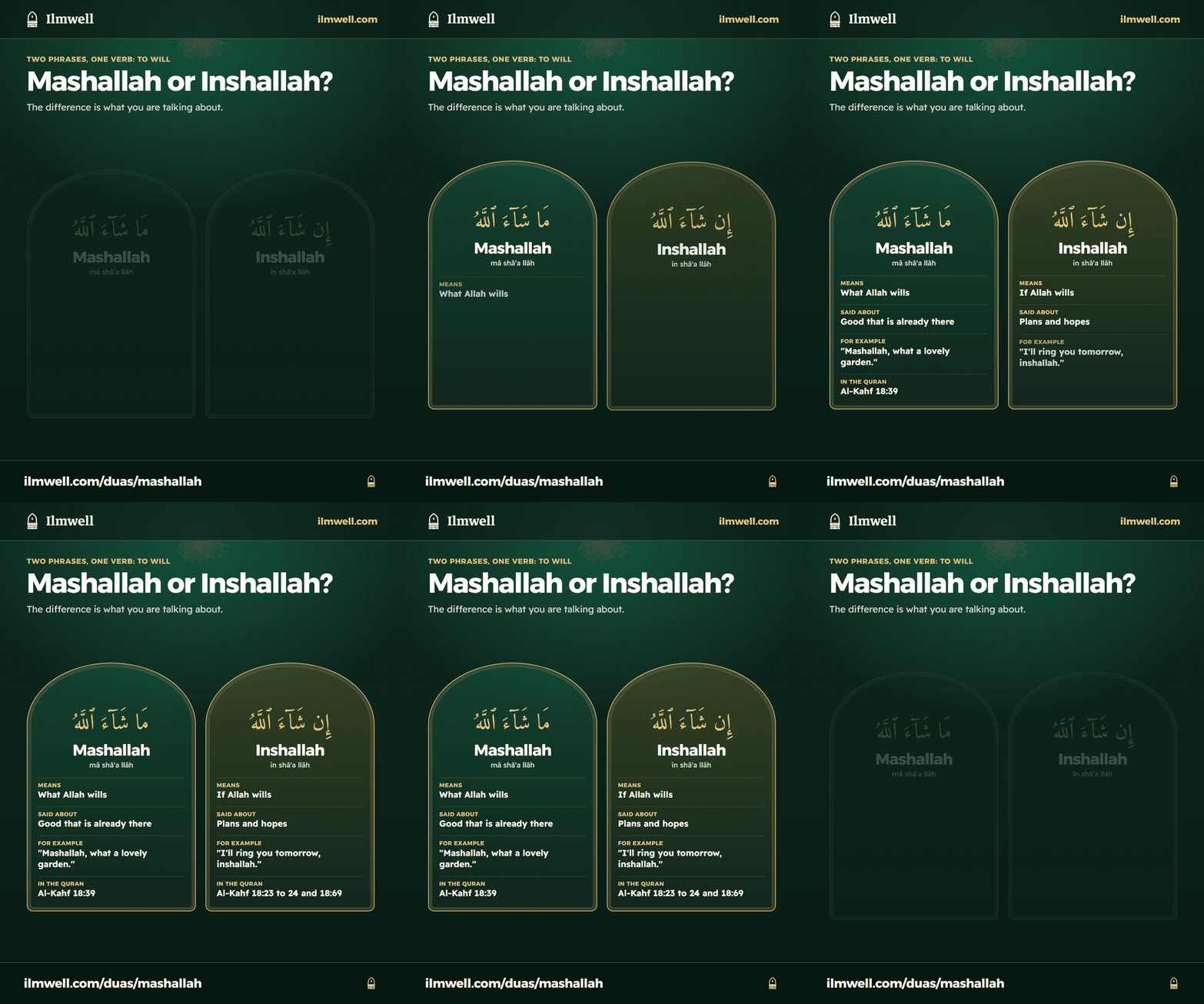
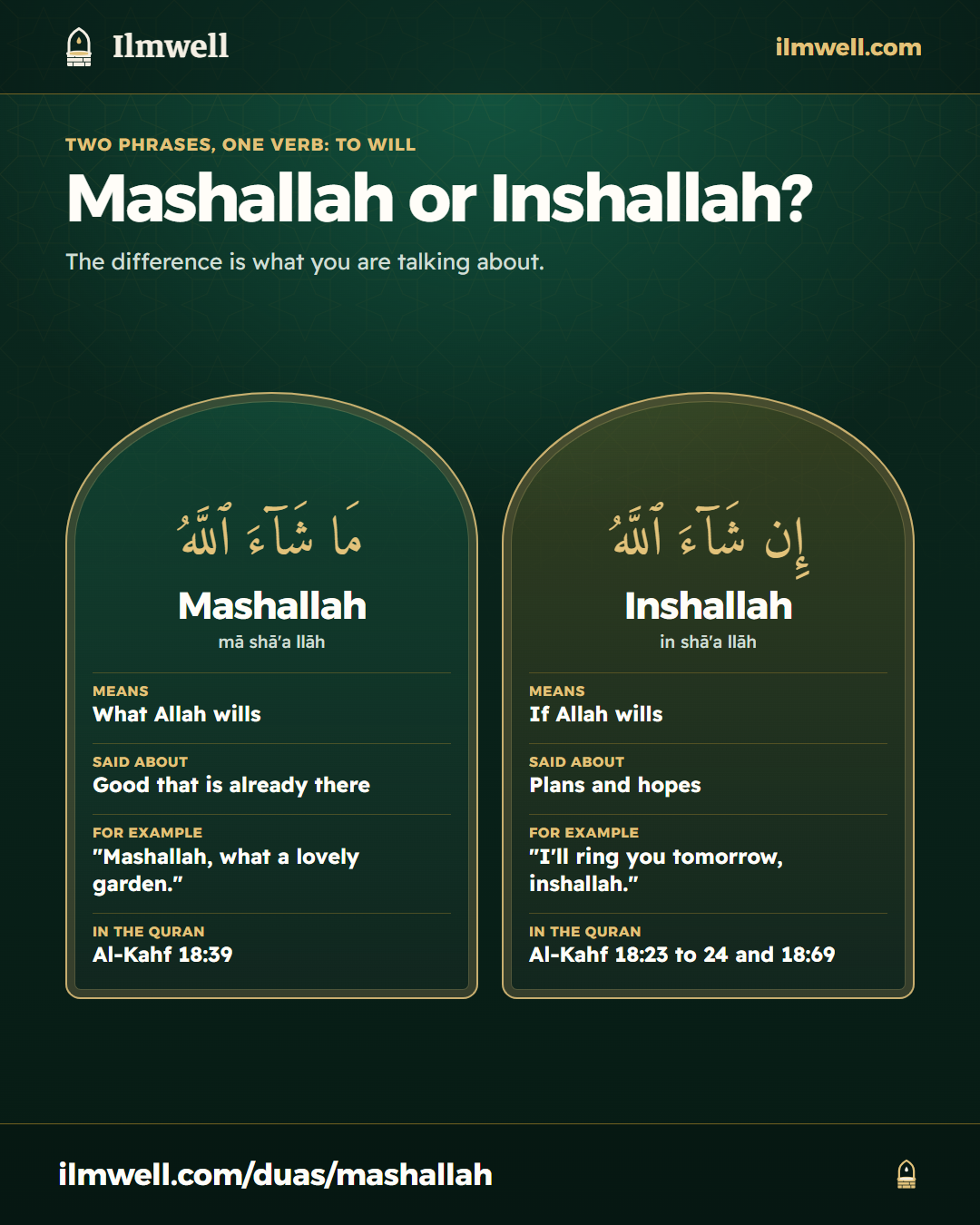
Mashallah or Inshallah, in one picture
Mashallah or Inshallah? Two phrases, one verb: to will. Mashallah means what Allah wills, said about good that is already there, for example: Mashallah, what a lovely garden; in the Quran, Al-Kahf 18:39. Inshallah means if Allah wills, said about plans and hopes, for example: I'll ring you tomorrow, inshallah; in the Quran, Al-Kahf 18:23 to 24 and 18:69.
The difference above, as a card to save or send to whoever mixes them up.
Posting it on your own site? Link back to this guide; the code under "Use it on your own site" does it in one line.
What does Mashallah Tabarakallah mean?
Mashallah Tabarakallah means "what Allah wills; blessed is Allah". Tabāraka llāh appears in the Quran, in Al-A'raf 7:54: "Blessed be Allah, the Lord of the Worlds".
تَبَارَكَ ٱللَّهُ
How do you reply to Mashallah?
No hadith we found sets a reply. You will often hear Jazakallah khair, "may Allah reward you with good", or Alhamdulillah in return.
At every family event someone's phone comes out and the baby, the graduate or the new car gets a round of Mashallah. I said it for years because everyone else did. Learning what it actually means made me say it more slowly.
Try it: what would you say?
Three everyday scenes. Pick an answer; each one explains itself.
1"See you at Eid next month, ..." What finishes the sentence?
Answer: Inshallah. Inshallah, "if Allah wills", goes with plans. Al-Kahf 18:23 to 24 is about what you mean to do tomorrow.
2You walk into your own newly decorated home and feel proud. What does Al-Kahf 18:39 point to?
Answer: Saying Mashallah. The man in Al-Kahf is told he should have said it on entering his own garden.
3You admire something about someone else. In the hadith of Sahl ibn Hunayf, may Allah be pleased with him, what did the Prophet tell the admirer to do?
Answer: Pray for blessing for them. He said that whoever sees something he likes in his brother should pray for blessing for him. Source 2
Does saying Mashallah protect from the evil eye?
We found no authentic narration that promises protection. The report behind the popular claim is graded weak, and some of its graders call it very weak. It comes from Anas ibn Malik, may Allah be pleased with him: whoever sees something he likes and says "ma sha Allah, la quwwata illa billah", it will not harm him.
من رأى شيئًا يعجبُهُ فقالَ: ما شاء اللَّهُ لا قوَّةَ إلَّا باللَّهِ لم يضرَّهُ
Sahih al-Bukhari 5740, graded sahih, says the evil eye is real. A hadith graded differently tells an admirer to pray for blessing for the owner.
4AuthenticSahih al-Bukhari 5740
The story behind the second point: 'Amir ibn Rabi'ah, may Allah be pleased with him, passed Sahl ibn Hunayf while he was bathing, and said he had never seen skin like it. Sahl collapsed. The Prophet was told, and asked whom they suspected. They named 'Amir. The Prophet said: why would one of you kill his brother? When one of you sees something he likes in his brother, he should pray for blessing for him. He then called for water and told 'Amir to wash with it and pour it over him.
إِذَا رَأَى أَحَدُكُمْ مِنْ أَخِيهِ مَا يُعْجِبُهُ فَلْيَدْعُ لَهُ بِالْبَرَكَةِ
2Graded differently Sunan Ibn Majah 3509
In Al-Kahf 18:39 the words are about the man's own garden; in the hadith of Sahl, graded differently, the admirer is told to pray for blessing.
Common mix-ups
- It is not only for other people's things. The verse in Al-Kahf was said about a man's own garden.
- Mashallah credits Allah's will. Subhanallah declares Him far above any fault. Alhamdulillah praises Him.
Questions people ask
Can non-Muslims say Mashallah?
None of the sources on this page limits who says it.
How do you spell Mashallah?
Mashallah is the most common English spelling. Masha Allah, MashaAllah, Mash'Allah and Ma sha Allah are other spellings of the same three Arabic words.
Sources
Every claim on this page comes from one of these. Gradings are reported with the scholar's name; we do not grade hadith ourselves.
- 1
The Prophet said not to say 'what Allah wills and so-and-so wills', but 'what Allah wills, then so-and-so wills'.
Sunan Abi Dawud 4980 Book 43, Hadith 208
Authentic: Sahih (Al-Albani); Sahih (Shu'ayb al-Arna'ut); Hasan, by the rule stated in his introduction (Ibn Hajar al-'Asqalani); its chain is sahih (Ibn Baz). Remarks: he was silent about it, which by his own stated rule means fit to use (Abu Dawud)
- 2
When Sahl ibn Hunayf collapsed after 'Amir ibn Rabi'ah admired him, the Prophet said that whoever sees something he likes in his brother should pray for blessing for him.
Sunan Ibn Majah 3509 Book 31, Hadith 74
Graded differently. Here is who graded it which way:
- SoundDarussalam, Al-Albani, Al-Nawawi, Shu'ayb al-Arna'ut, Al-Suyuti
- WeakAl-Munawi, Al-San'ani
See each grading in full, with its wording and where it was given
Scholars disagree about this hadith. Here is how each graded it, so you can follow the scholar you trust.
- Sahih: Darussalam (as shown on sunnah.com)
- صحيح (Sahih): Al-Albani, Sahih Ibn Majah 2844 (as listed on dorar.net)
- صحيح (Sahih, for the wording: let him pray for blessing for him): Al-Albani, Sahih al-Jami' 4020 (as listed on dorar.net)
- إسناده صحيح (its chain is sahih): Al-Nawawi, al-Majmu' 9/68 (as listed on dorar.net)
- صحيح رجاله ثقات رجال الشيخين (sahih; its narrators are trustworthy narrators used by al-Bukhari and Muslim): Shu'ayb al-Arna'ut, takhrij Mushkil al-Athar 2894 (as listed on dorar.net)
- صحيح (Sahih, for the wording: let him pray for blessing for him): Al-Suyuti, al-Jami' al-Saghir 5448 (as listed on dorar.net)
- مرسل (mursal: Abu Umama reports it without saying whom he heard it from; said of the short wording in al-Jami' al-Saghir): Al-Munawi, Fayd al-Qadir 4/324 (as listed on dorar.net)
- مرسل (mursal; said of the same short wording): Al-San'ani, al-Tanwir Sharh al-Jami' al-Saghir 7/257 (as listed on dorar.net)
- 3
A report from Anas ibn Malik says that whoever sees something he likes and says 'ma sha Allah, la quwwata illa billah', it will not harm him.
Musnad al-Bazzar 13/506 al-Bahr al-Zakhkhar (Musnad al-Bazzar), 13/506, as dorar.net cites it
Weak: weak (Al-Albani); its chain is very weak (Al-Albani); it contains Abu Bakr al-Hudhali, who is very weak (Al-Haythami); it contains Abu Bakr al-Hudhali, an abandoned narrator (Ibn al-Qattan); it contains Abu Bakr al-Hudhali, an abandoned narrator (Ibn al-Qaysarani); Abu Bakr is weak, and so is the one who narrates from him (Al-Busiri); it contains Abu Bakr al-Hudhali; most of what he narrates is not corroborated (Ibn 'Adi); weak (Muhammad Jarallah al-Sa'di). Remarks: we know of no one who narrated it except Anas, and no route for it except this one (Al-Bazzar)
- 4
The Prophet said the evil eye is real.
Sahih al-Bukhari 5740 Book 76, Hadith 55
Authentic: in Sahih al-Bukhari
- Q
Quran Arabic for Al-Kahf 18:39 (the Arabic in the scroll, the word cards and the longer form), Al-Kahf 18:23 to 24 and 18:69, and Al-A'raf 7:54, and their English.
Tanzil Project Uthmani text, CC BY 3.0. English: adapted from Marmaduke Pickthall's translation (1930), modernised and checked against modern translations.
Next
- Inshallah: meaning, spelling and usagePhrase lesson
- Allahumma barik: meaning and examplesPhrase lesson
- Alhamdulillah: meaning, pronunciation and everyday usePhrase lesson
- Subhanallah: meaning and everyday contextsPhrase lesson
- Wallahi: meaning, Arabic and how oaths are treated
- Duas, Remembrance and PhrasesThe hub
For your own situation, ask a scholar you trust.
Join the email list
New guides by email, now and then. No spam, and you can leave at any time.
Ilmwell is free and kept going by readers. See how to support it.