The short answer
Surah Mulk is Surah Al-Mulk, the 67th surah of the Quran: 30 verses that open "Blessed is He in Whose hand is the Sovereignty" (Al-Mulk 67:1, meaning surah 67, verse 1). The Prophet Muhammad, peace be upon him, said a surah of thirty verses interceded for a man until he was forgiven (Jami' at-Tirmidhi 2891, graded differently, most gradings accepting it).
Surah Mulk in Arabic
Al-Mulk 67:1 to 30
تَبَـٰرَكَ ٱلَّذِى بِيَدِهِ ٱلْمُلْكُ وَهُوَ عَلَىٰ كُلِّ شَىْءٍ قَدِيرٌ ١ ٱلَّذِى خَلَقَ ٱلْمَوْتَ وَٱلْحَيَوٰةَ لِيَبْلُوَكُمْ أَيُّكُمْ أَحْسَنُ عَمَلًا ۚ وَهُوَ ٱلْعَزِيزُ ٱلْغَفُورُ ٢ ٱلَّذِى خَلَقَ سَبْعَ سَمَـٰوَٰتٍ طِبَاقًا ۖ مَّا تَرَىٰ فِى خَلْقِ ٱلرَّحْمَـٰنِ مِن تَفَـٰوُتٍ ۖ فَٱرْجِعِ ٱلْبَصَرَ هَلْ تَرَىٰ مِن فُطُورٍ ٣ ثُمَّ ٱرْجِعِ ٱلْبَصَرَ كَرَّتَيْنِ يَنقَلِبْ إِلَيْكَ ٱلْبَصَرُ خَاسِئًا وَهُوَ حَسِيرٌ ٤ وَلَقَدْ زَيَّنَّا ٱلسَّمَآءَ ٱلدُّنْيَا بِمَصَـٰبِيحَ وَجَعَلْنَـٰهَا رُجُومًا لِّلشَّيَـٰطِينِ ۖ وَأَعْتَدْنَا لَهُمْ عَذَابَ ٱلسَّعِيرِ ٥ وَلِلَّذِينَ كَفَرُوا۟ بِرَبِّهِمْ عَذَابُ جَهَنَّمَ ۖ وَبِئْسَ ٱلْمَصِيرُ ٦ إِذَآ أُلْقُوا۟ فِيهَا سَمِعُوا۟ لَهَا شَهِيقًا وَهِىَ تَفُورُ ٧ تَكَادُ تَمَيَّزُ مِنَ ٱلْغَيْظِ ۖ كُلَّمَآ أُلْقِىَ فِيهَا فَوْجٌ سَأَلَهُمْ خَزَنَتُهَآ أَلَمْ يَأْتِكُمْ نَذِيرٌ ٨ قَالُوا۟ بَلَىٰ قَدْ جَآءَنَا نَذِيرٌ فَكَذَّبْنَا وَقُلْنَا مَا نَزَّلَ ٱللَّهُ مِن شَىْءٍ إِنْ أَنتُمْ إِلَّا فِى ضَلَـٰلٍ كَبِيرٍ ٩ وَقَالُوا۟ لَوْ كُنَّا نَسْمَعُ أَوْ نَعْقِلُ مَا كُنَّا فِىٓ أَصْحَـٰبِ ٱلسَّعِيرِ ١٠ فَٱعْتَرَفُوا۟ بِذَنۢبِهِمْ فَسُحْقًا لِّأَصْحَـٰبِ ٱلسَّعِيرِ ١١ إِنَّ ٱلَّذِينَ يَخْشَوْنَ رَبَّهُم بِٱلْغَيْبِ لَهُم مَّغْفِرَةٌ وَأَجْرٌ كَبِيرٌ ١٢ وَأَسِرُّوا۟ قَوْلَكُمْ أَوِ ٱجْهَرُوا۟ بِهِۦٓ ۖ إِنَّهُۥ عَلِيمٌۢ بِذَاتِ ٱلصُّدُورِ ١٣ أَلَا يَعْلَمُ مَنْ خَلَقَ وَهُوَ ٱللَّطِيفُ ٱلْخَبِيرُ ١٤ هُوَ ٱلَّذِى جَعَلَ لَكُمُ ٱلْأَرْضَ ذَلُولًا فَٱمْشُوا۟ فِى مَنَاكِبِهَا وَكُلُوا۟ مِن رِّزْقِهِۦ ۖ وَإِلَيْهِ ٱلنُّشُورُ ١٥ ءَأَمِنتُم مَّن فِى ٱلسَّمَآءِ أَن يَخْسِفَ بِكُمُ ٱلْأَرْضَ فَإِذَا هِىَ تَمُورُ ١٦ أَمْ أَمِنتُم مَّن فِى ٱلسَّمَآءِ أَن يُرْسِلَ عَلَيْكُمْ حَاصِبًا ۖ فَسَتَعْلَمُونَ كَيْفَ نَذِيرِ ١٧ وَلَقَدْ كَذَّبَ ٱلَّذِينَ مِن قَبْلِهِمْ فَكَيْفَ كَانَ نَكِيرِ ١٨ أَوَلَمْ يَرَوْا۟ إِلَى ٱلطَّيْرِ فَوْقَهُمْ صَـٰٓفَّـٰتٍ وَيَقْبِضْنَ ۚ مَا يُمْسِكُهُنَّ إِلَّا ٱلرَّحْمَـٰنُ ۚ إِنَّهُۥ بِكُلِّ شَىْءٍۭ بَصِيرٌ ١٩ أَمَّنْ هَـٰذَا ٱلَّذِى هُوَ جُندٌ لَّكُمْ يَنصُرُكُم مِّن دُونِ ٱلرَّحْمَـٰنِ ۚ إِنِ ٱلْكَـٰفِرُونَ إِلَّا فِى غُرُورٍ ٢٠ أَمَّنْ هَـٰذَا ٱلَّذِى يَرْزُقُكُمْ إِنْ أَمْسَكَ رِزْقَهُۥ ۚ بَل لَّجُّوا۟ فِى عُتُوٍّ وَنُفُورٍ ٢١ أَفَمَن يَمْشِى مُكِبًّا عَلَىٰ وَجْهِهِۦٓ أَهْدَىٰٓ أَمَّن يَمْشِى سَوِيًّا عَلَىٰ صِرَٰطٍ مُّسْتَقِيمٍ ٢٢ قُلْ هُوَ ٱلَّذِىٓ أَنشَأَكُمْ وَجَعَلَ لَكُمُ ٱلسَّمْعَ وَٱلْأَبْصَـٰرَ وَٱلْأَفْـِٔدَةَ ۖ قَلِيلًا مَّا تَشْكُرُونَ ٢٣ قُلْ هُوَ ٱلَّذِى ذَرَأَكُمْ فِى ٱلْأَرْضِ وَإِلَيْهِ تُحْشَرُونَ ٢٤ وَيَقُولُونَ مَتَىٰ هَـٰذَا ٱلْوَعْدُ إِن كُنتُمْ صَـٰدِقِينَ ٢٥ قُلْ إِنَّمَا ٱلْعِلْمُ عِندَ ٱللَّهِ وَإِنَّمَآ أَنَا۠ نَذِيرٌ مُّبِينٌ ٢٦ فَلَمَّا رَأَوْهُ زُلْفَةً سِيٓـَٔتْ وُجُوهُ ٱلَّذِينَ كَفَرُوا۟ وَقِيلَ هَـٰذَا ٱلَّذِى كُنتُم بِهِۦ تَدَّعُونَ ٢٧ قُلْ أَرَءَيْتُمْ إِنْ أَهْلَكَنِىَ ٱللَّهُ وَمَن مَّعِىَ أَوْ رَحِمَنَا فَمَن يُجِيرُ ٱلْكَـٰفِرِينَ مِنْ عَذَابٍ أَلِيمٍ ٢٨ قُلْ هُوَ ٱلرَّحْمَـٰنُ ءَامَنَّا بِهِۦ وَعَلَيْهِ تَوَكَّلْنَا ۖ فَسَتَعْلَمُونَ مَنْ هُوَ فِى ضَلَـٰلٍ مُّبِينٍ ٢٩ قُلْ أَرَءَيْتُمْ إِنْ أَصْبَحَ مَآؤُكُمْ غَوْرًا فَمَن يَأْتِيكُم بِمَآءٍ مَّعِينٍۭ ٣٠
Al-Mulk means "the Sovereignty", a word from its first verse. It is also called Tabarak, its first word, which is how the narrations below name it. You will see it searched as Surah al Mulk, Sura Mulk, Surat Mulk, Surat al Mulk and Surah e Mulk. To copy and paste the full Arabic text, use the button under the scroll. The English and an easy transliteration follow below, verse by verse. Like most surahs it is printed under Bismillah, which is not counted among its 30 verses.
What is Surah Mulk about?
The verses speak of Allah's sovereignty, shown in what He created, beside the warning of Hell and the reward of those who fear Him unseen. Here is the full surah verse by verse in six parts, each with the Arabic, the transliteration (Roman English) and the English. The six parts are our division by subject, to make it easier to read; they are not marked in the text.
Surah Al-Mulk (67), 30 verses. ilmwell.com/quran/al-mulk/
Verses 1 to 5: the Sovereignty and the seven heavens
It opens on Allah, "Blessed is He in Whose hand is the Sovereignty" (67:1), who created death and life "that He may try you which of you is best in conduct" (67:2). The reader is told that no fault can be seen in the Beneficent's creation, and to look again (67:3 to 4).
- 1
تَبَـٰرَكَ ٱلَّذِى بِيَدِهِ ٱلْمُلْكُ وَهُوَ عَلَىٰ كُلِّ شَىْءٍ قَدِيرٌ
Tabarakal-ladhi biyadihil-mulku wa huwa 'ala kulli shay'in qadir
Blessed is He in Whose hand is the Sovereignty, and, He is Able to do all things.
- 2
ٱلَّذِى خَلَقَ ٱلْمَوْتَ وَٱلْحَيَوٰةَ لِيَبْلُوَكُمْ أَيُّكُمْ أَحْسَنُ عَمَلًا ۚ وَهُوَ ٱلْعَزِيزُ ٱلْغَفُورُ
Alladhi khalaqal-mawta wal-hayata liyabluwakum ayyukum ahsanu 'amala, wa huwal-'azizul-ghafur
Who has created life and death that He may try you which of you is best in conduct; and He is the Mighty, the Forgiving.
- 3
ٱلَّذِى خَلَقَ سَبْعَ سَمَـٰوَٰتٍ طِبَاقًا ۖ مَّا تَرَىٰ فِى خَلْقِ ٱلرَّحْمَـٰنِ مِن تَفَـٰوُتٍ ۖ فَٱرْجِعِ ٱلْبَصَرَ هَلْ تَرَىٰ مِن فُطُورٍ
Alladhi khalaqa sab'a samawatin tibaqa, ma tara fi khalqir-rahmani min tafawut, farji'il-basara hal tara min futur
Who has created seven heavens in harmony. You (Muhammad) can see no fault in the Beneficent One's creation; then look again: Can you see any rifts?
- 4
ثُمَّ ٱرْجِعِ ٱلْبَصَرَ كَرَّتَيْنِ يَنقَلِبْ إِلَيْكَ ٱلْبَصَرُ خَاسِئًا وَهُوَ حَسِيرٌ
Thummar-ji'il-basara karratayni yanqalib ilaykal-basaru khasi'an wa huwa hasir
Then look again and yet again, your sight will return to you weakened and made dim.
- 5
وَلَقَدْ زَيَّنَّا ٱلسَّمَآءَ ٱلدُّنْيَا بِمَصَـٰبِيحَ وَجَعَلْنَـٰهَا رُجُومًا لِّلشَّيَـٰطِينِ ۖ وَأَعْتَدْنَا لَهُمْ عَذَابَ ٱلسَّعِيرِ
Wa laqad zayyannas-sama'ad-dunya bimasabiha wa ja'alnaha rujumal-lish-shayatin, wa a'tadna lahum 'adhabas-sa'ir
And truly We have beautified the world's heaven with lamps, and We have made them missiles for the devils, and for them We have prepared the doom of flame.
Verses 6 to 11: the warning of Hell
Each group thrown into Hell is asked by its wardens whether no warner came. They say one came and they denied him (67:8 to 9), and admit: "Had we been accustomed to listen or have sense" (67:10).
- 6
وَلِلَّذِينَ كَفَرُوا۟ بِرَبِّهِمْ عَذَابُ جَهَنَّمَ ۖ وَبِئْسَ ٱلْمَصِيرُ
Wa lilladhina kafaru birabbihim 'adhabu jahannam, wa bi'sal-masir
And for those who disbelieve in their Lord there is the doom of hell, a hapless journey's end!
- 7
إِذَآ أُلْقُوا۟ فِيهَا سَمِعُوا۟ لَهَا شَهِيقًا وَهِىَ تَفُورُ
Idha ulqu fiha sami'u laha shahiqan wa hiya tafur
When they are flung therein they hear its roaring as it boils up.
- 8
تَكَادُ تَمَيَّزُ مِنَ ٱلْغَيْظِ ۖ كُلَّمَآ أُلْقِىَ فِيهَا فَوْجٌ سَأَلَهُمْ خَزَنَتُهَآ أَلَمْ يَأْتِكُمْ نَذِيرٌ
Takadu tamayyazu minal-ghayz, kullama ulqiya fiha fawjun sa'alahum khazanatuha alam ya'tikum nadhir
As it would burst with rage. Whenever a (fresh) host is flung therein the wardens thereof ask them: Came there to you no warner?
- 9
قَالُوا۟ بَلَىٰ قَدْ جَآءَنَا نَذِيرٌ فَكَذَّبْنَا وَقُلْنَا مَا نَزَّلَ ٱللَّهُ مِن شَىْءٍ إِنْ أَنتُمْ إِلَّا فِى ضَلَـٰلٍ كَبِيرٍ
Qalu bala qad ja'ana nadhirun fakadhdhabna wa qulna ma nazzalallahu min shay', in antum illa fi dalalin kabir
They say: Yes, truly, a warner came to us; but we denied and said: Allah has revealed nothing; you are in nothing but a great error.
- 10
وَقَالُوا۟ لَوْ كُنَّا نَسْمَعُ أَوْ نَعْقِلُ مَا كُنَّا فِىٓ أَصْحَـٰبِ ٱلسَّعِيرِ
Wa qalu law kunna nasma'u aw na'qilu ma kunna fi ashabis-sa'ir
And they say: Had we been accustomed to listen or have sense, we had not been among the dwellers in the flames.
- 11
فَٱعْتَرَفُوا۟ بِذَنۢبِهِمْ فَسُحْقًا لِّأَصْحَـٰبِ ٱلسَّعِيرِ
Fa'tarafu bidhanbihim fasuhqal-li-ashabis-sa'ir
So they acknowledge their sins; but far removed (from mercy) are the dwellers in the flames.
Verses 12 to 14: fearing Him unseen
Those who fear their Lord in secret have forgiveness and a great reward (67:12). Speech kept secret or said aloud is known to Him: "Should He not know what He created?" (67:14).
- 12
إِنَّ ٱلَّذِينَ يَخْشَوْنَ رَبَّهُم بِٱلْغَيْبِ لَهُم مَّغْفِرَةٌ وَأَجْرٌ كَبِيرٌ
Innal-ladhina yakhshawna rabbahum bil-ghaybi lahum maghfiratun wa ajrun kabir
Indeed, those who fear their Lord in secret, theirs will be forgiveness and a great reward.
- 13
وَأَسِرُّوا۟ قَوْلَكُمْ أَوِ ٱجْهَرُوا۟ بِهِۦٓ ۖ إِنَّهُۥ عَلِيمٌۢ بِذَاتِ ٱلصُّدُورِ
Wa asirru qawlakum awij-haru bih, innahu 'alimum bidhatis-sudur
And keep your opinion secret or proclaim it, indeed, He is Knower of all that is in the breasts (of men).
- 14
أَلَا يَعْلَمُ مَنْ خَلَقَ وَهُوَ ٱللَّطِيفُ ٱلْخَبِيرُ
Ala ya'lamu man khalaq, wa huwal-latiful-khabir
Should He not know what He created? And He is the Subtle, the Aware.
Verses 15 to 22: the earth, the sky and the birds
The earth is made subservient to you, to walk its paths and eat of His providence (67:15). Then come questions: are you secure that He will not make the earth swallow you, or send a hurricane (67:16 to 17)? Who holds the birds up in flight but the Beneficent (67:19)?
- 15
هُوَ ٱلَّذِى جَعَلَ لَكُمُ ٱلْأَرْضَ ذَلُولًا فَٱمْشُوا۟ فِى مَنَاكِبِهَا وَكُلُوا۟ مِن رِّزْقِهِۦ ۖ وَإِلَيْهِ ٱلنُّشُورُ
Huwal-ladhi ja'ala lakumul-arda dhalulan famshu fi manakibiha wa kulu mir-rizqih, wa ilayhin-nushur
He it is Who has made the earth subservient to you, so Walk in the paths thereof and eat of His providence. And to Him will be the resurrection (of the dead).
- 16
ءَأَمِنتُم مَّن فِى ٱلسَّمَآءِ أَن يَخْسِفَ بِكُمُ ٱلْأَرْضَ فَإِذَا هِىَ تَمُورُ
A'amintum man fis-sama'i ay-yakhsifa bikumul-arda fa'idha hiya tamur
Have you taken security from Him Who is in the heaven that He will not cause the earth to swallow you when suddenly it is convulsed?
- 17
أَمْ أَمِنتُم مَّن فِى ٱلسَّمَآءِ أَن يُرْسِلَ عَلَيْكُمْ حَاصِبًا ۖ فَسَتَعْلَمُونَ كَيْفَ نَذِيرِ
Am amintum man fis-sama'i ay-yursila 'alaykum hasiba, fasata'lamuna kayfa nadhir
Or have you taken security from Him Who is in the heaven that He will not let loose on you a hurricane? But you shall know the manner of My warning.
- 18
وَلَقَدْ كَذَّبَ ٱلَّذِينَ مِن قَبْلِهِمْ فَكَيْفَ كَانَ نَكِيرِ
Wa laqad kadhdhabal-ladhina min qablihim fakayfa kana nakir
And truly those before them denied, then (see) the manner of My wrath (with them)!
- 19
أَوَلَمْ يَرَوْا۟ إِلَى ٱلطَّيْرِ فَوْقَهُمْ صَـٰٓفَّـٰتٍ وَيَقْبِضْنَ ۚ مَا يُمْسِكُهُنَّ إِلَّا ٱلرَّحْمَـٰنُ ۚ إِنَّهُۥ بِكُلِّ شَىْءٍۭ بَصِيرٌ
Awalam yaraw ilat-tayri fawqahum saffatin wa yaqbidn, ma yumsikuhunna illar-rahman, innahu bikulli shay'im basir
Have they not seen the birds above them spreading out their wings and closing them? Nothing upholds them except the Beneficent. Indeed, He is Seer of all things.
- 20
أَمَّنْ هَـٰذَا ٱلَّذِى هُوَ جُندٌ لَّكُمْ يَنصُرُكُم مِّن دُونِ ٱلرَّحْمَـٰنِ ۚ إِنِ ٱلْكَـٰفِرُونَ إِلَّا فِى غُرُورٍ
Amman hadhal-ladhi huwa jundul-lakum yansurukum min dunir-rahman, inil-kafiruna illa fi ghurur
Or who is he that will be an army to you to help you instead of the Beneficent? The disbelievers are in nothing but illusion.
- 21
أَمَّنْ هَـٰذَا ٱلَّذِى يَرْزُقُكُمْ إِنْ أَمْسَكَ رِزْقَهُۥ ۚ بَل لَّجُّوا۟ فِى عُتُوٍّ وَنُفُورٍ
Amman hadhal-ladhi yarzuqukum in amsaka rizqah, bal lajju fi 'utuwwiw-wa nufur
Or who is he that will provide for you if He should withhold His providence? Rather, they are set in pride and perversity.
- 22
أَفَمَن يَمْشِى مُكِبًّا عَلَىٰ وَجْهِهِۦٓ أَهْدَىٰٓ أَمَّن يَمْشِى سَوِيًّا عَلَىٰ صِرَٰطٍ مُّسْتَقِيمٍ
Afamay-yamshi mukibban 'ala wajhihi ahda ammay-yamshi sawiyyan 'ala siratim-mustaqim
Is he who goes groping on his face more rightly guided, or he who walks upright on a straight road?
Verses 23 to 27: ears, eyes and hearts, and the promised Day
He gave you being, ears and eyes and hearts: "Small thanks you give!" (67:23). Asked when the promise will come, the reply is: "The knowledge is with Allah only" (67:26).
- 23
قُلْ هُوَ ٱلَّذِىٓ أَنشَأَكُمْ وَجَعَلَ لَكُمُ ٱلسَّمْعَ وَٱلْأَبْصَـٰرَ وَٱلْأَفْـِٔدَةَ ۖ قَلِيلًا مَّا تَشْكُرُونَ
Qul huwal-ladhi ansha'akum wa ja'ala lakumus-sam'a wal-absara wal-af'idah, qalilam-ma tashkurun
Say (to them, O Muhammad): He it is who gave you being, and has assigned to you ears and eyes and hearts. Small thanks you give!
- 24
قُلْ هُوَ ٱلَّذِى ذَرَأَكُمْ فِى ٱلْأَرْضِ وَإِلَيْهِ تُحْشَرُونَ
Qul huwal-ladhi dhara'akum fil-ardi wa ilayhi tuhsharun
Say: He it is Who multiplies you in the earth, and to Whom you will be gathered.
- 25
وَيَقُولُونَ مَتَىٰ هَـٰذَا ٱلْوَعْدُ إِن كُنتُمْ صَـٰدِقِينَ
Wa yaquluna mata hadhal-wa'du in kuntum sadiqin
And they say: When (will) this promise (be fulfilled), if you are truthful?
- 26
قُلْ إِنَّمَا ٱلْعِلْمُ عِندَ ٱللَّهِ وَإِنَّمَآ أَنَا۠ نَذِيرٌ مُّبِينٌ
Qul innamal-'ilmu 'indallahi wa innama ana nadhirum-mubin
Say: The knowledge is with Allah only, and I am but a plain warner.
- 27
فَلَمَّا رَأَوْهُ زُلْفَةً سِيٓـَٔتْ وُجُوهُ ٱلَّذِينَ كَفَرُوا۟ وَقِيلَ هَـٰذَا ٱلَّذِى كُنتُم بِهِۦ تَدَّعُونَ
Falamma ra'awhu zulfatan si'at wujuhul-ladhina kafaru wa qila hadhal-ladhi kuntum bihi tadda'un
But when they see it near, the faces of those who disbelieve will be awry, and it will be said (to them): This is that for which you used to call.
Verses 28 to 30: trust, and a last question
The surah closes on "In Him we believe and in Him we put our trust" (67:29), then asks who could bring you gushing water if all your water disappeared into the earth (67:30).
- 28
قُلْ أَرَءَيْتُمْ إِنْ أَهْلَكَنِىَ ٱللَّهُ وَمَن مَّعِىَ أَوْ رَحِمَنَا فَمَن يُجِيرُ ٱلْكَـٰفِرِينَ مِنْ عَذَابٍ أَلِيمٍ
Qul ara'aytum in ahlakaniyallahu wa mam-ma'iya aw rahimana famay-yujirul-kafirina min 'adhabin alim
Say (O Muhammad): Have you thought: Whether Allah causes me (Muhammad) and those with me to perish or has mercy on us, still, who will protect the disbelievers from a painful doom?
- 29
قُلْ هُوَ ٱلرَّحْمَـٰنُ ءَامَنَّا بِهِۦ وَعَلَيْهِ تَوَكَّلْنَا ۖ فَسَتَعْلَمُونَ مَنْ هُوَ فِى ضَلَـٰلٍ مُّبِينٍ
Qul huwar-rahmanu amanna bihi wa 'alayhi tawakkalna, fasata'lamuna man huwa fi dalalim-mubin
Say: He is the Beneficent. In Him we believe and in Him we put our trust. And you will soon know who it is that is in error manifest.
- 30
قُلْ أَرَءَيْتُمْ إِنْ أَصْبَحَ مَآؤُكُمْ غَوْرًا فَمَن يَأْتِيكُم بِمَآءٍ مَّعِينٍۭ
Qul ara'aytum in asbaha ma'ukum ghawran famay-ya'tikum bima'im-ma'in
Say: Have you thought: If (all) your water were to disappear into the earth, who then could bring you gushing water?
Quran text from the Tanzil Project (tanzil.net, CC BY 3.0). English: adapted from Marmaduke Pickthall's translation (1930), modernised and checked against modern translations. Transliteration: Ilmwell.
What the verses mean in detail belongs to tafsir (Quran commentary), which a separate page will set out with its sources. Listen and repeat: a recording by a fluent human reciter is coming. We do not use a synthetic voice for the Quran.
Is there a Surah Mulk PDF, or can I read it online?
We do not offer a PDF file. The full Surah Mulk is on this page to read online, copy or print. The button below prints the 30 verses in Arabic, transliteration and English, without the rest of the page. To keep a copy on your phone or computer, choose "Save as PDF" in the print window, which most browsers offer.
This text is not colour-coded for tajweed (the rules of recitation).
A teacher at the masjid told us to recite Al-Mulk before bed. I never realised how powerful it was up until many years later.
Try it: what does it say?
Three quick questions on the surah. Each answer explains itself.
1In verse 2, why did Allah create death and life?
Answer: that He may try you which of you is best in conduct. "Who has created life and death that He may try you which of you is best in conduct" (67:2).
2Which verse asks who holds the birds up in flight?
Answer: 67:19. "Nothing upholds them except the Beneficent" (67:19).
3How does the surah end?
Answer: With a question about who could bring back your water. Verse 30 asks who could bring you gushing water if all your water disappeared into the earth.
What are the benefits of Surah Mulk?
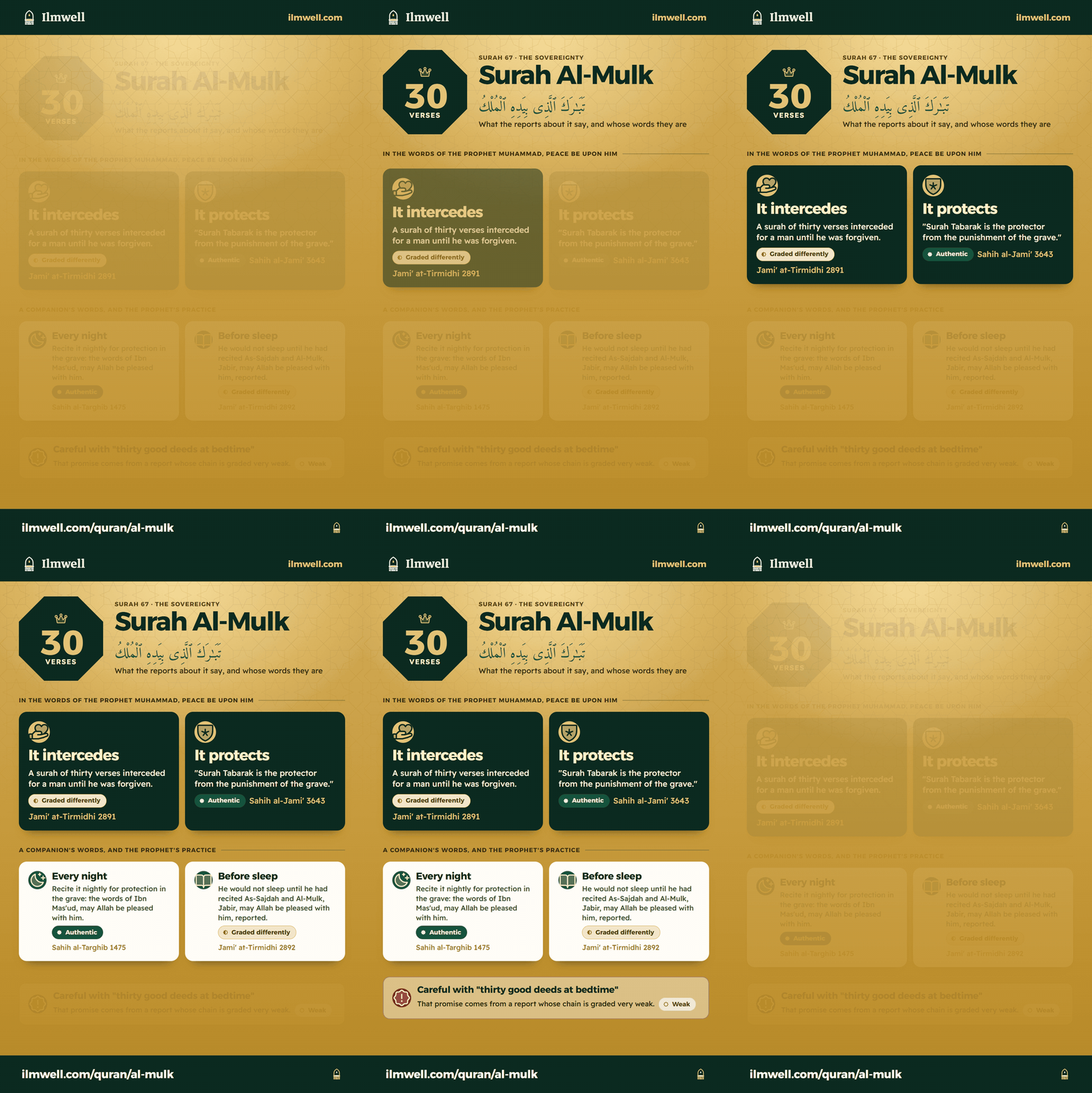
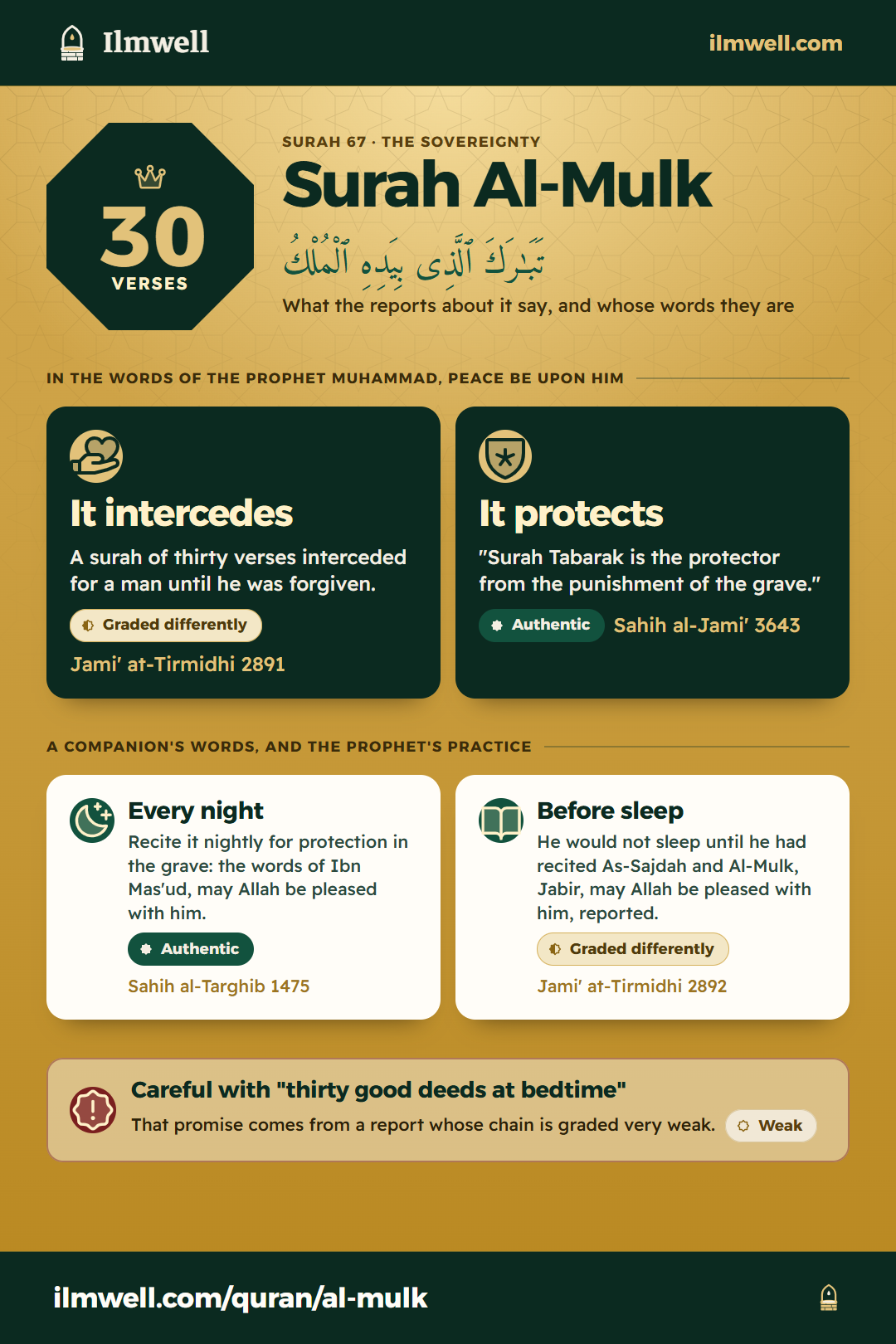
Six reports are quoted about it, and not all are the Prophet's words. Two are graded authentic, one of them a companion's statement; three are graded differently and one is weak.
| What is said | Whose words | Source and grade |
|---|---|---|
| A surah of the Quran, thirty verses long, interceded for a man until he was forgiven: Tabarak alladhi biyadihil-mulk. | The Prophet, reported by Abu Hurayrah, may Allah be pleased with him | Graded differently Jami' at-Tirmidhi 2891, also Abu Dawud 1400 and Ibn Majah 3786 Source 1 |
| "Surah Tabarak is the protector from the punishment of the grave." | The Prophet, as collections of his sayings list it, through Ibn Mas'ud, may Allah be pleased with him | Authentic Sahih al-Jami' 3643 Source 2 |
| Whoever recites it every night, Allah protects him by it from the punishment of the grave; in the Prophet's time "we called it al-mani'ah", the protector. | Ibn Mas'ud: his own words | Authentic Sahih al-Targhib 1475 Source 3 |
| Of a person found reciting it in a grave: "It is the protector, it is the rescuer; it rescues him from the punishment of the grave." | The Prophet, reported by Ibn Abbas, may Allah be pleased with him | Graded differently Jami' at-Tirmidhi 2890 Source 4 |
| He would not sleep until he had recited Surah As-Sajdah and Surah Al-Mulk. | Jabir ibn Abdullah, may Allah be pleased with him, describing the Prophet's practice | Graded differently Jami' at-Tirmidhi 2892 Source 5 |
| Whoever recites it when he goes to sleep: thirty good deeds written, thirty bad deeds erased, raised thirty degrees, and an angel guards him until he wakes. | Reported from Ibn Abbas; the listing does not say whose words they are | Weak Al-Durr al-Manthur 14/603 Source 6 |
What is the hadith of the thirty verses?
Abu Hurayrah reported that the Prophet said a surah of the Quran, thirty verses long, interceded for a man until he was forgiven, and named it: Tabarak alladhi biyadihil-mulk. Sunan Abi Dawud and Sunan Ibn Majah carry the same report from Abu Hurayrah. In their wording the surah intercedes for its sahib, literally its companion, and in Abu Dawud's the verb is present: it intercedes until he is forgiven.
1Graded differently Jami' at-Tirmidhi 2891also Sunan Abi Dawud 1400 and Sunan Ibn Majah 3786
Most of the gradings we found accept it as hasan or sahih; four, from two scholars, find weakness or a defect in its chain. The narration names no time of recitation and no number.
Does reciting Surah Mulk protect from the punishment of the grave?
Two reports graded authentic call it a protector from the punishment of the grave. A short wording, listed among the Prophet's own sayings and reported through Ibn Mas'ud, says: "Surah Tabarak is the protector from the punishment of the grave." It is graded sahih or hasan, and it gives no time or number of recitations.
2AuthenticSahih al-Jami' 3643
Ibn Mas'ud also said, in his own words, that whoever recites Tabarak every night, Allah protects him by it from the punishment of the grave. In the time of the Messenger of Allah, he said, "we used to call it al-mani'ah", the protector. It is a surah in the Book of Allah, he added, that whoever recites every night has done much and done well.
3AuthenticSahih al-Targhib 1475
The tent over a grave
Ibn Abbas reported that one of the Prophet's companions pitched his tent over a grave without thinking it was a grave. In it was a person reciting Surah Tabarak until he finished it. The companion went to the Prophet and told him, and the Prophet said: "It is the protector, it is the rescuer; it rescues him from the punishment of the grave."
4Graded differently Jami' at-Tirmidhi 2890
This narration is graded differently, most gradings weak; they name one of its narrators as weak. One grader adds, in two gradings, that only the Prophet's words "it is the protector" are sound.
Should you recite Surah Mulk before sleeping?
Jabir's report ties it to sleep. Jabir ibn Abdullah reported that the Prophet would not sleep until he had recited Alif Lam Mim Tanzil, which is Surah As-Sajdah, and Tabarak alladhi biyadihil-mulk. It is graded differently: many gradings call it sahih, while others name a weak narrator and doubt that one narrator heard it from Jabir.
5Graded differently Jami' at-Tirmidhi 2892
Ibn Mas'ud's words above give "every night" and no hour. Say a message in the family group chat promises thirty good deeds and a guarding angel for reading Surah Mulk at bedtime. That promise comes from a report from Ibn Abbas whose chain is graded very weak (one grading found).
6WeakAl-Durr al-Manthur 14/603
For bedtime recitations graded sahih, there is Ayat al-Kursi when you go to bed, and Al-Ikhlas, Al-Falaq and An-Nas, which 'Aisha, may Allah be pleased with her, reported the Prophet recited into his palms every night when he went to bed.
7AuthenticSahih al-Bukhari 2311
8AuthenticSahih al-Bukhari 5017
What do the Surah Mulk hadith not say?
Each report says less than it is often made to say.
- None of the six reports gives a number of recitations.
- The thirty verses report names no time. Its Arabic says "a man" or "its companion", and says nothing of the intercession beyond "until he was forgiven".
- A line printed after Jami' at-Tirmidhi 2892, a report graded differently, says that As-Sajdah and Al-Mulk surpass every other surah by seventy good deeds. It is recorded as the saying of Tawus, a Follower, of the generation after the companions, not of the Prophet.
Common mix-ups
- Surah As-Sajdah (32) also has 30 verses. The thirty verses narration names Tabarak alladhi biyadihil-mulk, so it is about Al-Mulk.
Questions people ask
How many verses are in Surah Mulk, and which surah number is it?
Surah Al-Mulk is surah 67 of the Quran and has 30 verses. The Tanzil listing marks it as Makkan, and the 29th of the Quran's 30 parts (juz) begins with it.
Sources
Every claim on this page comes from one of these. Gradings are reported with the scholar's name; we do not grade hadith ourselves.
- 1
Abu Hurayrah reported that the Prophet said a surah of the Quran of thirty verses interceded for a man until he was forgiven: Tabarak alladhi biyadihil-mulk (Surah Al-Mulk).
Jami' at-Tirmidhi 2891 Book 45, Hadith 17
Graded differently. Here is who graded it which way:
- SoundDarussalam, Al-Albani, Al-Tirmidhi, Al-Hakim, Ibn Taymiyya, Al-Mundhiri, Shu'ayb al-Arna'ut, Ahmad Shakir, Al-Suyuti, Al-Bayhaqi, Ibn al-Mulaqqin
- Weak chain, strengthenedAl-Albani, Shu'ayb al-Arna'ut
- WeakIbn Baz, Muqbil al-Wadi'i
- Other remarksAbu Dawud, Jamal al-Din al-Mardawi, Al-Shawkani, Al-Ruba'i, Ibn Hajar al-'Asqalani
See each grading in full, with its wording and where it was given
Scholars disagree about this hadith. Here is how each graded it, so you can follow the scholar you trust.
- Hasan: Darussalam (as shown on sunnah.com, tirmidhi:2891)
- Hasan: Al-Albani (as shown on sunnah.com, abudawud:1400)
- Hasan: Darussalam (as shown on sunnah.com, ibnmajah:3786)
- حسن (hasan): Al-Tirmidhi, Jami' at-Tirmidhi 2891 (as listed on dorar.net)
- سكت عنه، وقد قال في رسالته لأهل مكة كل ما سكت عنه فهو صالح (he was silent about it; in his letter to the people of Makkah he said whatever he is silent about is fit): Abu Dawud, Sunan Abi Dawud 1400 (as listed on dorar.net)
- صحيح الإسناد (sahih in its chain): Al-Hakim, al-Mustadrak 2103 (as listed on dorar.net)
- ثابت (established): Ibn Taymiyya, Majmu' al-Fatawa 22/277 (as listed on dorar.net)
- إسناده صحيح أو حسن أو ما قاربهما (its chain is sahih or hasan or close to them, by the sign al-Mundhiri explains in his introduction): Al-Mundhiri, al-Targhib wa al-Tarhib 2/319 (as listed on dorar.net)
- رواته ثقات (its narrators are trustworthy): Jamal al-Din al-Mardawi, Kifayat al-Mustaqni' 220 (as listed on dorar.net)
- له شاهد بإسناد صحيح (it has a supporting narration with a sahih chain): Al-Shawkani, Nayl al-Awtar 2/227 (as listed on dorar.net)
- في إسناده بعض المقال (there is some criticism of its chain): Ibn Baz, Majmu' al-Shuruh al-Fiqhiyya 14/264 (as listed on dorar.net)
- في إسناده بعض المقال (there is some criticism of its chain): Ibn Baz, Majmu' al-Shuruh al-Fiqhiyya 14/267 (as listed on dorar.net)
- معلول (it has a hidden defect): Ibn Baz, al-Fawa'id al-'Ilmiyya min al-Durus al-Baziyya 6/323 (as listed on dorar.net)
- حسن لغيره (hasan through supporting routes): Al-Albani, Sahih al-Targhib 1474 (as listed on dorar.net)
- حسن (hasan): Shu'ayb al-Arna'ut, takhrij Sharh al-Sunna 4/473 (as listed on dorar.net)
- حسن (hasan): Al-Albani, Sahih al-Tirmidhi 2891 (as listed on dorar.net)
- ضعيف بهذا السند (weak through this chain): Muqbil al-Wadi'i, al-Shafa'a 242 (as listed on dorar.net)
- إسناده حسن وله شاهدان (its chain is hasan, and it has two supporting narrations): Shu'ayb al-Arna'ut, takhrij Riyad al-Salihin 1016 (as listed on dorar.net)
- له شاهد بإسناد صحيح (it has a supporting narration with a sahih chain): Al-Ruba'i, Fath al-Ghaffar 1/331 (as listed on dorar.net)
- حسن لغيره (hasan through supporting routes): Shu'ayb al-Arna'ut, takhrij al-Musnad 7975 (as listed on dorar.net)
- حسن لغيره (hasan through supporting routes): Shu'ayb al-Arna'ut, takhrij al-Musnad 8276 (as listed on dorar.net)
- إسناده حسن (its chain is hasan): Al-Albani, Hidayat al-Ruwat 2094 (as listed on dorar.net)
- إسناده صحيح (its chain is sahih): Ahmad Shakir, takhrij al-Musnad 15/129 (as listed on dorar.net)
- صحيح (sahih): Al-Suyuti, al-Jami' al-Saghir 2273 (as listed on dorar.net)
- حسن (hasan): Al-Albani, Sahih al-Jami' 2091 (as listed on dorar.net)
- صحيح (sahih): Al-Albani, Sahih Ibn Majah 3068 (as listed on dorar.net)
- إسناده حسن (its chain is hasan): Al-Bayhaqi, Ithbat 'Adhab al-Qabr 151 (as listed on dorar.net)
- أعله البخاري وله شاهد بإسناد صحيح (al-Bukhari found a defect in it, and it has a supporting narration with a sahih chain): Ibn Hajar al-'Asqalani, al-Talkhis al-Habir 1/382 (as listed on dorar.net)
- صحيح (sahih): Ibn al-Mulaqqin, al-Badr al-Munir 3/561 (as listed on dorar.net)
- حسن (hasan): Al-Albani, Sahih Abi Dawud 1400 (as listed on dorar.net)
- حسن لغيره (hasan through supporting routes): Shu'ayb al-Arna'ut, takhrij Sunan Abi Dawud 1400 (as listed on dorar.net)
- 2
A short report through Ibn Mas'ud, listed among the Prophet's sayings, says: Surah Tabarak is the protector (al-mani'ah) from the punishment of the grave.
Sahih al-Jami' 3643 Al-Albani, Sahih al-Jami' al-Saghir, no. 3643, as dorar.net cites it; also al-Suyuti, al-Jami' al-Saghir 4711
Authentic: sahih (Al-Albani); its chain is hasan (Al-Albani); hasan (Al-Suyuti); hasan (Ibn Hajar al-'Asqalani)
- 3
Ibn Mas'ud said that whoever recites Tabarak alladhi biyadihil-mulk every night, Allah protects him by it from the punishment of the grave; that in the time of the Messenger of Allah they called it al-mani'ah (the protector); and that whoever recites it every night has done much and done well.
Sahih al-Targhib 1475 Al-Albani, Sahih al-Targhib wa al-Tarhib, no. 1475, as dorar.net cites it; the same wording is in al-Mundhiri, al-Targhib wa al-Tarhib 2/368
Authentic: hasan (Al-Albani); its chain is sahih or hasan or close to them, by the sign al-Mundhiri explains in his introduction (Al-Mundhiri); its chain is hasan (Shu'ayb al-Arna'ut). Remarks: preserved (Abu Nasr al-Sijzi); its narrators are trustworthy (Al-Haythami); only Ibn Abi Hazim narrates it from Suhayl ibn Abi Salih (Al-Tabarani); it has a corroborating route (Abu Nu'aym); Shu'ba, Mis'ar, Abu 'Awana, Hammad ibn Salama and Zayd ibn Abi Unaysa narrate it from Ibn Mas'ud as his own words, and that is the preserved version (Al-Daraqutni)
- 4
Ibn Abbas reported that a companion pitched his tent over a grave without thinking it was a grave, found a person in it reciting Surah Tabarak to its end, and told the Prophet, who said: it is the protector (al-mani'ah), it is the rescuer (al-munjiyah); it rescues him from the punishment of the grave.
Jami' at-Tirmidhi 2890 Book 45, Hadith 16
Graded differently. Here is who graded it which way:
- SoundAl-Tirmidhi, Ibn al-'Arabi
- WeakDarussalam, Shu'ayb al-Arna'ut, Al-Mundhiri, Al-Dimyati, Al-Bayhaqi, Al-Mubarakfuri, Al-Albani, Ibn 'Adi, Ibn al-Qaysarani
- Other remarksAl-Albani, Al-Mizzi, Abu Nu'aym
See each grading in full, with its wording and where it was given
Scholars disagree about this hadith. Here is how each graded it, so you can follow the scholar you trust.
- Da'if: Darussalam (as shown on sunnah.com)
- حسن غريب من هذا الوجه (hasan gharib through this route): Al-Tirmidhi, Jami' at-Tirmidhi 2890 (as listed on dorar.net)
- صحيح (sahih): Ibn al-'Arabi, 'Aridat al-Ahwadhi 6/36 (as listed on dorar.net)
- إسناده غريب (its chain is unusual): Al-Albani, Hidayat al-Ruwat 2095 (as listed on dorar.net)
- في سنده يحيى بن عمرو بن مالك النكري، وهو ضعيف (its chain has Yahya ibn Amr ibn Malik al-Nukri, who is weak): Shu'ayb al-Arna'ut, takhrij Siyar A'lam al-Nubala' 7/169 (as listed on dorar.net)
- لا يتطرق إليه احتمال التحسين (it does not admit being graded hasan, by the sign al-Mundhiri explains in his introduction): Al-Mundhiri, al-Targhib wa al-Tarhib 2/319 (as listed on dorar.net)
- سنده سقيم (its chain is unsound): Al-Dimyati, al-Matjar al-Rabih 199 (as listed on dorar.net)
- فيه يحيى بن عمرو بن مالك النكري، وهو ضعيف (it has Yahya ibn Amr ibn Malik al-Nukri, who is weak): Shu'ayb al-Arna'ut, takhrij Sharh al-Sunna 4/473 (as listed on dorar.net)
- تفرد به يحيى بن عمرو بن مالك، وهو ضعيف (Yahya ibn Amr ibn Malik alone narrates it, and he is weak): Al-Bayhaqi, Ithbat 'Adhab al-Qabr 150 (as listed on dorar.net)
- فيه يحيى بن عمرو بن مالك، قال يحيى بن معين وأبو زرعة وأبو داود والنسائي ضعيف (it has Yahya ibn Amr ibn Malik, whom Ibn Ma'in, Abu Zur'a, Abu Dawud and al-Nasa'i called weak): Al-Mizzi, Tahdhib al-Kamal 20/182 (as listed on dorar.net)
- في سنده يحيى بن عمرو بن مالك وهو ضعيف (its chain has Yahya ibn Amr ibn Malik, who is weak): Al-Mubarakfuri, Tuhfat al-Ahwadhi 7/309 (as listed on dorar.net)
- ضعيف وإنما صح منه قوله هي المانعة (weak; only his words 'it is the protector' are sound): Al-Albani, Da'if al-Tirmidhi 2890 (as listed on dorar.net)
- ضعيف وإنما يصح منه قوله هي المانعة (weak; only his words 'it is the protector' are sound): Al-Albani, Sahih al-Tirmidhi 2890 (as listed on dorar.net)
- عمرو بن مالك صدوق له أوهام وابنه يحيى ضعيف، وله مناكير هذا أحدها (Amr ibn Malik is truthful but makes mistakes, his son Yahya is weak, and this is one of his rejected reports): Al-Albani, al-Silsila al-Sahiha 3/131 (as listed on dorar.net)
- ضعيف (weak): Al-Albani, Da'if al-Jami' 6101 (as listed on dorar.net)
- ضعيف (weak): Al-Albani, Da'if al-Targhib 887 (as listed on dorar.net)
- تفرد به يحيى بن عمرو النكري وهو ضعيف، ولمعناه شاهد (Yahya ibn Amr al-Nukri alone narrates it, and he is weak; its meaning has a supporting report): Al-Bayhaqi, Dala'il al-Nubuwwa 7/41 (as listed on dorar.net)
- غريب من حديث أبي الجوزاء لم نكتبه مرفوعا مجودا إلا من حديث يحيى بن عمرو عن أبيه (gharib from Abu al-Jawza'; we wrote it down from the Prophet with a full chain only through Yahya ibn Amr from his father): Abu Nu'aym, Hilyat al-Awliya' 3/96 (as listed on dorar.net)
- غير محفوظ (not preserved): Ibn 'Adi, al-Kamil fi al-Du'afa' 9/37 (as listed on dorar.net)
- فيه يحيى بن عمرو ضعيف (it has Yahya ibn Amr, who is weak): Ibn al-Qaysarani, Dhakhirat al-Huffaz 3/1553 (as listed on dorar.net)
- 5
Jabir reported that the Prophet would not sleep until he had recited Alif Lam Mim Tanzil (Surah As-Sajdah) and Tabarak alladhi biyadihil-mulk (Surah Al-Mulk).
Jami' at-Tirmidhi 2892 Book 45, Hadith 18
Graded differently. Here is who graded it which way:
- SoundAl-Albani, Al-Suyuti, Al-Hakim, Ibn Hajar al-'Asqalani, Shu'ayb al-Arna'ut
- Weak chain, strengthenedAl-Albani, Al-Sakhawi
- WeakDarussalam, Ibn Hajar al-'Asqalani, Shu'ayb al-Arna'ut, Ibn Baz, Sadr al-Din al-Munawi
- Other remarksIbn Hajar al-'Asqalani, Al-Daraqutni, Al-Tabarani, Al-Nasa'i, Abu Hatim al-Razi
See each grading in full, with its wording and where it was given
Scholars disagree about this hadith. Here is how each graded it, so you can follow the scholar you trust.
- Da'if: Darussalam (as shown on sunnah.com)
- صحيح (sahih): Al-Albani, Sahih al-Tirmidhi 2892 (as listed on dorar.net)
- صحيح (sahih): Al-Albani, Sahih al-Tirmidhi 3404 (as listed on dorar.net)
- صحيح (sahih): Al-Albani, al-Silsila al-Sahiha 585 (as listed on dorar.net)
- صحيح (sahih): Al-Albani, Sahih al-Jami' 4873 (as listed on dorar.net)
- صحيح (sahih): Al-Albani, Hidayat al-Ruwat 2096 (as listed on dorar.net)
- صحيح لغيره (sahih through supporting routes): Al-Albani, Sahih al-Adab al-Mufrad 917 (as listed on dorar.net)
- صحيح (sahih): Al-Suyuti, al-Jami' al-Saghir 6903 (as listed on dorar.net)
- صحيح على شرط مسلم (sahih by the standard of Muslim): Al-Hakim, al-Mustadrak 3591 (as listed on dorar.net)
- حسن (hasan, by the sign he explains in his introduction): Ibn Hajar al-'Asqalani, Hidayat al-Ruwat 2/380 (as listed on dorar.net)
- صحيح (sahih): Shu'ayb al-Arna'ut, takhrij al-Musnad 14659 (as listed on dorar.net)
- حديث صحيح (a sahih hadith): Shu'ayb al-Arna'ut, takhrij al-Musnad 23/27, the route through Safwan or Ibn Safwan (as listed on dorar.net)
- غريب وفيه علتان عنعنة أبي الزبير وضعف ليث (gharib, with two defects: Abu al-Zubayr narrating with 'from', and Layth's weakness): Ibn Hajar al-'Asqalani, Nata'ij al-Afkar 3/265 (as listed on dorar.net)
- فيه ليث بن أبي سليم ضعيف، وأبو الزبير مدلس وقد عنعن (it has Layth ibn Abi Sulaym, who is weak, and Abu al-Zubayr, who conceals links and narrated it with 'from'): Shu'ayb al-Arna'ut, takhrij Sharh al-Sunna 1208 (as listed on dorar.net)
- ضعيف (weak): Ibn Baz, al-Fawa'id al-'Ilmiyya min al-Durus al-Baziyya 6/323 (as listed on dorar.net)
- فيه اضطراب (there is inconsistency in it): Sadr al-Din al-Munawi, as listed under Fayd al-Qadir 5/191 (as listed on dorar.net)
- فيه اضطراب (there is inconsistency in it): Sadr al-Din al-Munawi, Kashf al-Manahij wa al-Tanaqih 2/233 (as listed on dorar.net)
- مرسل له شاهد (mursal, with a supporting narration): Al-Sakhawi, al-Ajwiba al-Mardiyya 2/458 (as listed on dorar.net)
- صفوان لم يخرج مسلم لصفوان ولا هو معروف (Muslim did not narrate from Safwan, and he is not known): Ibn Hajar al-'Asqalani, Ithaf al-Mahara 3/155 (as listed on dorar.net)
- قول زهير أشبه بالصواب (Zuhayr's account, that Abu al-Zubayr heard it from Safwan or Ibn Safwan and not from Jabir, is closer to correct): Al-Daraqutni, al-'Ilal 3219 (as listed on dorar.net)
- لم يروه عن داود بن أبي هند إلا معاوية (only Mu'awiya narrates it from Dawud ibn Abi Hind): Al-Tabarani, al-Mu'jam al-Saghir 969 (as listed on dorar.net)
- تابعه ليث بن أبي سليم (Layth ibn Abi Sulaym corroborates him): Al-Nasa'i, al-Sunan al-Kubra 10474, the wording 'every night' (as listed on dorar.net)
- رواه زهير قال قلت لأبي الزبير أحدثك جابر (Zuhayr asked Abu al-Zubayr whether Jabir told it to him): Abu Hatim al-Razi, in Ibn Abi Hatim, al-'Ilal 1668 (as listed on dorar.net)
- 6
A report from Ibn Abbas says that whoever recites a thirty-verse surah, Tabarak, when going to sleep has thirty good deeds written, thirty bad deeds erased and is raised thirty degrees, and an angel guards him until he wakes, and that it argues for its companion in the grave. Its chain is graded very weak.
Al-Durr al-Manthur 14/603 Cited by al-Suyuti, al-Durr al-Manthur 14/603, as dorar.net lists it
Weak: a very weak chain (Al-Suyuti)
- 7
A thief whom Abu Hurayrah caught three nights running taught him to recite Ayat al-Kursi at bedtime, so that a guardian from Allah stays with him and no devil comes near until morning. The Prophet said the thief had told the truth though he was a liar, and that he was a devil.
Sahih al-Bukhari 2311 Book 40, Hadith 11
Authentic: sahih on the conditions of al-Bukhari (Ibn Hajar al-'Asqalani); sahih, well known (Ibn al-Mulaqqin); Sahih (Al-Albani). Remarks: mu'allaq: recorded with the start of its chain left out (Al-Bukhari)
- 8
'Aisha narrated that every night at bedtime the Prophet gathered his palms, blew into them and recited into them Al-Ikhlas, Al-Falaq and An-Nas, then wiped what he could of his body with them, doing that three times.
Sahih al-Bukhari 5017 Book 66, Hadith 39
Authentic: in Sahih al-Bukhari
- Q
Quran Arabic for Al-Mulk 67:1 to 30 (the scroll and the verse list), without the Bismillah the Tanzil copy prints at the head of verse 1, and its English. Surah number, verse count, Makkan listing and the start of the 29th part (juz) from the Tanzil metadata; As-Sajdah's 30 verses from the same.
Tanzil Project Uthmani text and metadata, CC BY 3.0. English: adapted from Marmaduke Pickthall's translation (1930), modernised and checked against modern translations.
Next
- Ayat al-Kursi: meaning and reported virtuesQuran lesson
- The last two verses of Surah Baqarah: Arabic, meaning and virtuesQuran lesson
- Al-Falaq and An-Nas: meaning and contextQuran lesson
- Al-Fatihah: meaning and understanding what you reciteQuran lesson
- Yasin: themes and the narrations about its virtuesQuran lesson
- Al-Kahf: four accounts and their lessonsQuran lesson
- Surah Muzammil (Al-Muzzammil): full text and meaningQuran lesson
- Quran and SurahsThe hub
For your own situation, ask a scholar you trust.
Join the email list
New guides by email, now and then. No spam, and you can leave at any time.
Ilmwell is free and kept going by readers. See how to support it.