The short answer
Surah Quraish (also spelt Quraysh) is the 106th surah of the Quran, with four verses. It recalls the Quraysh's winter and summer journeys and tells them to worship the Lord of this House (Al-Quraish 106:1 to 4, meaning surah 106, verses 1 to 4). Ibn Kathir reads the opening verse as the Quraysh's gathering in safety, and gives the trade journeys as a second view.
What is Surah Quraish in English, with the Arabic and transliteration?
Al-Quraish 106:1 to 4
لِإِيلَـٰفِ قُرَيْشٍ إِۦلَـٰفِهِمْ رِحْلَةَ ٱلشِّتَآءِ وَٱلصَّيْفِ فَلْيَعْبُدُوا۟ رَبَّ هَـٰذَا ٱلْبَيْتِ ٱلَّذِىٓ أَطْعَمَهُم مِّن جُوعٍ وَءَامَنَهُم مِّنْ خَوْفٍۭ
Li-īlāfi Quraysh. Īlāfihim riḥlata sh-shitāʾi wa-ṣ-ṣayf. Fal-yaʿbudū rabba hādhā l-bayt. Alladhī aṭʿamahum min jūʿin wa-āmanahum min khawf.
For the taming of Quraysh. For their taming (We cause) the caravans to set forth in winter and summer. So let them worship the Lord of this House, Who has fed them against hunger and has made them safe from fear.
Al-Quraish is surah 106, with four verses. To copy the Arabic, use the button under the scroll. The Tanzil copy prints the Bismillah at the start of verse 1, and the verses are counted as four, as the Tanzil metadata counts them.
What does Surah Quraish mean, verse by verse?
Each verse has its Arabic, its transliteration, its English and a plain note on the wording.
- 1
لِإِيلَـٰفِ قُرَيْشٍ
Li-īlāfi Quraysh
For the taming of Quraysh.
The translation begins "For the taming of Quraysh". It renders the word ilaf as "taming". Ibn Kathir reads it as gathering (see the context section).
- 2
إِۦلَـٰفِهِمْ رِحْلَةَ ٱلشِّتَآءِ وَٱلصَّيْفِ
Īlāfihim riḥlata sh-shitāʾi wa-ṣ-ṣayf
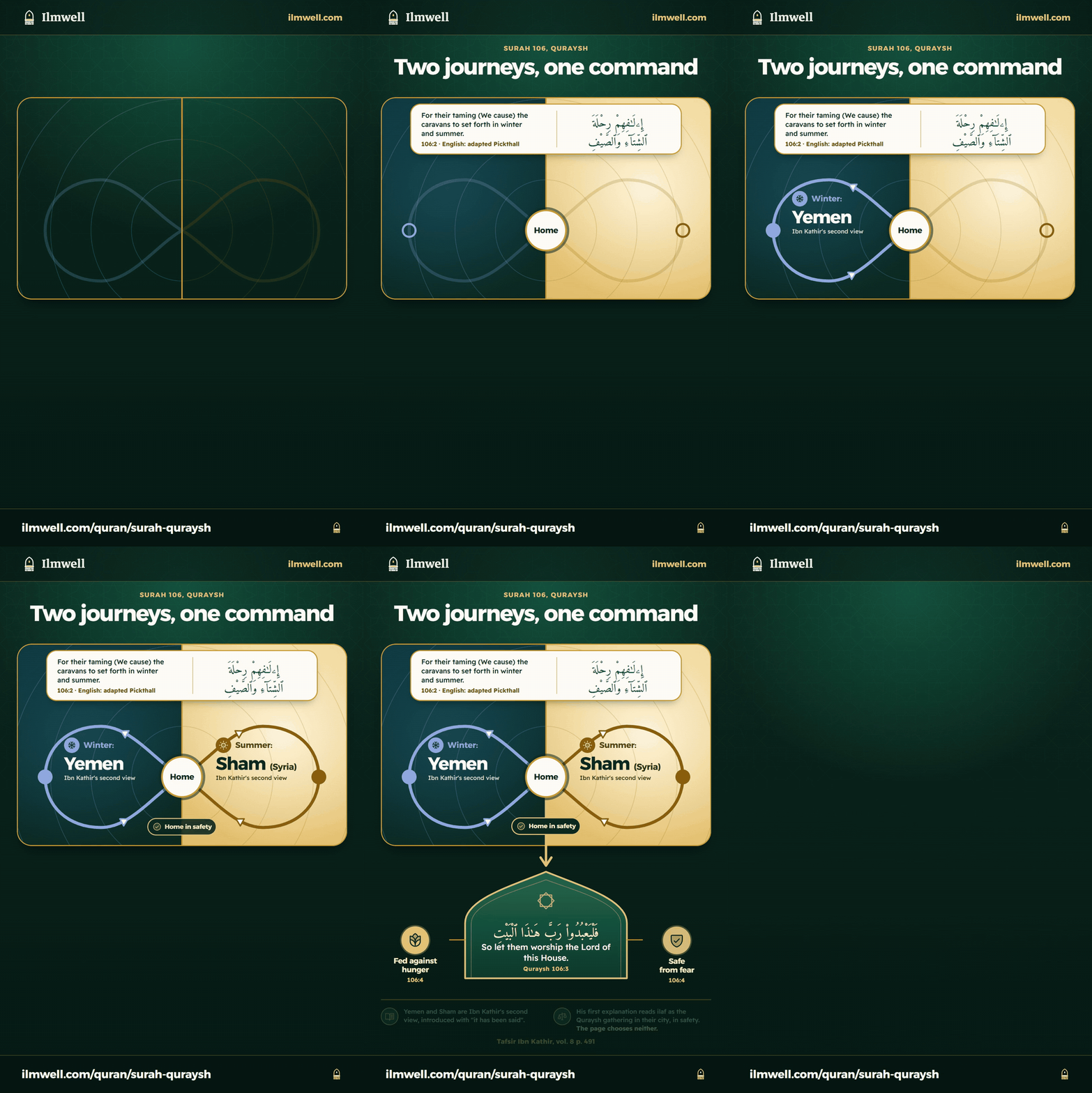
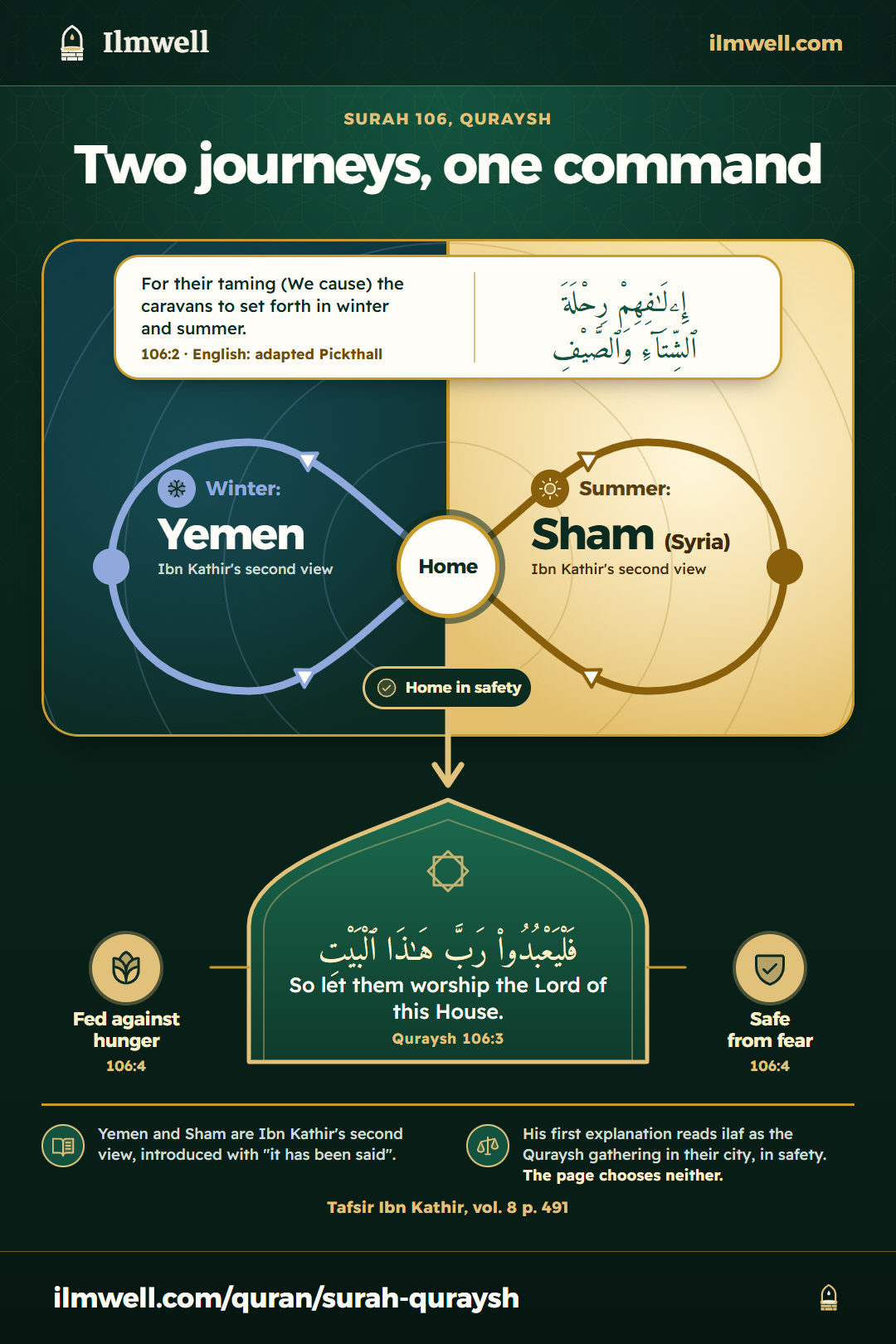
For their taming (We cause) the caravans to set forth in winter and summer.
The translation has the caravans setting forth in winter and summer.
- 3
فَلْيَعْبُدُوا۟ رَبَّ هَـٰذَا ٱلْبَيْتِ
Fal-yaʿbudū rabba hādhā l-bayt
So let them worship the Lord of this House.
A command, "let them worship", followed by the Lord of this House. The translation keeps that order.
- 4
ٱلَّذِىٓ أَطْعَمَهُم مِّن جُوعٍ وَءَامَنَهُم مِّنْ خَوْفٍۭ
Alladhī aṭʿamahum min jūʿin wa-āmanahum min khawf
Who has fed them against hunger and has made them safe from fear.
The translation gives two gifts, food against hunger and safety from fear, in the order of the Arabic.
Verse 1 has two words after the Bismillah:
Arabic reads right to left, so the first word is on the right.
- لِإِيلَـٰفِli-īlāfifor the taming ofThe particle li- joined to ilaf. The translation gives the phrase as "For the taming of".
- قُرَيْشٍQurayshQurayshThe tribe. Tanzil writes the transliterated name as Quraish and the English name as Quraysh.
What are the themes and passage structure of Surah Quraish?
The four verses fall into three parts. This describes the wording only. The readings of the commentators are in the next sections.
| Verse | What the wording does |
|---|---|
| 1 | Names the Quraysh, and the word the translation renders as "taming" |
| 2 | Says the caravans to set forth in winter and summer |
| 3 | Gives one command: So let them worship the Lord of this House |
| 4 | Describes that Lord as the one who fed them against hunger and made them safe from fear |
Verses 1 and 2 are about the Quraysh and their journeys. Verse 3 is the command, and verse 4 describes the Lord the command names.
What is the context of Surah Quraish: the caravans and Al-Fil?
The Tanzil metadata classes Surah Quraish as Meccan (from the Makkan period, before the move to Madinah), with four verses. It gives the transliterated name as Quraish and the English name as Quraysh. M
Ibn Kathir (d. 774 AH, in years of the Islamic calendar counted from the Hijrah), in his Tafsir al-Qur'an al-'Azim, vol. 8 p. 491, explains the opening word, ilaf, as the uniting and gathering of the Quraysh in their city, living in safety. 1
He reports that Ibn Ishaq and Abd al-Rahman ibn Zayd ibn Aslam took the sense to be that God held the elephant back from Makkah and destroyed its people, which links the surah with Al-Fil, the surah before it. 1
Ibn Kathir also notes that the Mushaf (the written copy of the Quran) separates the two surahs with a Bismillah line, although the surah is connected with what comes before it. 1
He gives a second view, introduced with "it has been said": the journeys the Quraysh made in winter to Yemen and in summer to Sham (Syria) for trade and other things. On these journeys they came home in safety, because of their standing among people as residents of God's sanctuary: whoever knew them respected them. 2
Neither reading is chosen over the other here. Both are attributed to the commentary, with its volume and page.
What does the command to worship the Lord of this House mean?
Ibn Kathir reads "so let them worship the Lord of this House" as meaning that they should single Him out in worship, just as He made a safe sanctuary and a sacred House for them (vol. 8 p. 492). 3
On the words "who fed them", he says that the one described is the Lord of this House. 3
Are there Surah Quraish benefits, such as a reward for reciting it?
No reward, benefit or virtue for reciting or memorising Surah Quraish is given here, and no report that gives one is cited.
Is there audio for Surah Quraish?
Audio is not yet provided. No reciter is named or embedded here. The transliteration above is a guide to the words, not a recording; it follows the Tanzil Arabic letter by letter. Listen to a qualified reciter for the sound itself.
Try it: Surah Quraish in three questions
Three quick questions on the surah. Each answer explains itself.
1How many verses does Surah Quraish have?
Answer: Four. Four. The Tanzil metadata gives surah 106 four verses.
2Which two journeys does verse 2 name?
Answer: Winter and summer. Verse 2: the caravans set forth in winter and summer.
3What does verse 3 tell the Quraysh to do?
Answer: Worship the Lord of this House. Verse 3: "So let them worship the Lord of this House."
I first heard Surah Quraysh recited by my younger cousin at a family gathering, proud because she had just learnt it. The aunties asked her to do it again, so she went through it twice. I remember the rhythm more than the words that day.
Common mix-ups
- Quraish and Quraysh are two spellings of the same surah, number 106.
- Al-Fil, which Ibn Kathir's context reading links with this surah, is surah 105.
Questions people ask
What is the Quraish surah about?
Surah Quraish is four verses. The first is about the Quraysh, the second about their winter and summer journeys, the third calls them to worship the Lord of this House, and the fourth says He fed them against hunger and made them safe from fear. The English is an adapted Pickthall translation.
Is Surah Quraysh the same as Surah Quraish?
Yes. Quraish and Quraysh are two spellings of surah 106, and it is also written Surah Al Quraish. The Tanzil metadata gives Quraish as the transliterated name and Quraysh as the English name.
What is the Surah Quraish transliteration?
Li-īlāfi Quraysh. Īlāfihim riḥlata sh-shitāʾi wa-ṣ-ṣayf. Fal-yaʿbudū rabba hādhā l-bayt. Alladhī aṭʿamahum min jūʿin wa-āmanahum min khawf. It is a guide to the words, not a recording.
Does reciting Surah Quraish bring a reward?
No reward or virtue for reciting or memorising Surah Quraish is stated here, and no report that gives one is cited.
Sources
Every claim on this page comes from one of these. Gradings are reported with the scholar's name; we do not grade hadith ourselves.
- 1
On 106:1, Ibn Kathir explains ilaf as the Quraysh's gathering and unity in their city, in safety; reports Ibn Ishaq and Abd al-Rahman ibn Zayd ibn Aslam on the link with Al-Fil; and notes the Bismillah line that separates the two surahs in the Mushaf.
Ibn Kathir (d. 774 AH), Tafsir al-Qur'an al-'Azim, vol. 8 p. 491, on 106:1 Electronic copy read on 28 October 2026 (shamela.ws, Dar al-Salam edition). Print verification outstanding. Record: scholarly-ibnkathir-106-ilaf.
- 2
Ibn Kathir gives, on 106:1 to 2, the trade reading of ilaf as a second view: the winter journeys to Yemen and summer journeys to Sham, and the safety of the Quraysh on them as people of the sanctuary.
Tafsir al-Qur'an al-'Azim (Ibn Kathir, d. 774 AH), vol. 8 p. 491, on 106:1 to 2 Electronic copy read on 28 October 2026 (shamela.ws, Dar al-Salam edition). Print verification outstanding. Record: scholarly-ibnkathir-106-caravans.
- 3
Explaining 106:3 and 106:4, Ibn Kathir reads the command to worship the Lord of this House as singling Him out in worship, and identifies the Lord described in verse 4 as the Lord of the House.
Vol. 8 p. 492: Tafsir al-Qur'an al-'Azim by Ibn Kathir (d. 774 AH), on 106:3 to 4 Electronic copy read on 28 October 2026 (shamela.ws, Dar al-Salam edition). Print verification outstanding. Record: scholarly-ibnkathir-106-worship.
- M
Surah 106 has four verses, the transliterated name Quraish, the English name Quraysh, and the Tanzil class Meccan.
Tanzil Project metadata CC BY 3.0. Record: data-tanzil-surah-106-meta.
- Q
Quran Arabic for Al-Quraish 106:1 to 4 (the scroll, the verse list and the word cards), without the Bismillah the Tanzil copy prints at the head of verse 1, and its English.
Tanzil Project Uthmani text, CC BY 3.0. English: adapted from Marmaduke Pickthall's translation (1930), modernised and checked against modern translations. Record: quran-106-1-4.
Next
For your own situation, ask a scholar you trust.
Join the email list
New guides by email, now and then. No spam, and you can leave at any time.
Ilmwell is free and kept going by readers. See how to support it.