The short answer
Surah Duha in English (also written Surat Duha) begins "By the morning hours" (Ad-Duha 93:1, meaning surah 93, verse 1). It is surah 93, eleven verses telling the Prophet Muhammad, peace be upon him: "Your Lord has not forsaken you nor does He hate you". Sahih al-Bukhari 4950 and Sahih Muslim 1797a, both graded sahih, tie verses 1 to 3 to his illness or to a delay in revelation.
What is Surah Duha in Arabic and English?
Ad-Duha 93:1 to 11
وَٱلضُّحَىٰ ١ وَٱلَّيْلِ إِذَا سَجَىٰ ٢ مَا وَدَّعَكَ رَبُّكَ وَمَا قَلَىٰ ٣ وَلَلْـَٔاخِرَةُ خَيْرٌ لَّكَ مِنَ ٱلْأُولَىٰ ٤ وَلَسَوْفَ يُعْطِيكَ رَبُّكَ فَتَرْضَىٰٓ ٥ أَلَمْ يَجِدْكَ يَتِيمًا فَـَٔاوَىٰ ٦ وَوَجَدَكَ ضَآلًّا فَهَدَىٰ ٧ وَوَجَدَكَ عَآئِلًا فَأَغْنَىٰ ٨ فَأَمَّا ٱلْيَتِيمَ فَلَا تَقْهَرْ ٩ وَأَمَّا ٱلسَّآئِلَ فَلَا تَنْهَرْ ١٠ وَأَمَّا بِنِعْمَةِ رَبِّكَ فَحَدِّثْ ١١
Surah 93, Ad-Duha, has 11 verses and sits in the 30th part (juz) of the Quran. The Tanzil Quran metadata lists it as Makki (from the Makkan period, before the move to Madinah), and Ibn Kathir heads his commentary on it "and it is Makki" (Tafsir al-Quran al-Azim 8/423, meaning volume 8, page 423, source 6).
Its first word, waḍ-ḍuḥā, is why you will see it written Surah Waduha or Wa Duha, as well as Surah Al Duha, Ad Dhuha and Duhaa. To copy the Arabic, use the button under the scroll. The English and a transliteration follow, verse by verse; there is no PDF file, but you can print that list from your browser. Like most surahs it is printed under Bismillah, which is not counted among its 11 verses.
What does Surah Duha mean, verse by verse?
Here is the Surah Duha transliteration and translation, one verse at a time, with a note on what each line says.
- 1
وَٱلضُّحَىٰ
Waḍ-ḍuḥā
By the morning hours.
The surah opens with an oath: "By the morning hours". Ad-Duha, its name, is this word.
- 2
وَٱلَّيْلِ إِذَا سَجَىٰ
Wal-layli idhā sajā
And by the night when it is stillest.
A second oath, by the night "when it is stillest". Morning and night stand side by side.
- 3
مَا وَدَّعَكَ رَبُّكَ وَمَا قَلَىٰ
Mā waddaʿaka rabbuka wa mā qalā
Your Lord has not forsaken you nor does He hate you.
What the two oaths lead to, spoken to one person, "you".
- 4
وَلَلْـَٔاخِرَةُ خَيْرٌ لَّكَ مِنَ ٱلْأُولَىٰ
Wa lal-ākhiratu khayrul-laka minal-ūlā
And truly the latter portion will be better for you than the former.
This translation reads it as "the latter portion" being better than "the former".
- 5
وَلَسَوْفَ يُعْطِيكَ رَبُّكَ فَتَرْضَىٰٓ
Wa lasawfa yuʿṭīka rabbuka fa-tarḍā
And truly your Lord will give to you so that you will be content.
A statement about what is to come: your Lord will give, and you will be content.
- 6
أَلَمْ يَجِدْكَ يَتِيمًا فَـَٔاوَىٰ
Alam yajidka yatīman fa-āwā
Did He not find you an orphan and protect (you)?
The first of three lines on the past: found an orphan, and protected.
- 7
وَوَجَدَكَ ضَآلًّا فَهَدَىٰ
Wa wajadaka ḍāllan fa-hadā
Did He not find you wandering and direct (you)?
The second: wandering, and directed. The Arabic opens wa wajadaka, "and He found you"; this translation keeps the question form.
- 8
وَوَجَدَكَ عَآئِلًا فَأَغْنَىٰ
Wa wajadaka ʿā'ilan fa-aghnā
Did He not find you destitute and enrich (you)?
The third: destitute, and enriched.
- 9
فَأَمَّا ٱلْيَتِيمَ فَلَا تَقْهَرْ
Fa-ammal-yatīma fa-lā taqhar
Therefore the orphan oppress not.
The first of three instructions. The orphan comes back from verse 6.
- 10
وَأَمَّا ٱلسَّآئِلَ فَلَا تَنْهَرْ
Wa ammas-sā'ila fa-lā tanhar
Therefore the beggar drive not away.
The Arabic word is as-sā'il, which this translation renders "the beggar".
- 11
وَأَمَّا بِنِعْمَةِ رَبِّكَ فَحَدِّثْ
Wa ammā bi-niʿmati rabbika fa-ḥaddith
Therefore of the bounty of your Lord be your discourse.
The last verse turns to speech: the bounty of your Lord is to be your discourse.
Verse 3, the line the reports below are about, is five words:
Arabic reads right to left, so the first word is on the right.
- مَاmānotA denial.
- وَدَّعَكَwaddaʿakahas forsaken youEnds in ka, which this translation renders "you".
- رَبُّكَrabbukayour LordEnds in ka again: "your".
- وَمَاwa mānorThe denial again.
- قَلَىٰqalāhateThe translation reads "nor does He hate you".
Why was Surah Ad-Duha revealed?
Three wordings of one report, all from Jundub, may Allah be pleased with him, name the occasion of the first three verses. Their details differ, so each is told on its own.
Ill for two or three nights
Jundub ibn Sufyan reported that the Prophet was ill and did not get up for two or three nights. A woman came and said, "O Muhammad, I hope that your shaytan has left you", adding that she had not seen it near him for two or three nights. Then Allah revealed verses 1 to 3.
1AuthenticSahih al-Bukhari 4950
The Arabic does not name the woman, and says only that he "did not get up". Words added in brackets in some English translations are not in the report.
Ill for a night or two
In a second wording, Jundub reported that the Prophet was ill and did not get up for a night or two. A woman came to him and said she saw nothing but that his shaytan had left him. Then Allah revealed verses 1 to 3.
2AuthenticSahih al-Bukhari 4983
Jibril was slow to come
In Sahih Muslim, Jundub reported that Jibril, peace be upon him, was slow in coming to the Prophet, and the polytheists said that Muhammad had been abandoned. Then Allah revealed verses 1 to 3. This wording names no illness, no woman and no number of nights.
3AuthenticSahih Muslim 1797a
| Report | What happened before the verses | Who spoke |
|---|---|---|
| Bukhari 4950 | Illness; two or three nights | A woman |
| Bukhari 4983 | Illness; a night or two | A woman |
| Muslim 1797a | Jibril slow to come; no length given | The polytheists |
Ibn Kathir cites both the illness wording and the wording about Jibril without choosing between them, and reports that it was said (qila) the woman was Umm Jamil, the wife of Abu Lahab (Tafsir al-Quran al-Azim 8/424, source 6). None of the three reports gives a pause of weeks or months.
What do the verses mean in tafsir?
This section is tafsir (Quran commentary) from one classical work, Ibn Kathir's Tafsir al-Quran al-Azim. The three parts are our grouping.
Verses 1 to 5: the oath and the reassurance
Ibn Kathir calls the opening an oath by the forenoon and the light Allah placed in it. The night "when it is stillest" is, in his words, the night that grows still and dark (8/425, source 6).
He glosses verse 3 as "He has not left you, nor hated you". Verse 4, for him, is the hereafter being better for the Prophet than this world. Verse 5 is Allah giving him in the hereafter until He pleases him, concerning his community and the honour prepared for him. He also reports other early views of verse 5, one of them that it means the intercession (8/425 to 426, source 7).
His reading of verse 5 is about the Prophet. It is not a promise to a reader of a job, a match or a sum of money by a certain date, and no source on this page makes it one.
Verses 6 to 8: three favours
Ibn Kathir explains verse 6 by the Prophet's childhood. His father died before he was born (or, it was said, after), and his mother when he was six. His grandfather cared for him until the grandfather died, when the Prophet was eight, and then his uncle Abu Talib. He compares verse 7 with Ash-Shura 42:52, and glosses verse 8 as "you were poor, with dependants, and Allah made you free of need of anyone besides Him" (8/426 to 427, source 8). In the translation on this site, 42:52 says "You knew not what the Scripture was, nor what the Faith".
Verses 9 to 11: three instructions
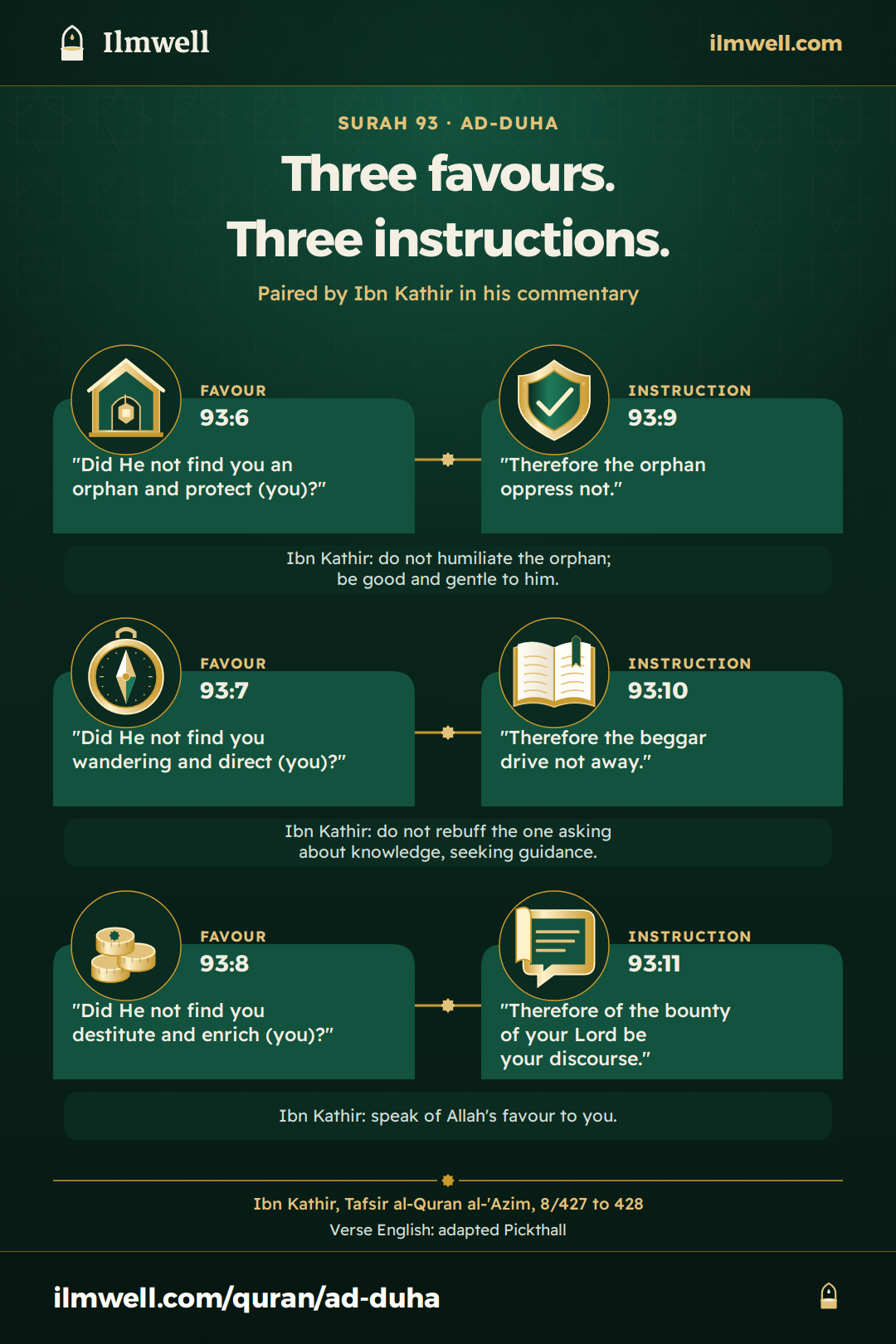
For verses 9 to 11, Ibn Kathir pairs each closing instruction with a favour named just before it (8/427 to 428, source 9):
| Favour (verse) | Instruction (verse) | His explanation |
|---|---|---|
| 6: an orphan, protected | 9: the orphan oppress not | As you were an orphan and Allah sheltered you, do not humiliate the orphan; be good and gentle to him |
| 7: wandering, directed | 10: the beggar drive not away | As you were wandering and Allah guided you, do not rebuff the one who asks about knowledge, seeking guidance |
| 8: destitute, enriched | 11: of the bounty of your Lord be your discourse | As you were poor and Allah enriched you, speak of Allah's favour to you |
He also reports Qatada explaining "the beggar" as the poor person, to be turned away with mercy and gentleness. Mujahid, he reports, said the bounty in verse 11 is prophethood, or in another report the Quran (8/427 to 428, source 9).

Does Surah Duha promise wealth, or cure depression?
No source on this page gives Ad-Duha a recitation count, a deadline for a wish or a cure. The reports about its revelation describe what happened to the Prophet; they set no practice for readers. Two reports in later collections do attach something to the surah, and no grader we found accepts either.
A reward for reciting it
A report listed under Ubayy ibn Ka'b, may Allah be pleased with him, promises a reward for reciting Surah Ad-Duha. The reciter, it says, will be among those Allah is pleased for Muhammad to intercede for, with ten good deeds for every orphan and every one who asks. Both gradings we found call it fabricated.
4FabricatedAl-Kafi al-Shaf 319
Reciting it in the forenoon prayer
A report listed under 'Uqbah ibn 'Amir, may Allah be pleased with him, tells people to pray the two rak'ahs (units of prayer) of the forenoon prayer (al-duha) with Ash-Shams and Ad-Duha. It is graded weak to fabricated: one grader calls it weak, and one, in two gradings, fabricated.
Posts that set a number of readings, such as seven, for a wish to come true would need a report of their own. We did not search for every such claim, so this page neither confirms nor rules out a particular post. If you are living with low mood or depression, please speak to your GP as well; the reports on this page make no medical claim.
I knew Ad-Duha as a short surah I could recite before I knew what it said. Reading what each verse means, and how the reassurance turns into how to treat the orphan and the one who asks, made it feel personal.
Try it: Surah Duha in four questions
Four quick questions on the surah and its reports. Each answer explains itself.
1How many verses does Surah Ad-Duha have?
Answer: Eleven. Eleven. Al-Layl, the surah before it, has 21, and Ash-Sharh, the surah after it, has 8.
2In Sahih Muslim 1797a, who said that Muhammad had been abandoned?
Answer: The polytheists. The polytheists. That wording names no woman and no illness; those are in Sahih al-Bukhari 4950 and 4983. Source 3
3In Sahih al-Bukhari 4950, for how long did the Prophet not get up?
Answer: Two or three nights. Two or three nights. Another wording, Sahih al-Bukhari 4983, says a night or two. Source 1
4Which verse says "Therefore the orphan oppress not"?
Answer: Verse 9. Verse 9, the first of the three closing instructions. Verse 6 is about being found an orphan.
How do you pronounce Surah Duha?
Read along with the transliteration above, a verse at a time, and slow down for these sounds:
- ḍ and ḥ in ḍuḥā: a heavy d with the tongue pressed wide, then a breathy h from the throat.
- ʿ in waddaʿaka, yuʿṭīka and niʿmati: a tightening deep in the throat.
- q in qalā and taqhar: further back than an English k.
- The doubled d in waddaʿaka and ḥaddith is held a little longer.
Listen and repeat. A recording by a fluent human reciter is coming. We do not use a synthetic voice for the Quran.
Common mix-ups
- Ad-Duha is surah 93. Al-Layl, surah 92, comes before it, and Ash-Sharh (Alam nashrah), surah 94, comes after it.
- The forenoon prayer, salat al-duha, shares the word duha but is a prayer, not this surah. The report that pairs the two is graded weak to fabricated.
- Ash-Shams 91:1 has a related word, wa ḍuḥāhā, in "By the sun and his brightness". That is a different surah, number 91.
Questions people ask
Is Surah Duha Makki or Madani?
Surah Duha is Makki. The Tanzil Quran metadata used on this site lists it as Makki, and the classical commentary cited on this page heads it the same way. It is surah 93, with eleven verses, in the 30th part (juz) of the Quran.
What does Ad-Duha mean?
Ad-Duha is the first word of the surah, and the surah is named after it. The translation used on this site renders the opening oath "By the morning hours", and the Tanzil metadata gives the English name The Morning Hours.
Is Surah Duha recited for depression?
None of the sources on this page calls Surah Duha a treatment for depression. The reports about why it was revealed describe a time the Prophet Muhammad, peace be upon him, was ill, or a time Jibril, peace be upon him, was slow to come, before verses 1 to 3 were revealed, and give no number of recitations. For low mood or depression, speak to your GP, and ask a scholar you trust about recitation.
Sources
Every claim on this page comes from one of these. Gradings are reported with the scholar's name; we do not grade hadith ourselves.
- 1
Jundub ibn Sufyan reports that the Prophet was ill and did not get up for two or three nights; a woman came and said she hoped his shaytan had left him, as she had not seen it near him for two or three nights; then Allah revealed Ad-Duha 93:1 to 3.
Sahih al-Bukhari 4950 Book 65, Hadith 472
Authentic: in Sahih al-Bukhari
- 2
Jundub reports that the Prophet was ill and did not get up for a night or two; a woman came and said she saw nothing but that his shaytan had left him; then Allah revealed Ad-Duha 93:1 to 3.
Sahih al-Bukhari 4983 Book 66, Hadith 5
Authentic: in Sahih al-Bukhari
- 3
Jundub reports that Jibril was slow in coming to the Prophet, and the polytheists said Muhammad had been abandoned; then Allah revealed Ad-Duha 93:1 to 3.
Sahih Muslim 1797a Book 32, Hadith 138
Authentic: in Sahih Muslim
- 4
A report listed under Ubayy ibn Ka'b says that whoever recites Surah Ad-Duha will be among those for whom Allah is pleased that Muhammad intercede, with ten good deeds written for the number of every orphan and every one who asks. Both gradings found call it fabricated.
Al-Kafi al-Shaf 319 Ibn Hajar, al-Kafi al-Shaf 319; al-Munawi, al-Fath al-Samawi 1009 (as dorar.net lists them)
Fabricated: fabricated (Ibn Hajar al-'Asqalani); fabricated (Zayn al-Din al-Munawi)
- 5
A report listed under 'Uqbah ibn 'Amir tells people to pray the two rak'ahs of al-duha (the forenoon prayer) with 'their two surahs', Ash-Shams and Ad-Duha. It is graded weak to fabricated.
Al-Jami' al-Saghir 5006 Al-Suyuti, al-Jami' al-Saghir 5006 (as dorar.net lists it)
Weak to fabricated: graders differ on how weak it is. Here is who graded it which way:
- WeakAl-Suyuti
- FabricatedAl-Albani
- Other remarksZayn al-Din al-Munawi, Al-San'ani
See each grading in full, with its wording and where it was given
Scholars disagree about this hadith. Here is how each graded it, so you can follow the scholar you trust.
- ضعيف (weak): Al-Suyuti, al-Jami' al-Saghir 5006 (as listed on dorar.net)
- موضوع (fabricated): Al-Albani, Da'if al-Jami' 3479 (as listed on dorar.net)
- موضوع (fabricated): Al-Albani, al-Silsilah al-Da'ifah 3774 (as listed on dorar.net)
- فيه مجاشع بن عمرو قال ابن حبان: يضع الحديث، وابن لهيعة ضعيف (its chain has Mujashi' ibn 'Amr, of whom Ibn Hibban said he fabricated hadith, and Ibn Lahi'ah, who is weak): Zayn al-Din al-Munawi, Fayd al-Qadir 4/201 (as listed on dorar.net)
- فيه مجاشع بن عمرو قال الذهبي في الضعفاء: قال ابن حبان يضع الحديث عن ابن لهيعة وهو ضعيف (narrator criticism of Mujashi' ibn 'Amr and Ibn Lahi'ah): Al-San'ani, al-Tanwir Sharh al-Jami' al-Saghir 6/597 (as listed on dorar.net)
- 6
Ibn Kathir heads his commentary on Ad-Duha as a Makki surah, reports that it was said the woman in Jundub's report was Umm Jamil, the wife of Abu Lahab, and explains the opening words as an oath by Allah by the forenoon (al-duha) and the light He placed in it.
Ibn Kathir, Tafsir al-Quran al-Azim, vol. 8, p. 423 to 425 (ed. al-Salamah, Dar Tayba, 1999) Record: scholarly-ibnkathir-duha-makki-opening. Read on shamela.ws, which follows the printed pages.
- 7
Ibn Kathir glosses Ad-Duha 93:3 as 'He has not left you, nor hated you', 93:4 as 'the abode of the hereafter is better for you than this abode', and 93:5 as Allah giving the Prophet in the hereafter until He pleases him concerning his community (ummah) and the honour He prepared for him.
Ibn Kathir, Tafsir al-Quran al-Azim, vol. 8, p. 425 to 426, on 93:3 to 5 Record: scholarly-ibnkathir-duha-3-5. Same edition.
- 8
Ibn Kathir explains Ad-Duha 93:6 by the Prophet's orphanhood (his father died before his birth, or it was said after it; his mother died when he was six; his grandfather cared for him until he was eight, then his uncle Abu Talib), compares 93:7 with Ash-Shura 42:52, and glosses 93:8 as 'you were poor, with dependants, and Allah made you free of need of anyone besides Him'.
Ibn Kathir, Tafsir al-Quran al-Azim, vol. 8, p. 426 to 427, on 93:6 to 8 Record: scholarly-ibnkathir-duha-6-8. Same edition.
- 9
Ibn Kathir pairs each closing command of Ad-Duha with a favour named before it: as you were an orphan and Allah sheltered you, do not humiliate the orphan but be good and gentle to him; as you were wandering and Allah guided you, do not rebuff the one who asks, seeking knowledge and guidance; as you were poor and Allah enriched you, speak of Allah's favour to you.
Ibn Kathir, Tafsir al-Quran al-Azim, vol. 8, p. 427 to 428, on 93:9 to 11 Record: scholarly-ibnkathir-duha-9-11. Same edition.
- Q
Quran Arabic for Ad-Duha 93:1 to 11 (the scroll, the verse list and the word cards), without the Bismillah the Tanzil copy prints at the head of verse 1, and its English, with the short quotes from Ash-Shura 42:52 and Ash-Shams 91:1. Surah number, verse count, Makkan listing, English name and the start of the 30th part from the Tanzil metadata; Al-Layl and Ash-Sharh verse counts from the same.
Tanzil Project Uthmani text and metadata, CC BY 3.0. English: adapted from Marmaduke Pickthall's translation (1930), modernised and checked against modern translations.
Next
- Al-Ikhlas: meaning, themes and reported virtuesQuran lesson
- Al-Kafirun: Arabic, meaning and the bedtime reportQuran lesson
- Surah Mulk in Arabic and EnglishQuran lesson
- Sabr: patience in IslamExplainer
- Bismillah: meaning and when to say it
- Surah Fajr (Al-Fajr): full text and meaningQuran lesson
- Quran and SurahsThe hub
For your own situation, ask a scholar you trust.
Join the email list
New guides by email, now and then. No spam, and you can leave at any time.
Ilmwell is free and kept going by readers. See how to support it.