The short answer
In Islam, sabr is the Arabic word that English renders as patience, steadfastness or endurance. Al-Raghib al-Asfahani, in his dictionary of the Quran's vocabulary, al-Mufradat fi Gharib al-Quran, gives its meaning as holding the self to what reason and the sharia (Islamic law) require. In Sahih al-Bukhari 1283, graded sahih, the Prophet Muhammad, peace be upon him, said patience is at the first shock.
How is sabr written in Arabic?
Al-Baqarah 2:250
صَبْرًا
ṣabran
The word as Al-Baqarah 2:250 prints it, with the ending -an. The site's English there: endurance.
The Quran prints the word in more than one shape, and the English changes with it. Here are three, each cut from the verse itself. All three share the consonants ṣ-b-r.
| Transliteration | Arabic | Where | This site's English |
|---|---|---|---|
| ṣabran | صَبْرًا | Al-Baqarah 2:250 | endurance |
| bi-ṣ-ṣabr | بِٱلصَّبْرِ | Al-Baqarah 2:153 | in steadfastness |
| aṣ-ṣābirūn | ٱلصَّـٰبِرُونَ | Az-Zumar 39:10 | the steadfast |
English has more than one word for it. This page's translation of the Quran uses steadfastness, the steadfast and endurance, while this page's own English for the hadith below uses patient and patience.
What does sabr mean?
In al-Mufradat fi Gharib al-Quran, al-Raghib al-Asfahani opens the entry for sabr with al-imsak fi dayq, holding in a tight place (source 4). In the same entry he then defines it as habs al-nafs 'ala ma yaqtadihi al-'aql wa-l-shar': holding the self to what reason and the sharia require, or back from what they require it to be held back from. That is one dictionary entry from one work, not the only definition scholars have given.
The report below is about a woman weeping beside a grave.
What does the Quran say about sabr?
This page quotes two verses. Al-Baqarah 2:153 is addressed to those who believe. Az-Zumar 39:10 opens with "Say: O My bondmen who believe!" and speaks of what the steadfast are paid.
يَـٰٓأَيُّهَا ٱلَّذِينَ ءَامَنُوا۟ ٱسْتَعِينُوا۟ بِٱلصَّبْرِ وَٱلصَّلَوٰةِ ۚ إِنَّ ٱللَّهَ مَعَ ٱلصَّـٰبِرِينَ
قُلْ يَـٰعِبَادِ ٱلَّذِينَ ءَامَنُوا۟ ٱتَّقُوا۟ رَبَّكُمْ ۚ لِلَّذِينَ أَحْسَنُوا۟ فِى هَـٰذِهِ ٱلدُّنْيَا حَسَنَةٌ ۗ وَأَرْضُ ٱللَّهِ وَٰسِعَةٌ ۗ إِنَّمَا يُوَفَّى ٱلصَّـٰبِرُونَ أَجْرَهُم بِغَيْرِ حِسَابٍ
Neither verse gives a date by which a particular problem will end. Keep the reference with any line you share, because a caption cut from the middle of a verse can lose who is being addressed.
What does patience at the first shock mean?
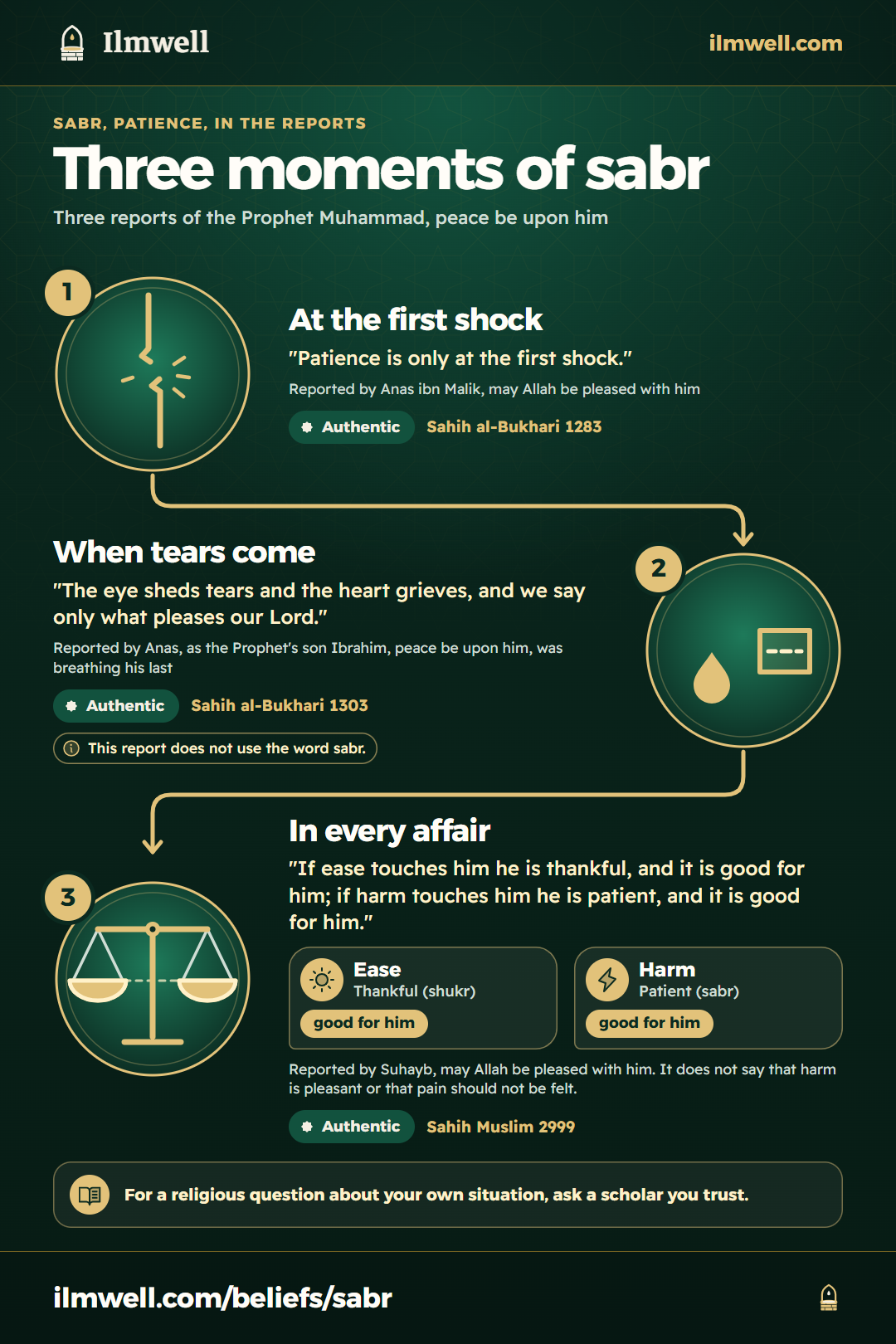
Anas ibn Malik, may Allah be pleased with him, reported that the Prophet passed a woman weeping beside a grave and told her to fear Allah and be patient. She said, "Go away from me, for you have not been struck by my calamity," and she did not know him. It was said to her that he was the Prophet. She went to his door and found no doorkeepers there, and said she had not known him. He said:
Sahih al-Bukhari 1283
إِنَّمَا الصَّبْرُ عِنْدَ الصَّدْمَةِ الأُولَى
innamā ṣ-ṣabru ʿinda ṣ-ṣadmati l-ūlā
Patience is only at the first shock.
1AuthenticSahih al-Bukhari 1283
The report does not say who was buried, what the woman had lost or who told her who he was, so this page adds none of it. Whose words are whose: the Prophet spoke the first advice and the sentence above; the woman's reply, "Go away from me", is hers.
The Quran also names the steadfast in a passage about misfortune. Its words in 2:156 are the subject of Inna lillahi wa inna ilayhi raji'un.
وَلَنَبْلُوَنَّكُم بِشَىْءٍ مِّنَ ٱلْخَوْفِ وَٱلْجُوعِ وَنَقْصٍ مِّنَ ٱلْأَمْوَٰلِ وَٱلْأَنفُسِ وَٱلثَّمَرَٰتِ ۗ وَبَشِّرِ ٱلصَّـٰبِرِينَ ٱلَّذِينَ إِذَآ أَصَـٰبَتْهُم مُّصِيبَةٌ قَالُوٓا۟ إِنَّا لِلَّهِ وَإِنَّآ إِلَيْهِ رَٰجِعُونَ
What do the reports say about tears?
In the reports on this page, the Prophet's eyes shed tears and he spoke of grief in the heart, and he told a weeping woman to be patient. This page cites no scholar on whether crying lessens sabr, and Sahih al-Bukhari 1303 does not use the word sabr at all.
Anas reported that he went with the Prophet to the blacksmith Abu Sayf, whose wife was the wet nurse of the Prophet's son Ibrahim, peace be upon him. The Prophet took Ibrahim, kissed him and smelled him. Later they entered again. Ibrahim was breathing his last, and the Prophet's eyes began to shed tears. 'Abd al-Rahman ibn 'Awf, may Allah be pleased with him, asked, "And you, O Messenger of Allah?" The Prophet answered that it was mercy. Then he said:
Sahih al-Bukhari 1303 (first part of his words)
إِنَّ الْعَيْنَ تَدْمَعُ، وَالْقَلْبَ يَحْزَنُ، وَلاَ نَقُولُ إِلاَّ مَا يَرْضَى رَبُّنَا
inna l-ʿayna tadmaʿu wa-l-qalba yaḥzanu wa-lā naqūlu illā mā yarḍā rabbunā
The eye sheds tears and the heart grieves, and we say only what pleases our Lord.
2AuthenticSahih al-Bukhari 1303
He ended with the words "O Ibrahim, we are grieved at your parting". The report gives the tears, the grief and the restraint in speech side by side. It gives no ruling on how anyone else should mourn.
What does the hadith about the believer's affairs say?
Suhayb, may Allah be pleased with him, reported that the Prophet said:
Sahih Muslim 2999 (the opening, then the two cases)
عَجَبًا لأَمْرِ الْمُؤْمِنِ إِنَّ أَمْرَهُ كُلَّهُ خَيْرٌ وَلَيْسَ ذَاكَ لأَحَدٍ إِلاَّ لِلْمُؤْمِنِ إِنْ أَصَابَتْهُ سَرَّاءُ شَكَرَ فَكَانَ خَيْرًا لَهُ وَإِنْ أَصَابَتْهُ ضَرَّاءُ صَبَرَ فَكَانَ خَيْرًا لَهُ
ʿajaban li-amri l-muʾmini inna amrahu kullahu khayr ... in aṣābathu sarrāʾu shakara fa-kāna khayran lah, wa-in aṣābathu ḍarrāʾu ṣabara fa-kāna khayran lah
How wonderful is the affair of the believer: all his affairs are good, and that is for no one but the believer. If ease touches him he is thankful, and it is good for him; if harm touches him he is patient, and it is good for him.
3AuthenticSahih Muslim 2999
| What touches the believer | The response in the report |
|---|---|
| Ease | Thankfulness (shukr) |
| Harm | Patience (sabr) |
The report says the response is good for the believer. It does not say that harm is pleasant or that pain should not be felt.

Is there a dua for sabr?
Al-Baqarah 2:250 records a prayer that asks for sabr. The passage before it, 2:247 to 249, names Saul (Talut in the Arabic) and the army that set out with him, and 2:250 says that when they went into the field against Goliath (Jalut in the Arabic) and his hosts, they said:
وَلَمَّا بَرَزُوا۟ لِجَالُوتَ وَجُنُودِهِۦ قَالُوا۟ رَبَّنَآ أَفْرِغْ عَلَيْنَا صَبْرًا وَثَبِّتْ أَقْدَامَنَا وَٱنصُرْنَا عَلَى ٱلْقَوْمِ ٱلْكَـٰفِرِينَ
The verse asks for endurance, a sure foothold and help. It assigns no count and no time, and it is given in the setting above, so this page does not present it as a promise about a present-day situation. Its first line, transliterated, is rabbana afrigh ʿalayna sabran wa-thabbit aqdamana, and the verse goes on.
Sabr quotes: where the lines come from
Each line below is from the Quran or the hadith, with its reference. The page cites no sayings of scholars or poets, so you will not find a quote here without a source you can open.
| The line | Reference |
|---|---|
| Seek help in steadfastness and prayer. | Al-Baqarah 2:153 |
| Allah is with the steadfast. | Al-Baqarah 2:153 |
| Truly the steadfast will be paid their wages without stint. | Az-Zumar 39:10 |
| Our Lord! Bestow on us endurance, make our foothold sure... | Al-Baqarah 2:250 (said by those who went out against Goliath) |
| Patience is only at the first shock. (our rendering of the Arabic) | Sahih al-Bukhari 1283 |
| The eye sheds tears and the heart grieves, and we say only what pleases our Lord. (our rendering of the Arabic) | Sahih al-Bukhari 1303 |
If you are struggling
This page does not try to tell you how to feel. If a loss or a worry is weighing on you, a GP is a good first person to speak to. For a religious question about your own situation, ask a scholar you trust. If a friend is grieving, the reports above give no script for comforting them; ordinary kindness, from us and not from a source, is to listen, ask what would help, and bring food if you can.
People told me to have sabr many times growing up, and it did not always help. Reading what the Quran and the hadith actually say about it, including the tears in the report about the Prophet, peace be upon him, and his son, made it feel kinder than the way it was often said.
Try it: four questions
Pick an answer; each one explains itself.
1Which verse says "Seek help in steadfastness and prayer"?
Answer: Al-Baqarah 2:153. The English here is the site's translation, which renders sabr as steadfastness in this verse.
2In Sahih al-Bukhari 1283, when does the Prophet Muhammad, peace be upon him, say patience is?
Answer: At the first shock. He says patience is only at the first shock. The report does not say who was buried or what the woman had lost. Source 1
3Does Sahih al-Bukhari 1303 contain the word sabr?
Answer: No. It records the Prophet's tears, his words "the eye sheds tears and the heart grieves" and that he would say only what pleases his Lord. It sits beside the first-shock report on this page; it does not itself speak of patience. Source 2
4Which two responses does Sahih Muslim 2999 pair?
Answer: Gratitude for ease, patience for harm. If ease touches the believer he is thankful; if harm touches him he is patient. The report says each is good for him. Source 3
Sources
Every claim on this page comes from one of these. Gradings are reported with the scholar's name; we do not grade hadith ourselves.
- 1
Anas ibn Malik reported that the Prophet passed a woman weeping beside a grave and told her to fear Allah and be patient; she answered, 'Go away from me, for you have not been struck by my calamity', and did not know him; it was said to her that he was the Prophet; she went to his door, found no doorkeepers, and said she had not known him; he said, 'Patience is only at the first shock.'
Sahih al-Bukhari 1283 Book 23, Hadith 43
Authentic: in Sahih al-Bukhari
- 2
Anas ibn Malik reported that he went with the Prophet to Abu Sayf the blacksmith, the husband of Ibrahim's wet nurse; the Prophet took Ibrahim, kissed him and smelled him; later, with Ibrahim breathing his last, the Prophet's eyes shed tears; 'Abd al-Rahman ibn 'Awf asked 'and you, O Messenger of Allah?' and the Prophet answered 'O Ibn 'Awf, it is mercy', then said 'the eye sheds tears and the heart grieves, and we say only what pleases our Lord; and we are, O Ibrahim, grieved at your parting.'
Sahih al-Bukhari 1303 Book 23, Hadith 61
Authentic: in Sahih al-Bukhari
- 3
Suhayb reported that the Prophet said: how wonderful is the affair of the believer, all his affairs are good, and that is for no one but the believer: if ease touches him he is thankful, and it is good for him; if harm touches him he is patient, and it is good for him.
Sahih Muslim 2999 Book 55, Hadith 82
Authentic: in Sahih Muslim
- 4
Al-Raghib al-Asfahani's entry for sabr in al-Mufradat fi Gharib al-Quran opens with al-imsak fi dayq (holding in a tight place) and defines al-sabr as habs al-nafs 'ala ma yaqtadihi al-'aql wa-l-shar', aw 'amma yaqtadiyan habsaha 'anhu (holding the self to what reason and the sharia require, or back from what they require it to be held back from). One dictionary entry; the page's other uses of the word come from the Quran and hadith.
Abu al-Qasim al-Husayn ibn Muhammad, known as al-Raghib al-Asfahani (d. 502 AH), al-Mufradat fi Gharib al-Quran, ed. Safwan 'Adnan al-Dawudi, 1st edition, Dar al-Qalam and al-Dar al-Shamiyyah, Damascus and Beirut, 1412 AH (shamela.ws numbering follows the print), p. 474, entry 'sbr' (shamela.ws/book/23636/456) Read on 24 October 2026. Record: scholarly-al-raghib-al-asfahani-al-mufradat-fi-gharib-al-q.
- Q
Quran Arabic and English for Al-Baqarah 2:153, 2:155 to 156, 2:250 and Az-Zumar 39:10 in full; lines cut from 2:153, 2:250, 2:247 and 39:10; and the words ṣabran, bi-ṣ-ṣabr and aṣ-ṣābirūn from 2:250, 2:153 and 39:10. The verse before 2:250 is 2:249.
Tanzil Project Uthmani text, CC BY 3.0. English: adapted from Marmaduke Pickthall's translation (1930), modernised and checked against modern translations.
Next
- Inna lillahi wa inna ilayhi raji'un: meaning and when to say itPhrase lesson
- Hasbunallahu wa ni'mal wakeelPhrase lesson
- Surah Al-BaqarahSurah lesson
- Start at AlifThe hub
- Anger in IslamExplainer
For your own situation, ask a scholar you trust.
Join the email list
New guides by email, now and then. No spam, and you can leave at any time.
Ilmwell is free and kept going by readers. See how to support it.