The short answer
Inna lillahi wa inna ilayhi raji'un means "we belong to Allah, and to Him we return", words from Al-Baqarah 2:156. Muslims say it on hearing of a death or another loss. The Prophet Muhammad, peace be upon him, taught a short dua to add after it, in Sahih Muslim 918, graded sahih.
How is Inna lillahi wa inna ilayhi raji'un written in Arabic?
Al-Baqarah 2:156
إِنَّا لِلَّهِ وَإِنَّآ إِلَيْهِ رَٰجِعُونَ
innā lillāhi wa innā ilayhi rājiʿūn
Indeed, we are Allah's and indeed, to Him we are returning
Also spelt Inna lillahi wa inallah-e-raji'oon.
Five words, the end of the verse. To copy the Arabic text for a message, use the button under it. Saying the words is called istirja'.
What does Inna lillahi wa inna ilayhi raji'un mean?
Arabic reads right to left, so the first word is on the right.
- إِنَّاinnāindeed weInna (indeed) joined to na (we).
- لِلَّهِlillāhibelong to AllahLi (for, belonging to) joined to Allah.
- وَإِنَّآwa innāand indeed we
- إِلَيْهِilayhito Him
- رَٰجِعُونَrājiʿūnare returningFrom the root r-j-ʿ, to return.
Where does Inna lillahi come from in the Quran?
The phrase sits in the middle verse of these three:
وَلَنَبْلُوَنَّكُم بِشَىْءٍ مِّنَ ٱلْخَوْفِ وَٱلْجُوعِ وَنَقْصٍ مِّنَ ٱلْأَمْوَٰلِ وَٱلْأَنفُسِ وَٱلثَّمَرَٰتِ ۗ وَبَشِّرِ ٱلصَّـٰبِرِينَ ٱلَّذِينَ إِذَآ أَصَـٰبَتْهُم مُّصِيبَةٌ قَالُوٓا۟ إِنَّا لِلَّهِ وَإِنَّآ إِلَيْهِ رَٰجِعُونَ أُو۟لَـٰٓئِكَ عَلَيْهِمْ صَلَوَٰتٌ مِّن رَّبِّهِمْ وَرَحْمَةٌ ۖ وَأُو۟لَـٰٓئِكَ هُمُ ٱلْمُهْتَدُونَ
How do you pronounce it?
innālillāhiwainnāilayhirājiʿūn
- nn and ll are doubled: in-nā, lil-lāhi.
- ʿ in rājiʿūn is a tight sound from the middle of the throat, with no English match.
- ūn is long, as in "moon".
Listen and repeat. A recorded pronunciation by a fluent reciter is coming. We do not use a synthetic voice for Arabic.
When do Muslims say Inna lillahi?
When someone dies
Umm Salamah, may Allah be pleased with her, said it when her husband Abu Salamah, may Allah be pleased with him, died (see the dua below).
1AuthenticSahih Muslim 918
At any misfortune
The verse speaks of a misfortune striking; the one before it names fear, hunger and loss of wealth, lives and crops.
Al-Baqarah 2:155 to 156
What is the dua after Inna lillahi wa inna ilayhi raji'un?
Sahih Muslim 918
إِنَّا لِلَّهِ وَإِنَّا إِلَيْهِ رَاجِعُونَ اللَّهُمَّ أْجُرْنِي فِي مُصِيبَتِي وَأَخْلِفْ لِي خَيْرًا مِنْهَا
innā lillāhi wa innā ilayhi rājiʿūn, allāhumma'jurnī fī muṣībatī wa akhlif lī khayran minhā
We belong to Allah and to Him we return. O Allah, reward me in my calamity and give me something better than it in its place.
Umm Salamah heard the Prophet say that when a Muslim struck by a calamity says what Allah has commanded, these words, Allah gives him something better than it in its place. The dua is often spelt Allahumma ajirni fi musibati.
When Abu Salamah died, she said: which Muslim is better than Abu Salamah, the first household to emigrate to the Messenger of Allah? Then she said the words, and Allah gave her the Messenger of Allah in his place.
1AuthenticSahih Muslim 918
What do you say when someone dies in Islam?
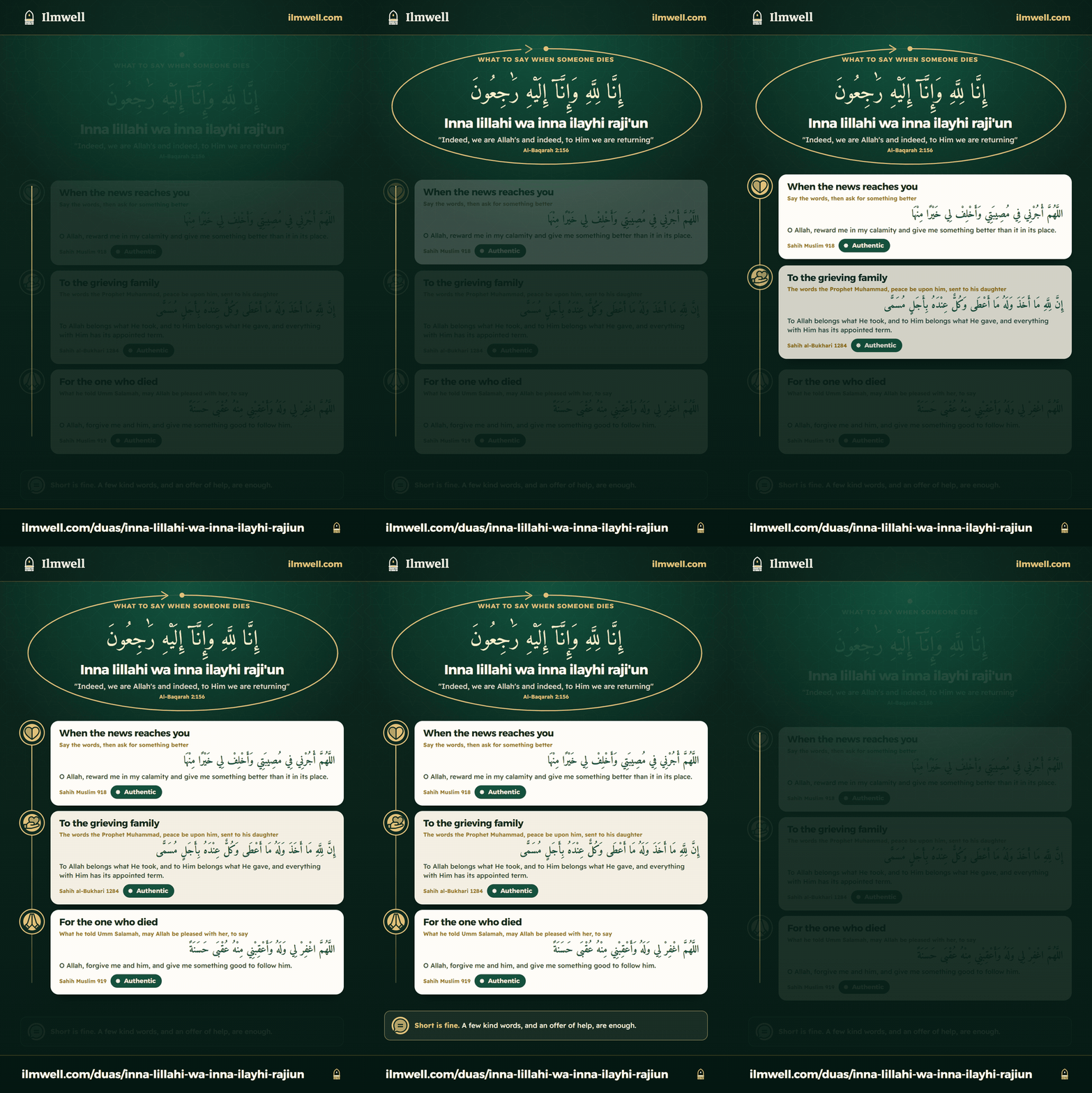
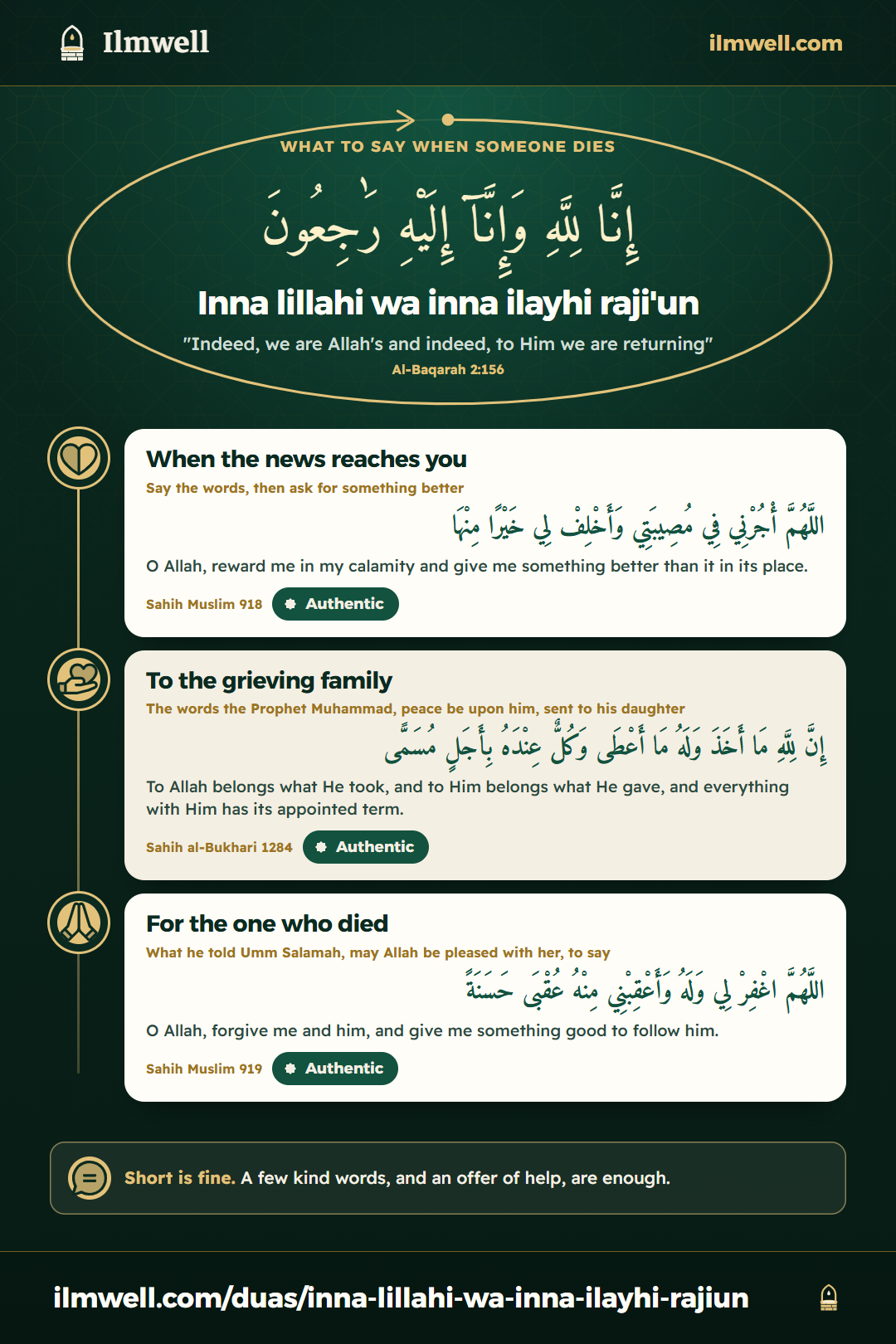
Wordings from authentic hadith for three moments.
To the grieving family
Usamah ibn Zayd, may Allah be pleased with him, reported that a daughter of the Prophet sent word that her son was dying and asked him to come. He sent his greeting with these words, and said she should be patient and hope for Allah's reward:
Sahih al-Bukhari 1284
إِنَّ لِلَّهِ مَا أَخَذَ وَلَهُ مَا أَعْطَى وَكُلٌّ عِنْدَهُ بِأَجَلٍ مُسَمًّى
inna lillāhi mā akhadha wa lahu mā aʿṭā, wa kullun ʿindahu bi-ajalin musammā
To Allah belongs what He took, and to Him belongs what He gave, and everything with Him has its appointed term.
When the boy was brought to him, the Prophet's eyes overflowed with tears. Sa'd ibn 'Ubadah, may Allah be pleased with him, asked what this was. He said it is a mercy Allah has placed in the hearts of His servants.
2AuthenticSahih al-Bukhari 1284
For the person who died
The Prophet said that when you are with someone who is ill or has died, say good, because the angels say amin to what you say. When Abu Salamah died, he told Umm Salamah to say:
اللَّهُمَّ اغْفِرْ لِي وَلَهُ وَأَعْقِبْنِي مِنْهُ عُقْبَى حَسَنَةً
Allāhumma ghfir lī wa lahu wa aʿqibnī minhu ʿuqbā ḥasanah: O Allah, forgive me and him, and give me something good to follow him.
3AuthenticSahih Muslim 919
For yourself
Inna lillahi wa inna ilayhi raji'un, and the dua of Umm Salamah.
Message examples
Say a friend texts that her father has died. You might write:
- "Inna lillahi wa inna ilayhi raji'un. I am so sorry about your dad. To Allah belongs what He took and what He gave. I am here for anything you need."
- To a colleague who is not Muslim: "I am so sorry for your loss. Thinking of you and your family."
Short is fine: a few kind words are enough.
The first time I used Inna lillahi properly, rather than just hearing it, was on a call with a friend who had bad news. I did not know what else to say, and those words were there. They gave us both something to hold.
Try it: what would you say?
Three gentle questions. Pick an answer; each one explains itself.
1Your aunt rings to say a family friend has passed away. What do you say?
Answer: Inna lillahi wa inna ilayhi raji'un. These are the words of Al-Baqarah 2:156, said "when a misfortune strikes".
2What does raji'un mean?
Answer: Returning. "And to Him we are returning": the phrase ends with the return to Allah.
3Which words did the Prophet send to his grieving daughter?
Answer: Inna lillahi ma akhadha wa lahu ma a'ta. "To Allah belongs what He took, and to Him belongs what He gave." Source 2
Questions people ask
How do you spell Inna lillahi wa inna ilayhi raji'un?
Inna lillahi wa inna ilayhi raji'un is the usual English spelling. You will also see Inna lillahi wa inallah-e-raji'oon, Inna lillahi wa in allah-e-rajioon, Innalillahiwainnailaihirojiun, Inalillahi wainailaihi rajiun, Ina lilah waina allah rajiun and Inna lillahi wa inna ilaihi rajioon. They are all ways of writing the same Arabic words from Al-Baqarah 2:156.
Can you say Inna lillahi when a non-Muslim dies?
Al-Baqarah 2:156 and Sahih Muslim 918 (graded sahih) speak of any calamity that strikes the speaker. For your own situation, ask a scholar you trust. To a non-Muslim family, "I am so sorry for your loss" is easy to understand.
How do you reply when someone says Inna lillahi wa inna ilayhi raji'un?
The sources on this page give no fixed reply; a kind word or an offer of help fits.
Sources
Every claim on this page comes from one of these. Gradings are reported with the scholar's name; we do not grade hadith ourselves.
- 1
Umm Salamah heard the Prophet say that any Muslim struck by a calamity who says what Allah has commanded, 'inna lillahi wa inna ilayhi raji'un, Allahumma'jurni fi musibati wa akhlif li khayran minha', is given something better in its place by Allah; when Abu Salamah died she said it, and Allah gave her the Messenger of Allah in his place.
Sahih Muslim 918 Book 11, Hadith 4
Authentic: in Sahih Muslim (Muslim); Sahih (Muslim); sahih (Al-Albani); established (Ibn Baz); sahih (Ibn 'Uthaymin); its chain is sahih to Muslim's standard (Shu'ayb al-Arna'ut)
- 2
Usamah ibn Zayd reported that when a daughter of the Prophet sent for him because her son was dying, he sent her his greeting with the words 'inna lillahi ma akhadha wa lahu ma a'ta, wa kullun 'indahu bi-ajalin musamma', and said she should be patient and hope for Allah's reward.
Sahih al-Bukhari 1284 Book 23, Hadith 44
Authentic: in Sahih al-Bukhari (Al-Bukhari); Sahih (Al-Bukhari); sahih (Al-Albani); sahih (Muhammad Jarullah al-Sa'di); sahih (Ibn Kathir); its chain is sahih to the standard of al-Bukhari and Muslim (Shu'ayb al-Arna'ut)
- 3
Umm Salamah reported that the Prophet said that when you are with someone who is ill or has died, say good, for the angels say amin to what you say; when Abu Salamah died he told her to say 'Allahumma ighfir li wa lahu wa a'qibni minhu 'uqba hasanah'.
Sahih Muslim 919 Book 11, Hadith 7
Authentic: in Sahih Muslim (Muslim); Sahih (Muslim); sahih (Al-Albani); its chain is sahih to the standard of al-Bukhari and Muslim (Shu'ayb al-Arna'ut); included in his Sahih (Ibn Hibban); to the standard of al-Bukhari and Muslim (Al-Dhahabi). Remarks: he was silent about it, which by his own stated rule means fit to use (Abu Dawud); he was silent about it; his introduction says its narrators are trustworthy (Al-Hakim)
- Q
Quran Arabic for Al-Baqarah 2:155 to 157 (the Arabic in the scroll, the word cards and the verse block), and their English.
Tanzil Project Uthmani text, CC BY 3.0. English: adapted from Marmaduke Pickthall's translation (1930), modernised and checked against modern translations.
Next
For your own situation, ask a scholar you trust.
Join the email list
New guides by email, now and then. No spam, and you can leave at any time.
Ilmwell is free and kept going by readers. See how to support it.