The short answer
Surah Kafiroon, also spelt Al-Kafirun, is the 109th surah of the Quran, six verses beginning "Say: O disbelievers!" (Al-Kafirun 109:1, meaning surah 109, verse 1). It ends: "To you your religion, and to me my religion". Sunan Abi Dawud 5055, graded differently (scholars disagree on its grade), has the Prophet Muhammad, peace be upon him, telling Nawfal to recite it before sleep.
What is Surah Kafiroon in English, Arabic and transliteration?
Al-Kafirun 109:1 to 6
قُلْ يَـٰٓأَيُّهَا ٱلْكَـٰفِرُونَ لَآ أَعْبُدُ مَا تَعْبُدُونَ وَلَآ أَنتُمْ عَـٰبِدُونَ مَآ أَعْبُدُ وَلَآ أَنَا۠ عَابِدٌ مَّا عَبَدتُّمْ وَلَآ أَنتُمْ عَـٰبِدُونَ مَآ أَعْبُدُ لَكُمْ دِينُكُمْ وَلِىَ دِينِ
Qul yā ayyuha l-kāfirūn. Lā aʿbudu mā taʿbudūn. Wa lā antum ʿābidūna mā aʿbud. Wa lā ana ʿābidum mā ʿabattum. Wa lā antum ʿābidūna mā aʿbud. Lakum dīnukum wa liya dīn.
Say: O disbelievers! I do not worship that which you worship; Nor do you worship that which I worship. And I shall not worship that which you worship. Nor will you worship that which I worship. To you your religion, and to me my religion.
Al-Kafirun is surah 109, with six verses. To copy and paste the Arabic text, use the button under the scroll. Like most surahs it is printed under Bismillah, which is not counted among its six verses.
What does Surah Kafiroon mean, verse by verse?
Here is the Surah Kafiroon transliteration, one verse at a time, with what each line says.
- 1
قُلْ يَـٰٓأَيُّهَا ٱلْكَـٰفِرُونَ
Qul yā ayyuhal-kāfirūn
Say: O disbelievers!
The surah opens with the command qul, "say", as Al-Ikhlas, Al-Falaq and An-Nas do. The ones addressed are named in the verse: the disbelievers.
- 2
لَآ أَعْبُدُ مَا تَعْبُدُونَ
Lā aʿbudu mā taʿbudūn
I do not worship that which you worship.
The first statement: what is worshipped by "you" is not worshipped by "I".
- 3
وَلَآ أَنتُمْ عَـٰبِدُونَ مَآ أَعْبُدُ
Wa lā antum ʿābidūna mā aʿbud
Nor do you worship that which I worship.
The mirror of verse 2: what "I" worship, "you" do not.
- 4
وَلَآ أَنَا۠ عَابِدٌ مَّا عَبَدتُّمْ
Wa lā ana ʿābidum mā ʿabattum
And I shall not worship that which you worship.
The Arabic changes the last word to ʿabattum, and this translation renders the verse with "shall not".
- 5
وَلَآ أَنتُمْ عَـٰبِدُونَ مَآ أَعْبُدُ
Wa lā antum ʿābidūna mā aʿbud
Nor will you worship that which I worship.
In Arabic these are the same words as verse 3. This translation renders verse 5 with "will not".
- 6
لَكُمْ دِينُكُمْ وَلِىَ دِينِ
Lakum dīnukum wa liya dīn
To you your religion, and to me my religion.
The last verse: "To you your religion, and to me my religion." It is the shortest line in the surah.
The first verse is three words:
Arabic reads right to left, so the first word is on the right.
- قُلْqulsayAn instruction: say these words.
- يَـٰٓأَيُّهَاyā ayyuhāOA call to those addressed.
- ٱلْكَـٰفِرُونَal-kāfirūnthe disbelieversThe ones addressed. The surah takes its name from this word.

Why was Surah Kafiroon revealed?
The surah itself names who is addressed, the disbelievers, and it is a declaration: what each side worships is not shared, and the religions stay separate. Reports about the occasion on which it was revealed come from tafsir (Quran commentary), and we cite none of them on this page. A page setting out the commentaries, each view with its named work and its grade, is coming.
I learnt Al-Kafirun for the Fajr sunnah prayer and said it for years without thinking about the last line. When a friend at school asked what it meant, I had to look it up.
Try it: Surah Kafiroon in four questions
Four quick questions on the surah and its reports. Each answer explains itself.
1How many verses does Surah Al-Kafirun have?
Answer: Six. Six. It is surah 109, one of the short surahs near the end of the Quran.
2How does the surah end?
Answer: To you your religion, and to me my religion. Verse 6: lakum dinukum wa liya din. The other two are verse 1 and verse 4 of Al-Ikhlas.
3Which two surahs did the Prophet recite in the two rak'ahs before Fajr, according to Sahih Muslim 726?
Answer: Al-Kafirun and Al-Ikhlas. Sahih Muslim 726, graded sahih: he recited Qul ya ayyuhal-kafirun and Qul huwa Allahu ahad in the two rak'ahs of dawn. Source 2
4What reason does Sunan Abi Dawud 5055 give for reciting Al-Kafirun before sleep?
Answer: It is a declaration of freedom from associating partners with Allah. The report names that reason and no other. It is graded differently, with the split shown below. Source 1
What do the reports about Surah Kafiroon say?
Three reports are cited here: one graded sahih and two graded differently. None promises a worldly reward.
Before Fajr
Abu Hurayrah, may Allah be pleased with him, reported that the Prophet recited Qul ya ayyuhal-kafirun and Qul huwa Allahu ahad in the two rak'ahs (units of prayer) of dawn, the Fajr sunnah. The report does not say he did it every day.
2AuthenticSahih Muslim 726
Before sleeping
Farwa ibn Nawfal reported from his father that the Prophet told Nawfal, may Allah be pleased with him, to recite Qul ya ayyuhal-kafirun and then go to sleep at its end. The stated reason is that it is a declaration of freedom from associating partners with Allah. The report gives no count and promises no reward. It is graded differently: four graders accept it, in six gradings, and one calls its chain disturbed and not established.
A fourth of the Quran
Ibn Abbas, may Allah be pleased with him, reported that the Prophet said Al-Zalzalah equals half of the Quran, Al-Ikhlas a third and Al-Kafirun a fourth. It is graded differently, and the gradings are set out on the four Quls.
No report cited here joins Al-Kafirun to Al-Ikhlas, Al-Falaq and An-Nas as one set. The page the four Quls sets the four side by side, and Surah Ikhlas has its own lesson.
How do you learn Surah Kafiroon by heart?
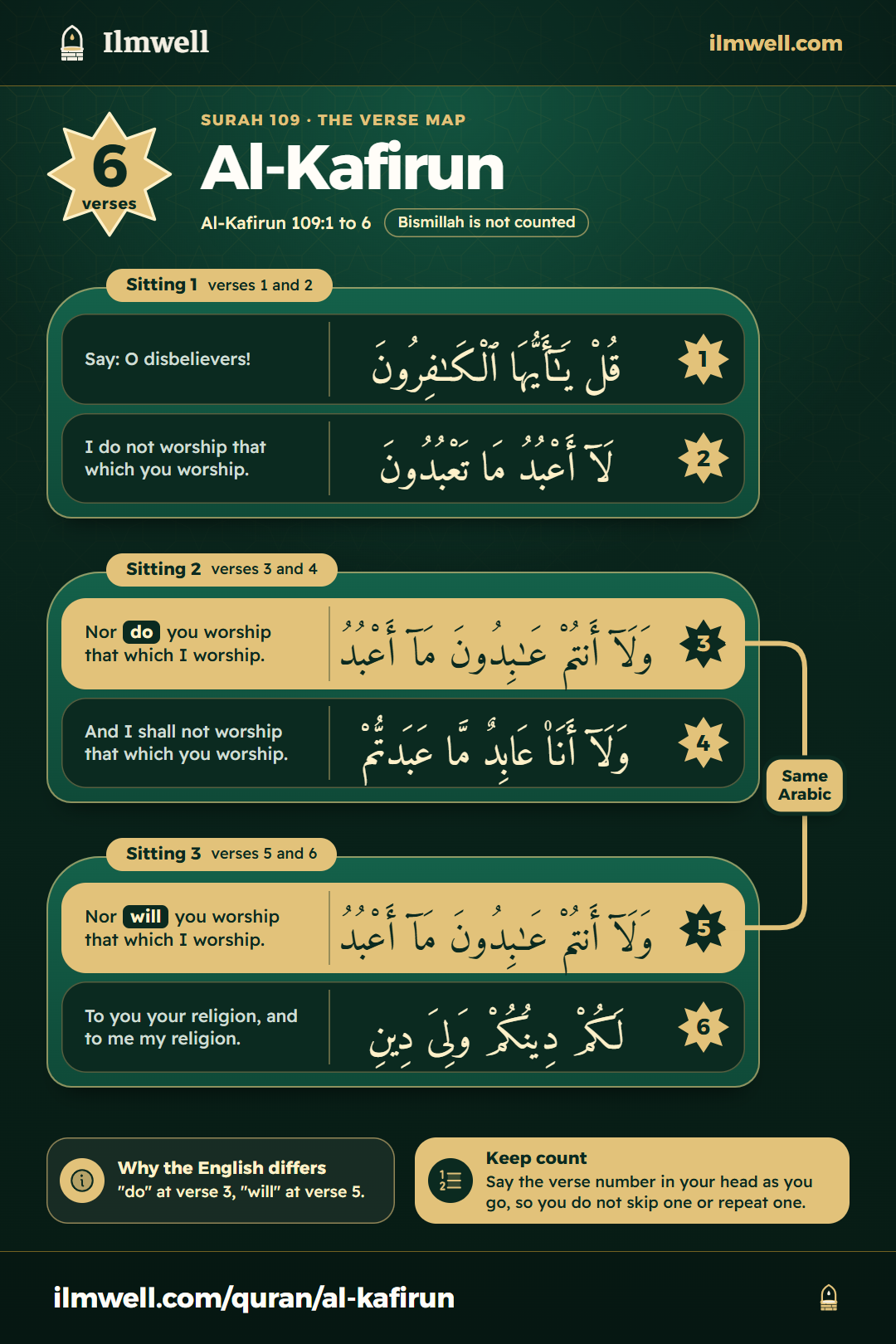
It is short, but verses 2 to 5 sound alike, so a simple way to learn it is in three short sittings: verses 1 and 2, then 3 and 4, then 5 and 6. Read along with the transliteration above, a verse at a time, and slow down for these sounds:
- ʿ in aʿbudu, taʿbudūn and ʿābid: a tightening deep in the throat.
- The long ā and ū in kāfirūn and taʿbudūn are held for two beats.
- Verses 3 and 5 are the same Arabic words. Say the verse number in your head as you go, so you do not skip one or repeat one.
Listen and repeat. A recording by a fluent human reciter is coming. We do not use a synthetic voice for the Quran.
Common mix-ups
- Al-Kafirun is surah 109. Al-Ikhlas is 112, and Al-Falaq and An-Nas are 113 and 114.
- The surah is also written Kafiroon, Kafirun, Surat al-Kafirun and Surah Kafirun. All mean this surah.
- Verses 3 and 5 are the same Arabic words, so a reciter has to keep count of where they are.
Questions people ask
What is the meaning of Surah Kafiroon?
Surah Kafiroon, or Al-Kafirun, is six verses that open "Say: O disbelievers!" and state that what each side worships is not shared, ending "To you your religion, and to me my religion." The spellings Kafiroon, Kafirun and Surat al-Kafirun all mean this surah, number 109.
Is Surah Kafirun a quarter of the Quran?
One report says so: Jami at-Tirmidhi 2894, from Ibn Abbas, may Allah be pleased with him, gives Al-Kafirun a fourth. It is graded differently, with some graders accepting something in it and others faulting it. The gradings are on the four Quls page.
What do you recite before sleeping?
Sunan Abi Dawud 5055 has the Prophet, peace be upon him, telling Nawfal to recite Al-Kafirun and go to sleep at its end. The report is graded differently. A separate report, Sahih al-Bukhari 5017, graded sahih, has him reciting Al-Ikhlas, Al-Falaq and An-Nas into his palms at bedtime.
Sources
Every claim on this page comes from one of these. Gradings are reported with the scholar's name; we do not grade hadith ourselves.
- 1
Farwa ibn Nawfal reported from his father Nawfal that the Prophet told Nawfal to recite Surah Al-Kafirun and then go to sleep at its end, because it is a declaration of freedom from associating partners with Allah (bara'a min al-shirk).
Sunan Abi Dawud 5055 Book 43, Hadith 283
Graded differently. Here is who graded it which way:
- SoundAl-Albani, Ibn Hajar al-'Asqalani, Shu'ayb al-Arna'ut, Al-Mundhiri
- Weak chain, strengthenedAl-Albani
- WeakIbn 'Abd al-Barr
- Other remarksAbu Dawud
See each grading in full, with its wording and where it was given
Scholars disagree about this hadith. Here is how each graded it, so you can follow the scholar you trust.
- صحيح (sahih): Al-Albani, as shown on sunnah.com
- صحيح (sahih): Al-Albani, صحيح أبي داود 5055 (as listed on dorar.net)
- سكت عنه [وقد قال في رسالته لأهل مكة كل ما سكت عنه فهو صالح] (silent about it): Abu Dawud, سنن أبي داود 5055 (as listed on dorar.net)
- حسن (hasan): Ibn Hajar al-'Asqalani, الفتوحات الربانية 3/155 (as listed on dorar.net)
- حسن على اضطراب في إسناده (hasan): Shu'ayb al-Arna'ut, تخريج سنن أبي داود 5055 (as listed on dorar.net)
- حسن لغيره (hasan li-ghayrihi): Al-Albani, صحيح الترغيب 605 (as listed on dorar.net)
- مضطرب الإسناد، لا يثبت (its chain is disturbed and it is not established): Ibn 'Abd al-Barr, مختصر سنن أبي داود 3/ 390 (as listed on dorar.net)
- [ لا ينزل عن درجة الحسن وقد يكون على شرط الصحيحين أو أحدهما] (verdict as listed on dorar.net): Al-Mundhiri, الترغيب والترهيب 1/282 (as listed on dorar.net)
- 2
Abu Hurayrah reported that the Prophet recited Qul ya ayyuhal-kafirun and Qul huwa Allahu ahad in the two supererogatory rak'ahs of dawn (the Fajr sunnah).
Sahih Muslim 726 Book 6, Hadith 120
Authentic: in Sahih Muslim
- 3
Ibn Abbas narrated, through Yaman ibn al-Mughirah from Ata, that the Prophet said Idha zulzilat (Al-Zalzalah) equals half of the Quran, Qul huwa Allahu ahad (Al-Ikhlas) a third and Qul ya ayyuhal-kafirun (Al-Kafirun) a fourth. Graded differently: the full report and the shortened extract are kept apart.
Jami' at-Tirmidhi 2894 Book 45, Hadith 20
Graded differently. Here is who graded it which way:
- SoundAl-Hakim
- Weak chain, strengthenedAl-Albani
- WeakDarussalam, Al-Bayhaqi, Al-Albani, Al-Mubarakfuri, Sadr al-Din al-Munawi
- Other remarksAl-Tirmidhi
See each grading in full, with its wording and where it was given
Scholars disagree about this hadith. Here is how each graded it, so you can follow the scholar you trust.
- Da'if (da'if; full report): Darussalam, as shown on sunnah.com (full report)
- صحيح الإسناد (its chain is sahih; full report): Al-Hakim, al-Mustadrak 1/754, no. 2078 (as reproduced on dorar.net)
- يمان بن المغيرة غير قوي (Yaman ibn al-Mughirah is not strong; full report): Al-Bayhaqi, Shu'ab al-Iman 2/981 (as listed on dorar.net)
- ضعيف (da'if; full report): Al-Albani, Da'if al-Jami' 531 (as listed on dorar.net)
- منكر (munkar; full report): Al-Albani, al-Silsila al-Da'ifa 1342 (as listed on dorar.net)
- يمان بن المغيرة منكر الحديث، استحق الترك (Yaman ibn al-Mughirah is munkar al-hadith and deserves to be left, quoting al-Bukhari and Abu Hatim; full report): Al-Mubarakfuri, Tuhfat al-Ahwadhi 7/313 (as listed on dorar.net)
- مداره على يمان ويمان ضعيف (it turns on Yaman, and Yaman is weak; full report): Sadr al-Din al-Munawi, Kashf al-Manahij wa al-Tanaqih 2/234 (as listed on dorar.net)
- حسن لغيره (hasan li-ghayrihi; shortened extract on Al-Ikhlas and Al-Kafirun): Al-Albani, Sahih al-Targhib 1477 (as listed on dorar.net)
- غريب لا نعرفه إلا من حديث يمان بن المغيرة (gharib; we know it only through Yaman ibn al-Mughirah): Al-Tirmidhi, Jami' at-Tirmidhi 2894 (his comment on the full report)
- Q
Quran Arabic for Al-Kafirun 109:1 to 6 (the scroll, the verse list and the word cards), without the Bismillah the Tanzil copy prints at the head of verse 1, and its English.
Tanzil Project Uthmani text, CC BY 3.0. English: adapted from Marmaduke Pickthall's translation (1930), modernised and checked against modern translations.
Next
- Al-Ikhlas: meaning, themes and reported virtuesQuran lesson
- The four Quls: Arabic, meaning and reported virtuesQuran lesson
- Surah Falaq and Surah Nas: meaning and contextQuran lesson
- Ayat al-Kursi: meaning and reported virtuesQuran lesson
- Bismillah: meaning and when to say it
- Surah Nasr (An-Nasr): meaning and learningQuran lesson
- Quran and SurahsThe hub
For your own situation, ask a scholar you trust.
Join the email list
New guides by email, now and then. No spam, and you can leave at any time.
Ilmwell is free and kept going by readers. See how to support it.