The short answer
Durood Ibrahim, also spelt Durood e Ibrahim, Durood-e-Ibrahim or Darood Ibrahim, is the prayer asking Allah to bless the Prophet Muhammad, peace be upon him, and his family. The wording below is from Sahih al-Bukhari 3370, graded sahih (authentic). The four schools differ on the status of sending blessings on the Prophet in the final tashahhud.
What is Durood Ibrahim in Arabic, transliteration and English?
This is the complete wording in Sahih al-Bukhari 3370, with the English meaning in our own words. Ibrahim, peace be upon him, is the prophet known in English as Abraham.
اللَّهُمَّ صَلِّ عَلَى مُحَمَّدٍ، وَعَلَى آلِ مُحَمَّدٍ، كَمَا صَلَّيْتَ عَلَى إِبْرَاهِيمَ وَعَلَى آلِ إِبْرَاهِيمَ، إِنَّكَ حَمِيدٌ مَجِيدٌ اللَّهُمَّ بَارِكْ عَلَى مُحَمَّدٍ، وَعَلَى آلِ مُحَمَّدٍ، كَمَا بَارَكْتَ عَلَى إِبْرَاهِيمَ، وَعَلَى آلِ إِبْرَاهِيمَ، إِنَّكَ حَمِيدٌ مَجِيدٌ
Transliteration: Allāhumma ṣalli ʿalā Muḥammadin wa ʿalā āli Muḥammad, kamā ṣallayta ʿalā Ibrāhīma wa ʿalā āli Ibrāhīm, innaka ḥamīdun majīd. Allāhumma bārik ʿalā Muḥammadin wa ʿalā āli Muḥammad, kamā bārakta ʿalā Ibrāhīma wa ʿalā āli Ibrāhīm, innaka ḥamīdun majīd.
Meaning: O Allah, bestow Your favour upon Muhammad and the family of Muhammad, as You bestowed Your favour upon Ibrahim and the family of Ibrahim. You are Praiseworthy, Glorious. O Allah, grant blessing to Muhammad and the family of Muhammad, as You granted blessing to Ibrahim and the family of Ibrahim. You are Praiseworthy, Glorious.
1AuthenticSahih al-Bukhari 3370
What do the words of Durood Ibrahim mean?
Say your nephew asks, halfway through a long drive, what the words you have known since childhood actually say. The two halves ask Allah for favour and for blessing, and both end by praising Him.
Arabic reads right to left, so the first word is on the right.
- اللَّهُمَّAllāhummaO Allah
- صَلِّ عَلَىṣalli ʿalāBestow Your favour upon
- مُحَمَّدٍMuḥammadinMuhammad
- وَعَلَى آلِ مُحَمَّدٍwa ʿalā āli MuḥammadAnd upon Muhammad's family
- كَمَا صَلَّيْتَkamā ṣallaytaAs You bestowed Your favour
- عَلَى إِبْرَاهِيمَʿalā IbrāhīmaUpon Ibrahim
- وَعَلَى آلِ إِبْرَاهِيمَwa ʿalā āli IbrāhīmAnd upon Ibrahim's family
- إِنَّكَ حَمِيدٌ مَجِيدٌinnaka ḥamīdun majīdYou are Praiseworthy, Glorious
- بَارِكْ عَلَىbārik ʿalāGrant blessing to
- كَمَا بَارَكْتَkamā bāraktaAs You granted blessing
How do you pronounce Durood Ibrahim?
Learn the opening as three small pieces: Allāhumma / ṣalli ʿalā / Muḥammadin. Then add the family phrase before moving to the comparison with Ibrahim.
allāhummaṣalliʿalāmuḥammadin
- ā is a long vowel; ḥ is a breathy h from the throat.
- ʿ is the letter ʿayn, a tight sound from the throat.
Listen and repeat. Transliteration is a reading aid, so ask a fluent teacher to listen to your Arabic. A recorded pronunciation by a fluent reciter is coming. We do not use a synthetic voice for Arabic.
When is Durood Ibrahim said in salah?
On sunnah.com, Sahih Muslim 406a sits under the chapter heading "sending blessings on the Prophet after the tashahhud", the seated testimony in prayer. The four schools differ on the status of sending blessings in the final sitting.
2AuthenticSahih Muslim 406a
| School | Blessings on the Prophet | Adding his family |
|---|---|---|
| Hanafi | Sunnah, stated for the blessings on the Prophet and his family together, the Ibrahimi blessings (al-Zuhayli, p. 894 online) | |
| Maliki | Sunnah after the final tashahhud; each tashahhud is also a sunnah of its own (al-Zuhayli, p. 894 online) | Not stated separately on that page |
| Shafi'i | Obligatory (wajib) in the final tashahhud (al-Zuhayli, p. 894 online) | Sunnah (al-Zuhayli, p. 894 online) |
| Hanbali | Obligatory (wajib) in the final tashahhud (al-Zuhayli, p. 894 online) | Obligatory (al-Zuhayli, p. 894 online) |
This table is about sending blessings on the Prophet and his family. It does not say that every word of the full formula has the same status. For a mistake in your own prayer, ask a scholar you trust.
The words before it are in Tashahhud and Attahiyat, the calls before prayer in Adhan and Iqamah, the whole sequence in how to pray salah and another prayer text in the dua qunoot lesson.
Why does another version sound different?
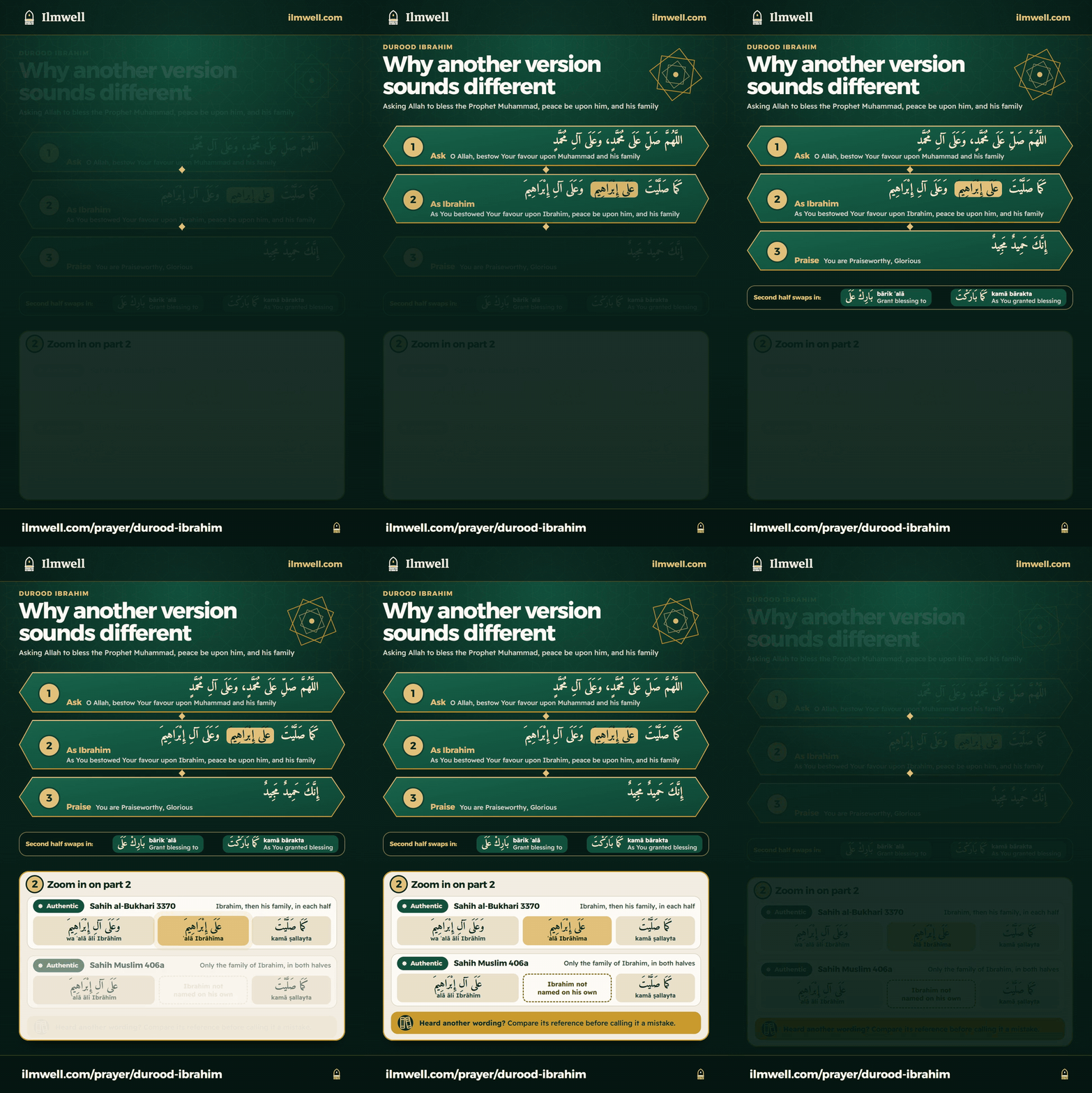
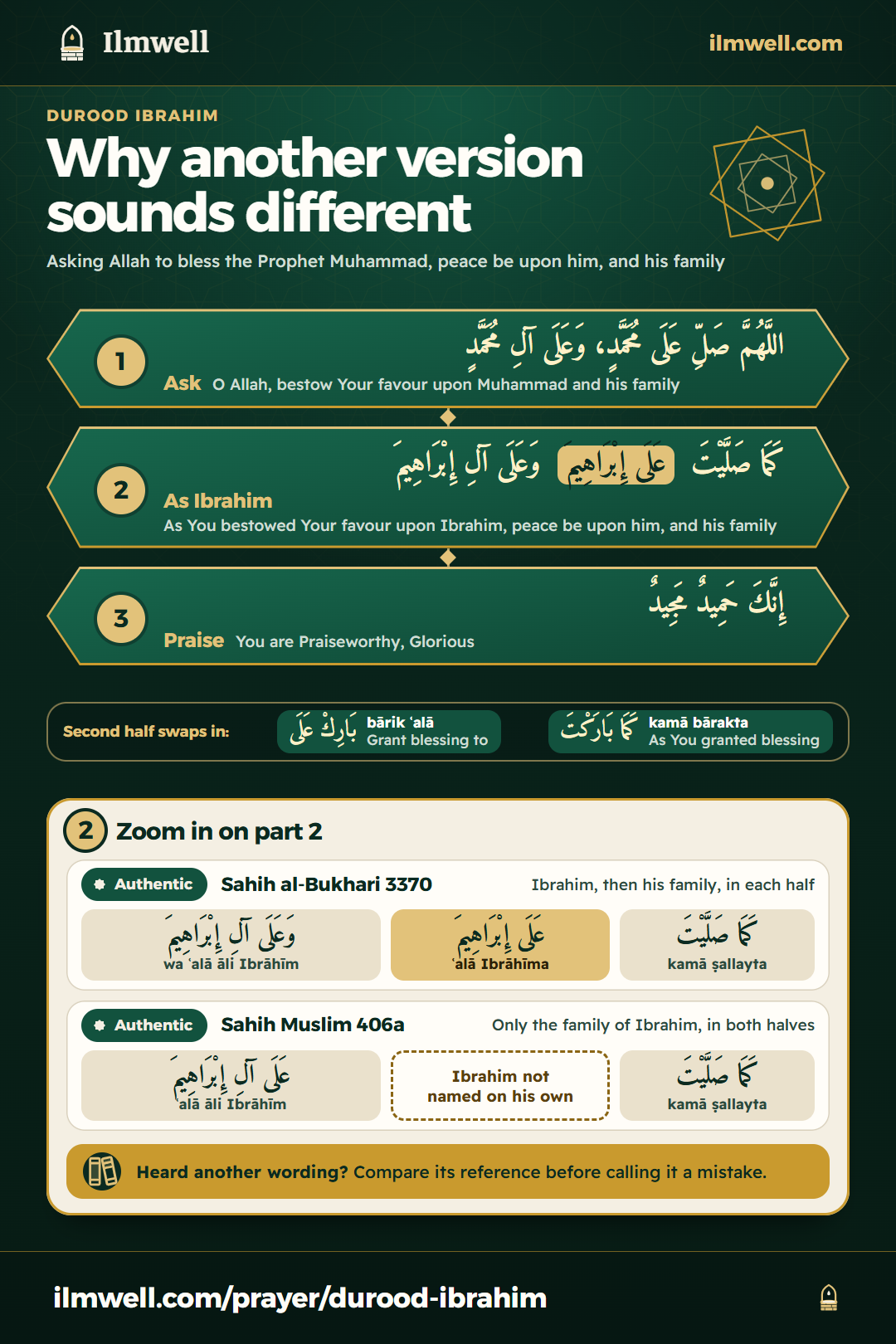
More than one wording appears in authentic reports. The version above names Ibrahim and his family in each half. Sahih Muslim 406a has only ʿalā āli Ibrāhīm, the family of Ibrahim, in both places, and it is graded sahih (authentic).
2AuthenticSahih Muslim 406a
Learn one complete sourced version. If your teacher taught another wording, compare its own reference before calling the difference a mistake.
What do hadith say about sending blessings?
Sahih Muslim 408 reports the Prophet saying that whoever sends one blessing on him, Allah will bless that person ten times. It is graded sahih.
3AuthenticSahih Muslim 408
The report is about sending blessings in general. It gives no wording, so it attaches no exclusive reward or fixed daily count to the formula above.
You may meet the spellings darood sharif, durood shareef or salawat. This lesson teaches only the Ibrahim wording. Forty Durood, Durood Taj, Durood Tanjina (also spelt Tunjina) and other named collections are separate texts that need their own source checks, which are not made here.
I learnt Durood Ibrahim at the end of prayer as a long string of sounds. It was years before I slowed down and noticed the line comparing it to Ibrahim and his family.
Practice: recognise the wording
1Who is being asked to bless Muhammad in Durood Ibrahim?
Answer: Allah. Both halves open with Allahumma, "O Allah". Source 1
2Which report has only "the family of Ibrahim", without naming Ibrahim first?
Answer: Sahih Muslim 406a. Sahih Muslim 406a has ala ali Ibrahim in both halves; Sahih al-Bukhari 3370 names both. Source 2
3Does the ten-blessings report give a count for reciting this full formula?
Answer: No. Sahih Muslim 408 speaks of one blessing on the Prophet and ten in return. It gives no wording and no count. Source 3
Questions people ask
Is Durood Ibrahim the same as Tashahhud?
No, they are separate texts. The tashahhud is the seated testimony; the sunnah.com chapter heading for Sahih Muslim 406a files the blessings after it.
Is the English meaning the transliteration?
No. Transliteration shows Arabic sounds in Latin letters, such as Allāhumma ṣalli. The English meaning says what those words mean. Keep both beside the Arabic while learning.
What dua comes after Durood Ibrahim?
Sahih Muslim 588a, graded sahih (authentic), has the Prophet say that when any of you says the tashahhud he should seek refuge with Allah from four things. One sourced wording is Allāhumma innī aʿūdhu bika min ʿadhābi jahannama wa min ʿadhābil-qabri wa min fitnatil-maḥyā wal-mamāti wa min sharri fitnatil-masīḥid-dajjāl. It means: O Allah, I seek Your refuge from the punishment of Hell and of the grave, the trials of life and death and the evil of the trial of the false messiah. The report does not mention the blessings or name the sitting, and it is a separate supplication, not part of Durood Ibrahim. Arabic: اللَّهُمَّ إِنِّي أَعُوذُ بِكَ مِنْ عَذَابِ جَهَنَّمَ وَمِنْ عَذَابِ الْقَبْرِ وَمِنْ فِتْنَةِ الْمَحْيَا وَالْمَمَاتِ وَمِنْ شَرِّ فِتْنَةِ الْمَسِيحِ الدَّجَّالِ
Is Darood Sharif the same as Durood Ibrahim?
Darood sharif, durood sharif and durood shareef are spellings of the name used for sending blessings on the Prophet. Durood Ibrahim is the one wording taught here, from Sahih al-Bukhari 3370, graded sahih. Other texts with durood in the name need their own sources.
Sources
Every claim on this page comes from one of these. Gradings are reported with the scholar's name; we do not grade hadith ourselves.
- 1
Asked how to send blessings (salat) on him and his household, the Prophet taught a wording that includes: Allahumma barik 'ala Muhammad wa 'ala ali Muhammad, kama barakta 'ala Ibrahim wa 'ala ali Ibrahim, innaka hamidun majid.
Sahih al-Bukhari 3370 Book 60, Hadith 44
Authentic: in Sahih al-Bukhari
- 2
Ka'b ibn 'Ujra, may Allah be pleased with him, reported that the Companions told the Prophet they knew how to greet him and asked how to send blessings on him, and the Prophet told them to say: Allahumma salli 'ala Muhammad wa 'ala ali Muhammad, kama sallayta 'ala ali Ibrahim, innaka hamidun majid, followed by the same with barik and barakta.
Sahih Muslim 406a Book 4, Hadith 70
Authentic: in Sahih Muslim
- 3
Abu Hurayrah, may Allah be pleased with him, reported that the Prophet said: whoever sends one blessing on me, Allah will bless him ten times.
Sahih Muslim 408 Book 4, Hadith 74
Authentic: in Sahih Muslim
- 4
Abu Hurayrah, may Allah be pleased with him, reported that the Prophet said: when any of you says the tashahhud he should seek refuge with Allah from four things, from four things, the first two being the punishment of Hell and the punishment of the grave.
Sahih Muslim 588a Book 5, Hadith 162
Authentic: in Sahih Muslim
- 5
Wahbah al-Zuhayli, summarising the four schools in al-Fiqh al-Islami wa Adillatuhu, reports that the Hanafis and the Malikis count blessings on the Prophet at the end of the prayer as sunnah, while the Shafi'is and the Hanbalis count them as required in the final tashahhud; on adding the family, he reports it as sunnah for the Shafi'is and required for the Hanbalis.
Wahbah al-Zuhayli, al-Fiqh al-Islami wa Adillatuhu, online page 894 Record: scholarly-zuhayli-blessings-final-tashahhud. A four-school summary, not a hadith grade.
Next
- Tashahhud and Attahiyat: words and meaningPrayer words
- Adhan and Iqamah: words, meaning and the four schoolsPrayer words
- How to pray salah: the whole prayer, step by stepPractical guide
- Dua qunoot: words, meaning and when to say itDua lesson
- Morning and evening adhkarDua lesson
- The four QulsQuran lesson
- Dua after salah and a simple dhikr guideWords lesson
- Prayer and PurificationThe hub
For your own situation, ask a scholar you trust.
Join the email list
New guides by email, now and then. No spam, and you can leave at any time.
Ilmwell is free and kept going by readers. See how to support it.