The short answer
The Adhan (azan) is the call to prayer, and the Iqamah is the call made as the prayer is held. Sunan Abi Dawud 499 (graded hasan or sahih) gives a 15-phrase Adhan and an 11-phrase Iqamah, by our count, from a dream the Prophet Muhammad, peace be upon him, called a genuine vision. The schools do not all count alike (tables below).
Jump to the dua after the Adhan
What are the Adhan (azan) words in Arabic and English?
Azan and azaan are other spellings of Adhan, the call to prayer. Ibn Qudamah defines it as the known wording laid down for the prayer times, to announce them (al-Mughni, source 12). The Iqamah is the second call. Sunan Abi Dawud 499 (graded hasan or sahih) gives its words as what to say "when you establish the prayer" (our rendering), and the phrase qad qamat as-salah belongs to it.
| Arabic | Transliteration | English meaning |
|---|---|---|
| اللَّهُ أَكْبَرُ | Allāhu akbar | Allah is the Greatest |
| أَشْهَدُ أَنْ لاَ إِلَهَ إِلاَّ اللَّهُ | Ashhadu an lā ilāha illā llāh | I testify that there is no god but Allah |
| أَشْهَدُ أَنَّ مُحَمَّدًا رَسُولُ اللَّهِ | Ashhadu anna Muḥammadan rasūlu llāh | I testify that Muhammad is Allah's Messenger |
| حَىَّ عَلَى الصَّلاَةِ | Ḥayya ʿalā ṣ-ṣalāh | Come to prayer |
| حَىَّ عَلَى الْفَلاَحِ | Ḥayya ʿalā l-falāḥ | Come to success |
| قَدْ قَامَتِ الصَّلاَةُ | Qad qāmati ṣ-ṣalāh | The prayer has been established (Iqamah only) |
| لاَ إِلَهَ إِلاَّ اللَّهُ | Lā ilāha illā llāh | There is no god but Allah |
In the transliteration, ā is a long vowel, ḥ a breathy h and ʿ the letter ʿayn. Learn each phrase with a fluent teacher before saying the whole call. A recording by a fluent reciter is coming.
What does Iqamah mean?
Iqamah is the call made as the prayer is held, after the Adhan. Its own phrase, qad qamat as-salah, means "the prayer has been established" (our rendering). The Iqamah words in Arabic are in the table above and in the complete calls below.
1AuthenticSunan Abi Dawud 499
What is the dua after the Adhan (azan)?
Jabir ibn 'Abd Allah, may Allah be pleased with him, reported that the Prophet said whoever says this on hearing the call, the Prophet's intercession becomes due for him on the Day of Resurrection.
اللَّهُمَّ رَبَّ هَذِهِ الدَّعْوَةِ التَّامَّةِ وَالصَّلاَةِ الْقَائِمَةِ آتِ مُحَمَّدًا الْوَسِيلَةَ وَالْفَضِيلَةَ وَابْعَثْهُ مَقَامًا مَحْمُودًا الَّذِي وَعَدْتَهُ
Transliteration: Allāhumma rabba hādhihi d-daʿwati t-tāmmah, wa ṣ-ṣalāti l-qāʾimah, āti Muḥammadan al-wasīlata wa l-faḍīlah, wa bʿathhu maqāman maḥmūdan alladhī waʿadtah.
Meaning: O Allah, Lord of this complete call and of the prayer that is established, grant Muhammad, peace be upon him, al-Wasilah and the excellence, and raise him to the praised station You promised him.
7AuthenticSahih al-Bukhari 614
The Arabic stops where Bukhari's wording stops. Words people add after it need their own references.
Ibn Rajab, in Sharh 'Ilal al-Tirmidhi, quotes this report and says it has a defect ('illa) that Ibn Abi Hatim mentioned from his father. He reports the criticism: Shu'ayb ibn Abi Hamzah presented a book to Ibn al-Munkadir, who recognised some of it and denied some. Shu'ayb's transmission of those hadiths was not established, and this hadith is among them (source 15).
His own illustration afterwards is another report Shu'ayb related from Ibn al-Munkadir from Jabir, the opening supplication of the prayer, not this one.
What do you say when you hear the Adhan (azan)?
'Umar ibn al-Khattab, may Allah be pleased with him, reported that the Prophet said to repeat the caller's words, except that at hayya 'ala as-salah and hayya 'ala al-falah the listener says:
لاَ حَوْلَ وَلاَ قُوَّةَ إِلاَّ بِاللَّهِ
Transliteration: lā ḥawla wa lā quwwata illā billāh.
Meaning: There is no might and no power except through Allah.
5AuthenticSahih Muslim 385
'Abd Allah ibn 'Amr, may Allah be pleased with him, reported that after repeating the caller's words the listener sends blessings on the Prophet and then asks Allah for al-Wasilah for him (Sahih Muslim 384, Authentic). The report calls al-Wasilah a rank in Paradise fitting for one servant of Allah. One set of words for the blessings is in Durood Ibrahim.
6AuthenticSahih Muslim 384
How do the four schools say the Adhan and the Iqamah?
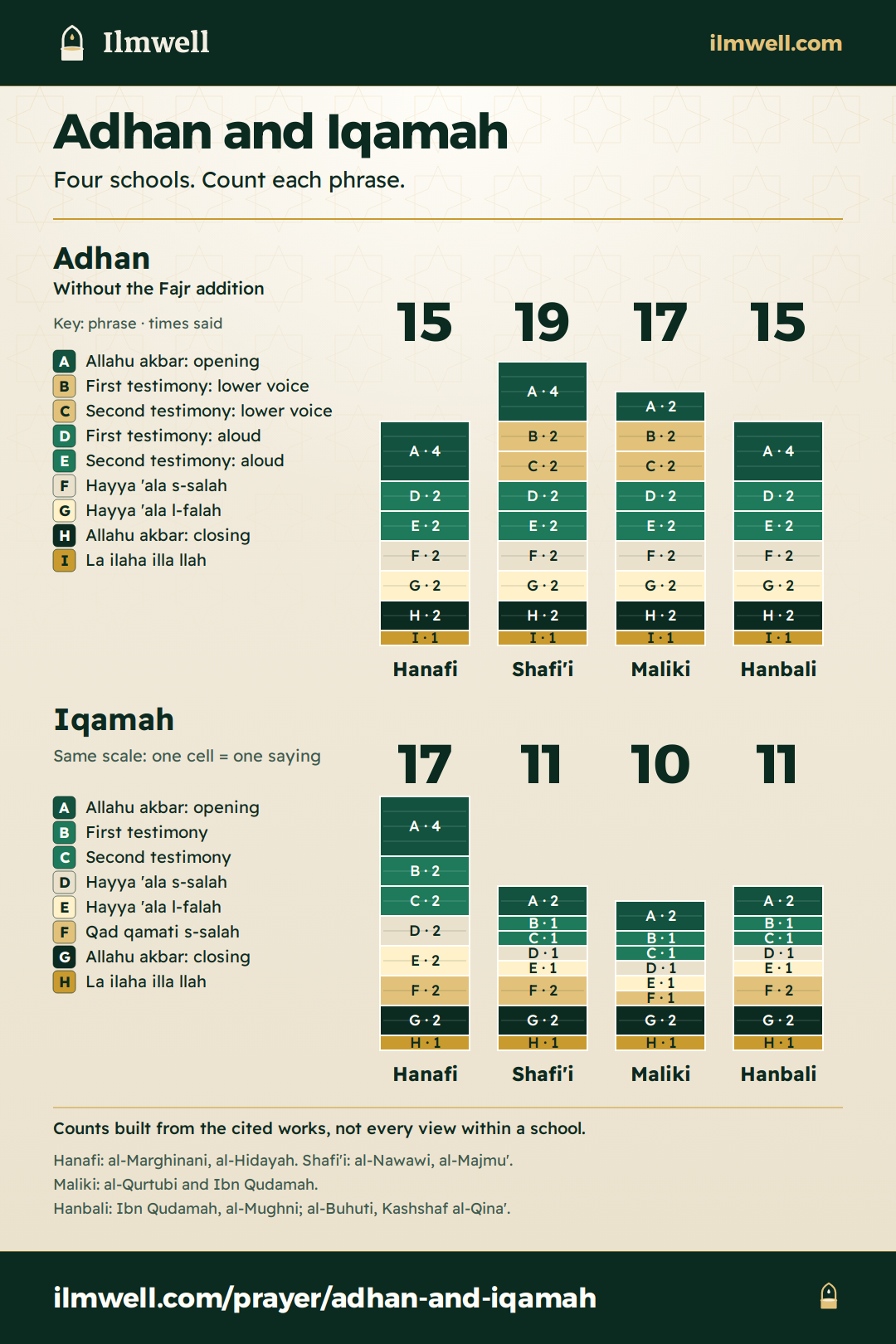
Visit a mosque in another town and its Iqamah may sound different from the one you grew up hearing. Several forms have a source, and the tables show whose count is whose.
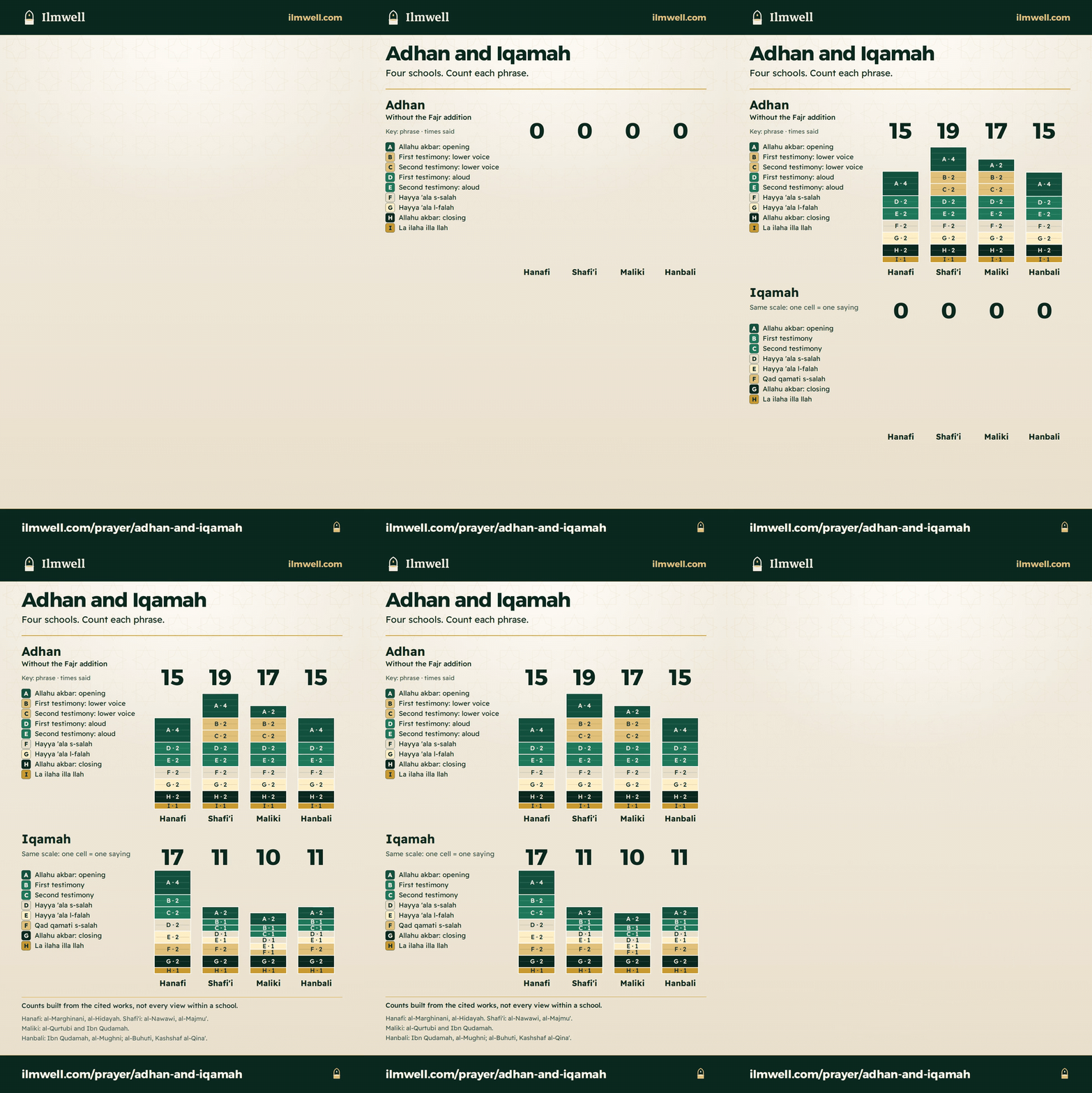
These are counts built from each work's description of the call, and the totals are ours. They are not every position within a school: al-Nawawi alone reports five Shafi'i views on the Iqamah and takes 11 phrases as the sound one.
Takbir means saying Allahu akbar. In the tables, the first testimony is Ashhadu an lā ilāha illā llāh and the second is Ashhadu anna Muḥammadan rasūlu llāh. Tarji' is saying the two testimonies twice in a lower voice, then twice again aloud: Sunan Abi Dawud 500 (graded differently) has them lowered, then raised, while Sahih Muslim 379 (Authentic) repeats them without saying lower. Ibn Qudamah gives the same description (al-Mughni, source 12). None in the table means no separate lower-voice round.
Swipe a table sideways if a column is cut off.
Adhan: how often each phrase is said
| Phrase, in order | Hanafi | Shafi'i | Maliki | Hanbali |
|---|---|---|---|---|
| Allāhu akbar (opening) | 4 | 4 | 2 | 4 |
| First testimony, lower voice | None | 2 | 2 | None |
| Second testimony, lower voice | None | 2 | 2 | None |
| First testimony, aloud | 2 | 2 | 2 | 2 |
| Second testimony, aloud | 2 | 2 | 2 | 2 |
| Ḥayya ʿalā ṣ-ṣalāh | 2 | 2 | 2 | 2 |
| Ḥayya ʿalā l-falāḥ | 2 | 2 | 2 | 2 |
| Allāhu akbar (closing) | 2 | 2 | 2 | 2 |
| Lā ilāha illā llāh | 1 | 1 | 1 | 1 |
| Total (without the Fajr addition) | 15 | 19 | 17 | 15 |
Iqamah: how often each phrase is said
| Phrase, in order | Hanafi | Shafi'i | Maliki | Hanbali |
|---|---|---|---|---|
| Allāhu akbar (opening) | 4 | 2 | 2 | 2 |
| First testimony | 2 | 1 | 1 | 1 |
| Second testimony | 2 | 1 | 1 | 1 |
| Ḥayya ʿalā ṣ-ṣalāh | 2 | 1 | 1 | 1 |
| Ḥayya ʿalā l-falāḥ | 2 | 1 | 1 | 1 |
| Qad qāmati ṣ-ṣalāh | 2 | 2 | 1 | 2 |
| Allāhu akbar (closing) | 2 | 2 | 2 | 2 |
| Lā ilāha illā llāh | 1 | 1 | 1 | 1 |
| Total | 17 | 11 | 10 | 11 |
Where each school's count comes from
- Hanafi: al-Marghinani, al-Hidayah 1/43 (source 10), with the four opening takbirs and the Iqamah in twos from Ibn Rushd 1/112 to 1/113 (source 9) and al-Qurtubi 6/227 (source 14).
- Shafi'i: al-Nawawi, al-Majmu' 3/90 to 3/93 (source 11).
- Maliki: two opening takbirs and tarji' from al-Qurtubi 6/226 (source 14) and Ibn Qudamah 1/294 (source 12). Ibn Rushd 1/117 to 1/118 (source 9) gives the Iqamah's opening takbir twice and the rest once; the 10 phrases rest on Ibn Qudamah 1/295.
- Hanbali: Ibn Qudamah, al-Mughni 1/293 to 1/295 (source 12); al-Buhuti, Kashshaf al-Qina' 2/47 (source 13).
Ibn Rushd records that Ahmad and Dawud took the Adhan forms as a choice (1/114), and Ahmad the same for the Iqamah (1/118) (source 9). Ibn Qudamah calls tarji' a permitted difference: if the caller does it, there is no harm (source 12).
Cells come from the printed editions as read on shamela.ws. The al-Durar al-Saniyya pages (source 16) were opened for context only. Entry 724 groups Hanafis, Shafi'is and Hanbalis for the 15-phrase Adhan (the Shafi'i Adhan is 19, with tarji'), and entry 776 gives the 11-phrase Iqamah also as a narration from Malik, where the table has 10.
What do the reports say?
- Sunan Abi Dawud 499, graded hasan or sahih: by our count from its Arabic, an Adhan of 15 phrases and an Iqamah of 11. Abu Dawud adds that Ma'mar and Yunus report two opening takbirs, not four.
1AuthenticSunan Abi Dawud 499
- Sahih Muslim 379, Authentic: two opening takbirs, the testimonies twice and then repeated twice, then hayya 'ala as-salah and hayya 'ala al-falah twice each. With the ending Ishaq, a narrator in its chain, added (Allahu akbar twice and la ilaha illa Allah), 17 phrases.
2AuthenticSahih Muslim 379
- Jami' at-Tirmidhi 192, graded hasan or sahih: Abu Mahdhurah, may Allah be pleased with him, was taught an Adhan of nineteen phrases and an Iqamah of seventeen. It also records that he is reported to have said the Iqamah singly.
3AuthenticJami' at-Tirmidhi 192
A different count can have a source. These three reports each give their own count, and none is called the only wording.
What are the complete Adhan and Iqamah words for each school?
Each call is written out in Arabic from the counts above, with lower-voice lines first. The transliteration of each phrase is in the words table.
Hanafi: Adhan and Iqamah
Adhan
اللَّهُ أَكْبَرُ، اللَّهُ أَكْبَرُ، اللَّهُ أَكْبَرُ، اللَّهُ أَكْبَرُ
أَشْهَدُ أَنْ لاَ إِلَهَ إِلاَّ اللَّهُ، أَشْهَدُ أَنْ لاَ إِلَهَ إِلاَّ اللَّهُ
أَشْهَدُ أَنَّ مُحَمَّدًا رَسُولُ اللَّهِ، أَشْهَدُ أَنَّ مُحَمَّدًا رَسُولُ اللَّهِ
حَىَّ عَلَى الصَّلاَةِ، حَىَّ عَلَى الصَّلاَةِ
حَىَّ عَلَى الْفَلاَحِ، حَىَّ عَلَى الْفَلاَحِ
اللَّهُ أَكْبَرُ، اللَّهُ أَكْبَرُ
لاَ إِلَهَ إِلاَّ اللَّهُ
Iqamah
اللَّهُ أَكْبَرُ، اللَّهُ أَكْبَرُ، اللَّهُ أَكْبَرُ، اللَّهُ أَكْبَرُ
أَشْهَدُ أَنْ لاَ إِلَهَ إِلاَّ اللَّهُ، أَشْهَدُ أَنْ لاَ إِلَهَ إِلاَّ اللَّهُ
أَشْهَدُ أَنَّ مُحَمَّدًا رَسُولُ اللَّهِ، أَشْهَدُ أَنَّ مُحَمَّدًا رَسُولُ اللَّهِ
حَىَّ عَلَى الصَّلاَةِ، حَىَّ عَلَى الصَّلاَةِ
حَىَّ عَلَى الْفَلاَحِ، حَىَّ عَلَى الْفَلاَحِ
قَدْ قَامَتِ الصَّلاَةُ، قَدْ قَامَتِ الصَّلاَةُ
اللَّهُ أَكْبَرُ، اللَّهُ أَكْبَرُ
لاَ إِلَهَ إِلاَّ اللَّهُ
Shafi'i: Adhan and Iqamah
Adhan
اللَّهُ أَكْبَرُ، اللَّهُ أَكْبَرُ، اللَّهُ أَكْبَرُ، اللَّهُ أَكْبَرُ
Lower voice:
أَشْهَدُ أَنْ لاَ إِلَهَ إِلاَّ اللَّهُ، أَشْهَدُ أَنْ لاَ إِلَهَ إِلاَّ اللَّهُ
Lower voice:
أَشْهَدُ أَنَّ مُحَمَّدًا رَسُولُ اللَّهِ، أَشْهَدُ أَنَّ مُحَمَّدًا رَسُولُ اللَّهِ
أَشْهَدُ أَنْ لاَ إِلَهَ إِلاَّ اللَّهُ، أَشْهَدُ أَنْ لاَ إِلَهَ إِلاَّ اللَّهُ
أَشْهَدُ أَنَّ مُحَمَّدًا رَسُولُ اللَّهِ، أَشْهَدُ أَنَّ مُحَمَّدًا رَسُولُ اللَّهِ
حَىَّ عَلَى الصَّلاَةِ، حَىَّ عَلَى الصَّلاَةِ
حَىَّ عَلَى الْفَلاَحِ، حَىَّ عَلَى الْفَلاَحِ
اللَّهُ أَكْبَرُ، اللَّهُ أَكْبَرُ
لاَ إِلَهَ إِلاَّ اللَّهُ
Iqamah
اللَّهُ أَكْبَرُ، اللَّهُ أَكْبَرُ
أَشْهَدُ أَنْ لاَ إِلَهَ إِلاَّ اللَّهُ
أَشْهَدُ أَنَّ مُحَمَّدًا رَسُولُ اللَّهِ
حَىَّ عَلَى الصَّلاَةِ
حَىَّ عَلَى الْفَلاَحِ
قَدْ قَامَتِ الصَّلاَةُ، قَدْ قَامَتِ الصَّلاَةُ
اللَّهُ أَكْبَرُ، اللَّهُ أَكْبَرُ
لاَ إِلَهَ إِلاَّ اللَّهُ
Maliki: Adhan and Iqamah
Adhan
اللَّهُ أَكْبَرُ، اللَّهُ أَكْبَرُ
Lower voice:
أَشْهَدُ أَنْ لاَ إِلَهَ إِلاَّ اللَّهُ، أَشْهَدُ أَنْ لاَ إِلَهَ إِلاَّ اللَّهُ
Lower voice:
أَشْهَدُ أَنَّ مُحَمَّدًا رَسُولُ اللَّهِ، أَشْهَدُ أَنَّ مُحَمَّدًا رَسُولُ اللَّهِ
أَشْهَدُ أَنْ لاَ إِلَهَ إِلاَّ اللَّهُ، أَشْهَدُ أَنْ لاَ إِلَهَ إِلاَّ اللَّهُ
أَشْهَدُ أَنَّ مُحَمَّدًا رَسُولُ اللَّهِ، أَشْهَدُ أَنَّ مُحَمَّدًا رَسُولُ اللَّهِ
حَىَّ عَلَى الصَّلاَةِ، حَىَّ عَلَى الصَّلاَةِ
حَىَّ عَلَى الْفَلاَحِ، حَىَّ عَلَى الْفَلاَحِ
اللَّهُ أَكْبَرُ، اللَّهُ أَكْبَرُ
لاَ إِلَهَ إِلاَّ اللَّهُ
Iqamah
اللَّهُ أَكْبَرُ، اللَّهُ أَكْبَرُ
أَشْهَدُ أَنْ لاَ إِلَهَ إِلاَّ اللَّهُ
أَشْهَدُ أَنَّ مُحَمَّدًا رَسُولُ اللَّهِ
حَىَّ عَلَى الصَّلاَةِ
حَىَّ عَلَى الْفَلاَحِ
قَدْ قَامَتِ الصَّلاَةُ
اللَّهُ أَكْبَرُ، اللَّهُ أَكْبَرُ
لاَ إِلَهَ إِلاَّ اللَّهُ
Hanbali: Adhan and Iqamah
Adhan
اللَّهُ أَكْبَرُ، اللَّهُ أَكْبَرُ، اللَّهُ أَكْبَرُ، اللَّهُ أَكْبَرُ
أَشْهَدُ أَنْ لاَ إِلَهَ إِلاَّ اللَّهُ، أَشْهَدُ أَنْ لاَ إِلَهَ إِلاَّ اللَّهُ
أَشْهَدُ أَنَّ مُحَمَّدًا رَسُولُ اللَّهِ، أَشْهَدُ أَنَّ مُحَمَّدًا رَسُولُ اللَّهِ
حَىَّ عَلَى الصَّلاَةِ، حَىَّ عَلَى الصَّلاَةِ
حَىَّ عَلَى الْفَلاَحِ، حَىَّ عَلَى الْفَلاَحِ
اللَّهُ أَكْبَرُ، اللَّهُ أَكْبَرُ
لاَ إِلَهَ إِلاَّ اللَّهُ
Iqamah
اللَّهُ أَكْبَرُ، اللَّهُ أَكْبَرُ
أَشْهَدُ أَنْ لاَ إِلَهَ إِلاَّ اللَّهُ
أَشْهَدُ أَنَّ مُحَمَّدًا رَسُولُ اللَّهِ
حَىَّ عَلَى الصَّلاَةِ
حَىَّ عَلَى الْفَلاَحِ
قَدْ قَامَتِ الصَّلاَةُ، قَدْ قَامَتِ الصَّلاَةُ
اللَّهُ أَكْبَرُ، اللَّهُ أَكْبَرُ
لاَ إِلَهَ إِلاَّ اللَّهُ
What is added to the Fajr Adhan (azan)?
Sunan Abi Dawud 500 (graded differently) has Abu Mahdhurah taught to say this twice for the Fajr prayer, after hayya 'ala al-falah and before the closing takbirs.
الصَّلاَةُ خَيْرٌ مِنَ النَّوْمِ
Transliteration: aṣ-ṣalātu khayrun mina n-nawm.
Meaning: Prayer is better than sleep.
4Graded differently Sunan Abi Dawud 500
The report gives the addition for the Adhan and does not mention the Iqamah.
Al-Hidayah 1/43 (Hanafi) adds it after hayya 'ala al-falah. Al-Nawawi, al-Majmu' 3/90 (Shafi'i) calls it sunnah; Ibn Rushd 1/114 reports al-Shafi'i against it, and al-Qurtubi 6/228 gives his Iraq and Egypt positions differently and Malik as saying it. Ibn Qudamah, al-Mughni 1/296 (Hanbali), says it is sunnah to say it twice in the Fajr Adhan after hayya 'ala al-falah and calls it tathwib; al-Buhuti, Kashshaf al-Qina' (Hanbali) says the same.
The first time I heard a different Iqamah, in a mosque in another town, I thought the imam had got it wrong. A friend explained that the schools repeat the phrases differently. I felt a bit daft and quite relieved.
Try it: follow the call
Three quick checks, each with its source.
1At hayya 'ala as-salah, what does Sahih Muslim 385 say the listener says?
Answer: La hawla wa la quwwata illa billah. The listener repeats the caller's words, but answers both invitations, hayya 'ala as-salah and hayya 'ala al-falah, with la hawla wa la quwwata illa billah (Authentic). Source 5
2How often does the Maliki form in the tables say qad qamat as-salah?
Answer: Once. Once for Malik and twice for al-Shafi'i, in Ibn Rushd's account (source 9).
3Where does the Fajr phrase go in the Adhan?
Answer: After hayya 'ala al-falah. Sunan Abi Dawud 500 (graded differently) puts it twice after hayya 'ala al-falah, before the closing takbirs. Source 4
Questions people ask
What is the Iqamah?
The call made when the prayer is held. Sunan Abi Dawud 499 (graded hasan or sahih) introduces its words with aqamta, "when you establish the prayer" (our rendering), so the name follows that verb. The words table above gives each phrase in Arabic, transliteration and English.
Is there a dua between the Adhan and the Iqamah?
Sunan Abi Dawud 521 (graded differently) has Anas ibn Malik, may Allah be pleased with him, report that the Prophet said the supplication made between the Adhan and the Iqamah is not rejected. It names the interval as a time for dua and gives no set wording.
Does the Adhan tell me the exact congregation time?
The Adhan announces the prayer time (Ibn Qudamah, al-Mughni 1/292), and the Iqamah is said when the prayer is held (Sunan Abi Dawud 499, graded hasan or sahih). Your mosque's timetable gives when the congregation prays.
Sources
Every claim on this page comes from one of these. Gradings are reported with the scholar's name; we do not grade hadith ourselves.
- 1
A dream seen by 'Abd Allah ibn Zayd, may Allah be pleased with him, which the Prophet, peace be upon him, called a genuine vision: an Adhan of 15 phrases and an Iqamah of 11 phrases, counted from the Arabic.
Sunan Abi Dawud 499 Book 2, Hadith 109
Authentic: hasan sahih (Al-Albani). Remarks: the Ma'mar narration from al-Zuhri from Sa'id is mursal (Shu'ayb al-Arna'ut); silent about it ('Abd al-Haqq al-Ishbili); mursal (Al-Bayhaqi)
- 2
Abu Mahdhurah's (may Allah be pleased with him) Adhan as Sahih Muslim gives it: two opening takbirs, the testimonies twice and then repeated twice, hayya 'ala as-salah and hayya 'ala al-falah twice each, with Ishaq's added ending.
Sahih Muslim 379 Book 4, Hadith 6
Authentic: in Sahih Muslim
- 3
Abu Mahdhurah's (may Allah be pleased with him) report that the Prophet, peace be upon him, taught him an Adhan of nineteen phrases and an Iqamah of seventeen, with al-Tirmidhi's note that he is also reported to have said the Iqamah singly.
Jami' at-Tirmidhi 192 Book 2, Hadith 44
Authentic: Sahih (Darussalam); hasan sahih (Al-Tirmidhi); sahih (Al-Albani); sahih (Al-Suyuti)
- 4
Abu Mahdhurah, may Allah be pleased with him, was taught the Adhan with four takbirs, the testimonies lowered then raised, and, for Fajr, as-salatu khayrun mina n-nawm said twice after hayya 'ala al-falah.
Sunan Abi Dawud 500 Book 2, Hadith 110
Graded differently. Here is who graded it which way:
- SoundAl-Albani, Ibn Hajar al-'Asqalani, Ibn Hibban, Shu'ayb al-Arna'ut, Zakariyya al-Ansari, Al-Nawawi
- Weak chain, strengthenedal-Rubai'i, Al-Shawkani
- Weak'Abd al-Haqq al-Ishbili, Ibn al-Turkumani
- Other remarksIbn Kathir, Abu Dawud, Shu'ayb al-Arna'ut
See each grading in full, with its wording and where it was given
Scholars disagree about this hadith. Here is how each graded it, so you can follow the scholar you trust.
- صحيح (sahih): Al-Albani, as shown on sunnah.com
- في إسناده مقال، لكنه قد روي من طرق أخرى. (verdict as listed on dorar.net): al-Rubai'i, فتح الغفار 220/1 (as listed on dorar.net)
- في إسناده محمد بن عبد الملك بن أبي محذورة والحارث بن عبيد والأول غير معروف والثاني فيه مقال ولكنه قد روي من طريق أخرى (verdict as listed on dorar.net): Al-Shawkani, نيل الأوطار 2/26 (as listed on dorar.net)
- [حسن كما قال في المقدمة] (verdict as listed on dorar.net): Ibn Hajar al-'Asqalani, هداية الرواة 1/310 (as listed on dorar.net)
- صحيح (sahih): Al-Albani, هداية الرواة 615 (as listed on dorar.net)
- رجاله ثقات إلا الحارث بن عبيد متكلم فيه كثيرا (verdict as listed on dorar.net): Ibn Kathir, إرشاد الفقيه 1/100 (as listed on dorar.net)
- سكت عنه [وقد قال في رسالته لأهل مكة كل ما سكت عنه فهو صالح] (silent about it): Abu Dawud, سنن أبي داود 500 (as listed on dorar.net)
- أخرجه في صحيحه (verdict as listed on dorar.net): Ibn Hibban, صحيح ابن حبان 1682 (as listed on dorar.net)
- [فيه] الحارث بن عبيد يضعف (verdict as listed on dorar.net): 'Abd al-Haqq al-Ishbili, الأحكام الشرعية الكبرى 2/84 (as listed on dorar.net)
- هذا يرويه الحارث بن عبيد، عن مُحمَّد بن عبد الملك بن أبي محذورة عن أبيه عن جده، ولا يحتج بهذا الإسناد (verdict as listed on dorar.net): 'Abd al-Haqq al-Ishbili, الأحكام الوسطى 1/ 300 (as listed on dorar.net)
- [فيه] الحارث أبو قدامة ضعفه ابن معين وقال أيضا هو وابن حنبل مضطرب الحديث و[فيه أيضا] محمد بن عبد الملك مجهول الحال ذكره ابن القطان وقال محمد بن عثمان بن أبي شيبة سمعت علي بن المديني يقول بنو أبي محذورة الذين يحدثون كلهم ضعيف ليس بشيء (verdict as listed on dorar.net): Ibn al-Turkumani, الجوهر النقي 1/392 (as listed on dorar.net)
- صحيح (sahih): Al-Albani, صحيح أبي داود 500 (as listed on dorar.net)
- حديث صحيح بطرقه (verdict as listed on dorar.net): Shu'ayb al-Arna'ut, تخريج صحيح ابن حبان 1682 (as listed on dorar.net)
- صحيح بطرقه (sahih): Shu'ayb al-Arna'ut, تخريج سنن أبي داود 500 (as listed on dorar.net)
- [فيه] محمد بن عبد الملك، وأبوه لم يوثقهما غير ابن حبان (verdict as listed on dorar.net): Shu'ayb al-Arna'ut, تخريج شرح السنة 408 (as listed on dorar.net)
- إسناده جيد (verdict as listed on dorar.net): Zakariyya al-Ansari, أسنى المطالب 1/363 (as listed on dorar.net)
- حسن (hasan): Al-Nawawi, خلاصة الأحكام للنووي 1/285 (as listed on dorar.net)
- صحيح بطرقه (sahih): Shu'ayb al-Arna'ut, تخريج المسند لشعيب 15379 (as listed on dorar.net)
- 5
'Umar ibn al-Khattab's report: the listener repeats the caller's words, except that at hayya 'ala as-salah and at hayya 'ala al-falah he says la hawla wa la quwwata illa billah.
Sahih Muslim 385 Book 4, Hadith 14
Authentic: in Sahih Muslim
- 6
'Abd Allah ibn 'Amr's report of the Prophet's words: when you hear the caller, repeat what he says, then send blessings on the Prophet, then ask Allah for al-Wasilah for him.
Sahih Muslim 384 Book 4, Hadith 13
Authentic: in Sahih Muslim
- 7
Jabir ibn 'Abd Allah, may Allah be pleased with him, reported that the Prophet said whoever says the dua 'Allahumma rabba hadhihi d-da'wati t-tammah...' on hearing the call, the Prophet's intercession becomes due for him on the Day of Resurrection.
Sahih al-Bukhari 614 Book 10, Hadith 12
Authentic: in Sahih al-Bukhari (Al-Bukhari). Remarks: criticism of how Shu'ayb transmitted it, not a verdict on the report (Ibn Rajab)
- 8
Anas ibn Malik, may Allah be pleased with him, reported that the supplication made between the Adhan and the Iqamah is not rejected.
Sunan Abi Dawud 521 Book 2, Hadith 131
Graded differently. Here is who graded it which way:
- SoundAl-Albani, Shu'ayb al-Arna'ut, Al-Tirmidhi, Ibn Khuzaymah, Ibn Hibban, al-Baghawi, Muwaffaq al-Din Ibn Qudamah, Al-'Iraqi, Ibn Hajar al-'Asqalani, Al-Sakhawi, Muhammad Jar Allah al-Sa'di, al-Saffarini al-Hanbali, Ibn Baz
- WeakIbn 'Adi, Ibn al-Qaysarani, Ibn al-Qattan, Mughultay, Al-Albani, Shu'ayb al-Arna'ut
- Other remarksAbu Dawud, al-Bazzar, Ibn 'Adi, Al-Diya' al-Maqdisi, Ibn Sayyid al-Nas, Al-Dhahabi, Al-'Iraqi, Al-Daraqutni
See each grading in full, with its wording and where it was given
Scholars disagree about this hadith. Here is how each graded it, so you can follow the scholar you trust.
- صحيح (sahih): Al-Albani, as shown on sunnah.com
- إسناده صحيح (its chain is sahih): Shu'ayb al-Arna'ut, تخريج المسند لشعيب 12584 (as listed on dorar.net)
- سكت عنه [وقد قال في رسالته لأهل مكة كل ما سكت عنه فهو صالح] (silent about it): Abu Dawud, سنن أبي داود 521 (as listed on dorar.net)
- حسن صحيح (hasan sahih): Al-Tirmidhi, سنن الترمذي 212 (as listed on dorar.net)
- حسن (hasan): Al-Tirmidhi, مختصر الأحكام 2/37 (as listed on dorar.net)
- لا نعلم رواه عن التيمي إلا سهل بن زياد وعمرو بن النعمان (verdict as listed on dorar.net): al-Bazzar, البحر الزخار 13/125 (as listed on dorar.net)
- رواه جماعة عن أنس (verdict as listed on dorar.net): al-Bazzar, البحر الزخار 14/99 (as listed on dorar.net)
- أخرجه في صحيحه (verdict as listed on dorar.net): Ibn Khuzaymah, صحيح ابن خزيمة 1/ 504 (as listed on dorar.net)
- صحيح (sahih): Ibn Hibban, بلوغ المرام 454 (as listed on dorar.net)
- [فيه] أسيد بن زيد يتبين على رواياته الضعف (verdict as listed on dorar.net): Ibn 'Adi, الكامل في الضعفاء 2/86 (as listed on dorar.net)
- [ضعيف] (verdict as listed on dorar.net): Ibn 'Adi, فيض القدير 3/ 541 (as listed on dorar.net)
- [من طرق فيها ضعيف أو لم يتابع عليع] (verdict as listed on dorar.net): Ibn al-Qaysarani, ذخيرة الحفاظ 3/1340 (as listed on dorar.net)
- حسن (hasan): al-Baghawi, شرح السنة 2/76 (as listed on dorar.net)
- حسن (hasan): Muwaffaq al-Din Ibn Qudamah, الكافي لابن قدامة 1/106 (as listed on dorar.net)
- [ هو ] من رواية زيد بن الحواري العمي وهو عندهم ضعيف (verdict as listed on dorar.net): Ibn al-Qattan, الوهم والإيهام 3/349 (as listed on dorar.net)
- [ضعيف] (verdict as listed on dorar.net): Ibn al-Qattan, فيض القدير 3/ 541 (as listed on dorar.net)
- أورده في المختارة وقال [هذه أحاديث اخترتها مما ليس في البخاري ومُسلِم] (verdict as listed on dorar.net): Al-Diya' al-Maqdisi, الأحاديث المختارة 1563 (as listed on dorar.net)
- [له شاهد] (verdict as listed on dorar.net): Ibn Sayyid al-Nas, النفح الشذي 4/146 (as listed on dorar.net)
- [فيه أسيد بن زيد ذكر من جرحه] (verdict as listed on dorar.net): Al-Dhahabi, ميزان الاعتدال 1/257 (as listed on dorar.net)
- [ضعيف] (verdict as listed on dorar.net): Mughultay, فيض القدير 3/ 541 (as listed on dorar.net)
- إسناده جيد (verdict as listed on dorar.net): Al-'Iraqi, تخريج الإحياء للعراقي 1/403 (as listed on dorar.net)
- [ورد] بإسناد آخر جيد (verdict as listed on dorar.net): Al-'Iraqi, فيض القدير 3/ 541 (as listed on dorar.net)
- حسن، وهو غريب من هذا الوجه (hasan): Ibn Hajar al-'Asqalani, نتائج الأفكار 1/364 (as listed on dorar.net)
- [حسن كما قال في المقدمة] (verdict as listed on dorar.net): Ibn Hajar al-'Asqalani, هداية الرواة 1/321 (as listed on dorar.net)
- حسن وهو غريب من هذا الوجه (hasan): Al-Sakhawi, البلدانيات 172 (as listed on dorar.net)
- صحيح (sahih): Muhammad Jar Allah al-Sa'di, النوافح العطرة 143 (as listed on dorar.net)
- صحيح (sahih): al-Saffarini al-Hanbali, شرح كتاب الشهاب 265 (as listed on dorar.net)
- حسن جيد لا بأس به (hasan): Ibn Baz, مجموع الشروح الفقهية. 124/6 (as listed on dorar.net)
- صحيح (sahih): Ibn Baz, مجموع الشروح الفقهية. 115/14 (as listed on dorar.net)
- صحيح (sahih): Ibn Baz, مجموع الشروح الفقهية. 153/23 (as listed on dorar.net)
- جيد الإسناد (verdict as listed on dorar.net): Ibn Baz, مجموع الشروح الفقهية. 93/25 (as listed on dorar.net)
- صحيح (sahih): Al-Albani, صحيح الترمذي 212 (as listed on dorar.net)
- صحيح (sahih): Al-Albani, صحيح الترمذي 3595 (as listed on dorar.net)
- إسناده ضعيف (verdict as listed on dorar.net): Al-Albani, هداية الرواة 641 (as listed on dorar.net)
- صحيح (sahih): Al-Albani, إرواء الغليل 244 (as listed on dorar.net)
- صحيح (sahih): Al-Albani, صحيح أبي داود 521 (as listed on dorar.net)
- صحيح (sahih): Shu'ayb al-Arna'ut, تخريج المسند لشعيب 12200 (as listed on dorar.net)
- إسناده ضعيف، لكن [ورد] من طريق آخر بإسناد صحيح وزاد فيه ((فادعوا)) (verdict as listed on dorar.net): Shu'ayb al-Arna'ut, تخريج رياض الصالحين 1041 (as listed on dorar.net)
- صحيح (sahih): Shu'ayb al-Arna'ut, تخريج سنن أبي داود 521 (as listed on dorar.net)
- [فيه] زيد العمي وهو ضعيف (verdict as listed on dorar.net): Shu'ayb al-Arna'ut, تخريج زاد المعاد 2/359 (as listed on dorar.net)
- [فيه] زيد العمي، وهو ضعيف (verdict as listed on dorar.net): Shu'ayb al-Arna'ut, تخريج شرح السنة 425 (as listed on dorar.net)
- أخرجه في صحيحه (verdict as listed on dorar.net): Ibn Khuzaymah, صحيح ابن خزيمة 1/ 503 (as listed on dorar.net)
- تفرد به سلم بن سالم البلخي عن الثوري عن أبي إسحاق عنه (verdict as listed on dorar.net): Al-Daraqutni, أطراف الغرائب 1/160 (as listed on dorar.net)
- غريب من حديث التيمي عنه، لم يروه عنه مرفوعًا غير عبد الله بن المبارك، تفرد به أسيد بن زيد (verdict as listed on dorar.net): Al-Daraqutni, أطراف الغرائب 1/210 (as listed on dorar.net)
- 9
Ibn Rushd's description of the schools' Adhan and Iqamah: tarji' among the later Malikis, al-Shafi'i's four-fold form, Abu Hanifa's form without tarji', the difference on qad qamat as-salah, and Ahmad's allowance of a choice.
Ibn Rushd, Bidayat al-Mujtahid, Kitab al-Salah, 1/112 to 1/118 Record: scholarly-adhan-ibn-rushd. Read on shamela.ws.
- 10
Al-Hidayah (Hanafi): the Adhan has no tarji', and the Iqamah is like the Adhan with qad qamat as-salah said twice.
al-Marghinani, al-Hidayah 1/43 Record: scholarly-adhan-hidayah-hanafi. Read on shamela.ws.
- 11
Al-Nawawi (Shafi'i): a 19-phrase Adhan with tarji' and an 11-phrase Iqamah with qad qamat said twice, and the other schools' counts.
al-Nawawi, al-Majmu' 3/90 to 3/93 Record: scholarly-adhan-nawawi-shafii. Read on shamela.ws.
- 12
Ibn Qudamah (Hanbali): Ahmad's choice of the 15-phrase Adhan of Bilal, may Allah be pleased with him, without tarji', an 11-phrase Iqamah, tarji' as a permitted difference, and the other schools' counts, and the Fajr addition (tathwib).
Ibn Qudamah, al-Mughni 1/292 to 1/296 Record: scholarly-adhan-ibn-qudamah-hanbali. Read on shamela.ws.
- 13
Al-Buhuti (Hanbali): the chosen forms are the 15-phrase Adhan without tarji' and the 11-phrase Iqamah, and the Fajr addition.
al-Buhuti, Kashshaf al-Qina' 2/47, and the section on the Fajr tathwib Record: scholarly-adhan-buhuti-hanbali. Read on shamela.ws.
- 14
Al-Qurtubi (Maliki): Malik and al-Shafi'i agree on tarji' and differ only on qad qamat in the Iqamah; the Hanafis say both calls in twos; Ahmad and others allowed each reported form.
al-Qurtubi, al-Jami' li-Ahkam al-Quran, on 5:58, 6/226 to 6/228 Record: scholarly-adhan-qurtubi-maliki. Read on shamela.ws.
- 15
Ibn Rajab records a criticism of Shu'ayb ibn Abi Hamzah's transmission of the after-Adhan dua report (Sahih al-Bukhari 614), from Abu Hatim via Ibn Abi Hatim: Ibn al-Munkadir recognised some of the book Shu'ayb presented and denied some, and Shu'ayb's transmission of those hadiths was not established; this hadith is among them. His own illustration is another report, not this one.
Ibn Rajab, Sharh 'Ilal al-Tirmidhi 2/862 to 2/863 Record: scholarly-bukhari-614-ibn-rajab. Read on shamela.ws.
- 16
The al-Durar al-Saniyya fiqh encyclopedia entries on the number of Adhan phrases and the words of the Iqamah, opened for context.
dorar.net, al-Mawsu'a al-Fiqhiyya, entries 724 and 776 Entry 776: https://dorar.net/feqhia/776.
Quran text: the Tanzil Project (CC BY 3.0), reproduced verbatim. English: adapted from Marmaduke Pickthall's translation (1930).
Next
- Durood Ibrahim: Arabic and meaningWords lesson
- The tashahhud: words and meaningWords lesson
- How to pray Salah: the whole prayerPractical guide
- Morning and evening adhkarDua lesson
- The four QulsQuran lesson
- How to pray Fajr: steps and recitationsGuide
- Jummah prayer: what it is and how it differsGuide
- How many rak'ahs in each prayerGuide
- Prayer and PurificationThe hub
- Bilal ibn Rabah: life and lessonsExplainer
For your own situation, ask a scholar you trust.
Join the email list
New guides by email, now and then. No spam, and you can leave at any time.
Ilmwell is free and kept going by readers. See how to support it.