The short answer
Dua qunoot is a supplication said standing in prayer, in Witr or Fajr depending on the school. Some Hanafi scholars preferred Allahumma inna nasta'inuka for Witr. The other wording, Allahumma-hdini fiman hadayt, was taught by the Prophet Muhammad, peace be upon him, to his grandson al-Hasan, may Allah be pleased with him (Sunan Abi Dawud 1425, graded differently).
What are the words of dua qunoot in Arabic, transliteration and English?
Two wordings, each with its own Copy button. Also spelt dua e qunoot, dua al qunoot, dua qunut or qunut dua.
Allahumma inna nasta'inuka: the wording Hanafi books give for Witr
اللَّهُمَّ إنَّا نَسْتَعِينُكَ وَنَسْتَهْدِيكَ وَنَسْتَغْفِرُكَ وَنَتُوبُ إلَيْكَ وَنُؤْمِنُ بِكَ وَنَتَوَكَّلُ عَلَيْكَ وَنُثْنِي عَلَيْكَ الْخَيْرَ كُلَّهُ نَشْكُرُكَ وَلَا نَكْفُرُكَ وَنَخْلَعُ وَنَتْرُكُ مَنْ يَفْجُرُكَ اللَّهُمَّ إيَّاكَ نَعْبُدُ وَلَكَ نُصَلِّي وَنَسْجُدُ وَإِلَيْكَ نَسْعَى وَنَحْفِدُ نَرْجُو رَحْمَتَكَ وَنَخْشَى عَذَابَكَ إنَّ عَذَابَكَ الْجِدَّ بِالْكُفَّارِ مُلْحِقٌ
Text as Durar al-Hukkam 1/113 gives it (source 6). Small differences in wording exist between books.
Allahumma-hdini: taught to al-Hasan (Sunan Abi Dawud 1425)
اللَّهُمَّ اهْدِنِي فِيمَنْ هَدَيْتَ وَعَافِنِي فِيمَنْ عَافَيْتَ وَتَوَلَّنِي فِيمَنْ تَوَلَّيْتَ وَبَارِكْ لِي فِيمَا أَعْطَيْتَ وَقِنِي شَرَّ مَا قَضَيْتَ إِنَّكَ تَقْضِي وَلاَ يُقْضَى عَلَيْكَ وَإِنَّهُ لاَ يَذِلُّ مَنْ وَالَيْتَ وَلاَ يَعِزُّ مَنْ عَادَيْتَ تَبَارَكْتَ رَبَّنَا وَتَعَالَيْتَ
1Graded differently Sunan Abi Dawud 1425
Al-Kasani's Bada'i' al-Sana'i' (1/273) reports al-Karkhi's view that no dua is fixed for qunoot, and that some Hanafi scholars preferred the first wording, with the second after it (source 6). Al-Nawawi's Shafi'i Minhaj gives the second for the Fajr (Subh) qunoot (source 7).
What does dua qunoot mean in English, line by line?
Allahumma inna nasta'inuka (Hanafi books)
اللَّهُمَّ إنَّا نَسْتَعِينُكَ
Allāhumma innā nastaʿīnuka
O Allah, we ask You for help
وَنَسْتَهْدِيكَ
wa nastahdīka
and ask You for guidance
وَنَسْتَغْفِرُكَ
wa nastaghfiruka
and ask Your forgiveness
وَنَتُوبُ إلَيْكَ
wa natūbu ilayka
and turn to You in repentance;
وَنُؤْمِنُ بِكَ
wa nuʾminu bika
we believe in You
وَنَتَوَكَّلُ عَلَيْكَ
wa natawakkalu ʿalayka
and rely on You;
وَنُثْنِي عَلَيْكَ الْخَيْرَ كُلَّهُ
wa nuthnī ʿalayka l-khayra kullahu
we praise You with all good;
نَشْكُرُكَ وَلَا نَكْفُرُكَ
nashkuruka wa lā nakfuruka
we thank You and are not ungrateful to You;
وَنَخْلَعُ وَنَتْرُكُ مَنْ يَفْجُرُكَ
wa nakhlaʿu wa natruku man yafjuruk
we cast off and leave whoever disobeys You.
اللَّهُمَّ إيَّاكَ نَعْبُدُ
Allāhumma iyyāka naʿbudu
O Allah, You alone we worship;
وَلَكَ نُصَلِّي وَنَسْجُدُ
wa laka nuṣallī wa nasjudu
to You we pray and prostrate;
وَإِلَيْكَ نَسْعَى وَنَحْفِدُ
wa ilayka nasʿā wa naḥfidu
towards You we strive and hasten;
نَرْجُو رَحْمَتَكَ
narjū raḥmataka
we hope for Your mercy
وَنَخْشَى عَذَابَكَ
wa nakhshā ʿadhābaka
and fear Your punishment.
إنَّ عَذَابَكَ الْجِدَّ بِالْكُفَّارِ مُلْحِقٌ
inna ʿadhābaka l-jidda bil-kuffāri mulḥiq
Your earnest punishment will overtake the disbelievers.
Allahumma-hdini (the dua taught to al-Hasan)
اللَّهُمَّ اهْدِنِي
Allāhumma-hdinī
O Allah, guide me
فِيمَنْ هَدَيْتَ
fīman hadayt
among those You have guided,
وَعَافِنِي
wa ʿāfinī
grant me well-being
فِيمَنْ عَافَيْتَ
fīman ʿāfayt
among those You have granted well-being,
وَتَوَلَّنِي
wa tawallanī
take me into Your care
فِيمَنْ تَوَلَّيْتَ
fīman tawallayt
among those You have taken into Your care,
وَبَارِكْ لِي
wa bārik lī
bless me
فِيمَا أَعْطَيْتَ
fīmā aʿṭayt
in what You have given,
وَقِنِي شَرَّ مَا قَضَيْتَ
wa qinī sharra mā qaḍayt
and protect me from the evil of what You have decreed.
إِنَّكَ تَقْضِي وَلاَ يُقْضَى عَلَيْكَ
innaka taqḍī wa lā yuqḍā ʿalayk
You decree, and none decrees over You.
وَإِنَّهُ لاَ يَذِلُّ مَنْ وَالَيْتَ
wa innahu lā yadhillu man wālayt
The one You befriend is not humbled,
وَلاَ يَعِزُّ مَنْ عَادَيْتَ
wa lā yaʿizzu man ʿādayt
and the one You take as an enemy is not honoured. (In Abu Dawud's wording only; graded differently on its own, see below.)
تَبَارَكْتَ رَبَّنَا وَتَعَالَيْتَ
tabārakta rabbanā wa taʿālayt
Blessed are You, our Lord, and exalted.
How do you say dua qunoot? Transliteration tips
- ʿ in ʿāfinī and nastaʿīnuka is the letter ʿayn, a tight sound from the throat.
- ḍ in qaḍayt and ṭ in aʿṭayt are heavy, said with the tongue spread wide.
- dh in yadhillu and ʿadhābaka is the "th" in "this".
Listen and repeat. A recording by a fluent reciter is coming, with a printable card. We do not use a synthetic voice for Arabic.
Where does each wording come from?
Allahumma-hdini: a hadith of the Prophet
Al-Hasan ibn 'Ali said the Messenger of Allah taught him words to say in Witr, the odd-numbered night prayer. One narrator's wording adds: in the qunoot of Witr. It is graded differently: of the 32 verdicts we recorded (plus five remarks), 31 accept it and one says it is not authentic.
1Graded differently Sunan Abi Dawud 1425
Jami' at-Tirmidhi 464, the same hadith, has the words without wa la ya'izzu man 'adayt. That phrase is graded differently on its own: six gradings accept it, three call it weak, disconnected or open to question.
2Graded differently Sunan Abi Dawud 1425
Durar al-Hukkam continues the dua with fa-laka l-hamdu 'ala ma qadayta wa nastaghfiruka Allahumma wa natubu ilayk (source 6). Those words are not in the narrations above.
Allahumma inna nasta'inuka: a Companion's own words
'Ubayd ibn 'Umayr, a Follower (of the generation after the Companions), reported that 'Umar ibn al-Khattab, may Allah be pleased with him, said this in qunoot after ruku' (bowing):
Reported as 'Umar's own words: al-Bayhaqi, al-Sunan al-Kubra 3268
اللَّهمَّ إنَّا نَستعينُكَ ونَستغفِرُكَ ، ونُثني علَيكَ ، ولا نَكْفرُكَ ونَخلعُ ونَترُكُ من يفجُرُكَ اللَّهُمَّ إيَّاكَ نَعبدُ ولَكَ نُصلِّي ونسجُدُ ولَكَ نَسعَى ونَحفِدُ ونخشَى عَذابَكَ الجِدَّ ونَرجو رحمتِكَ إنَّ عذابَكَ بالكافِرينَ مُلحِقٌ
How it differs from the Hanafi-book wording:
- It has no wa nastahdika, wa natubu ilayk, wa nu'minu bika wa natawakkalu 'alayk, al-khayra kullahu or nashkuruka.
- It reads wa laka nas'a for wa ilayka nas'a, and puts fear before hope.
- It sits inside a longer dua, and the report opens each part with Bismillah.
It is graded authentic (sahih or hasan) as 'Umar's own words, not a saying of the Prophet. Another report, in a similar wording, has him say it in the dawn prayer; its listings differ on before or after ruku' and on which part comes first.
3AuthenticAl-Bayhaqi, al-Sunan al-Kubra 3268
A report from Khalid ibn Abi 'Imran, a Follower, in which Jibril, peace be upon him, teaches the Prophet a similar wording, is mursal (a Follower names no Companion) and graded weak.
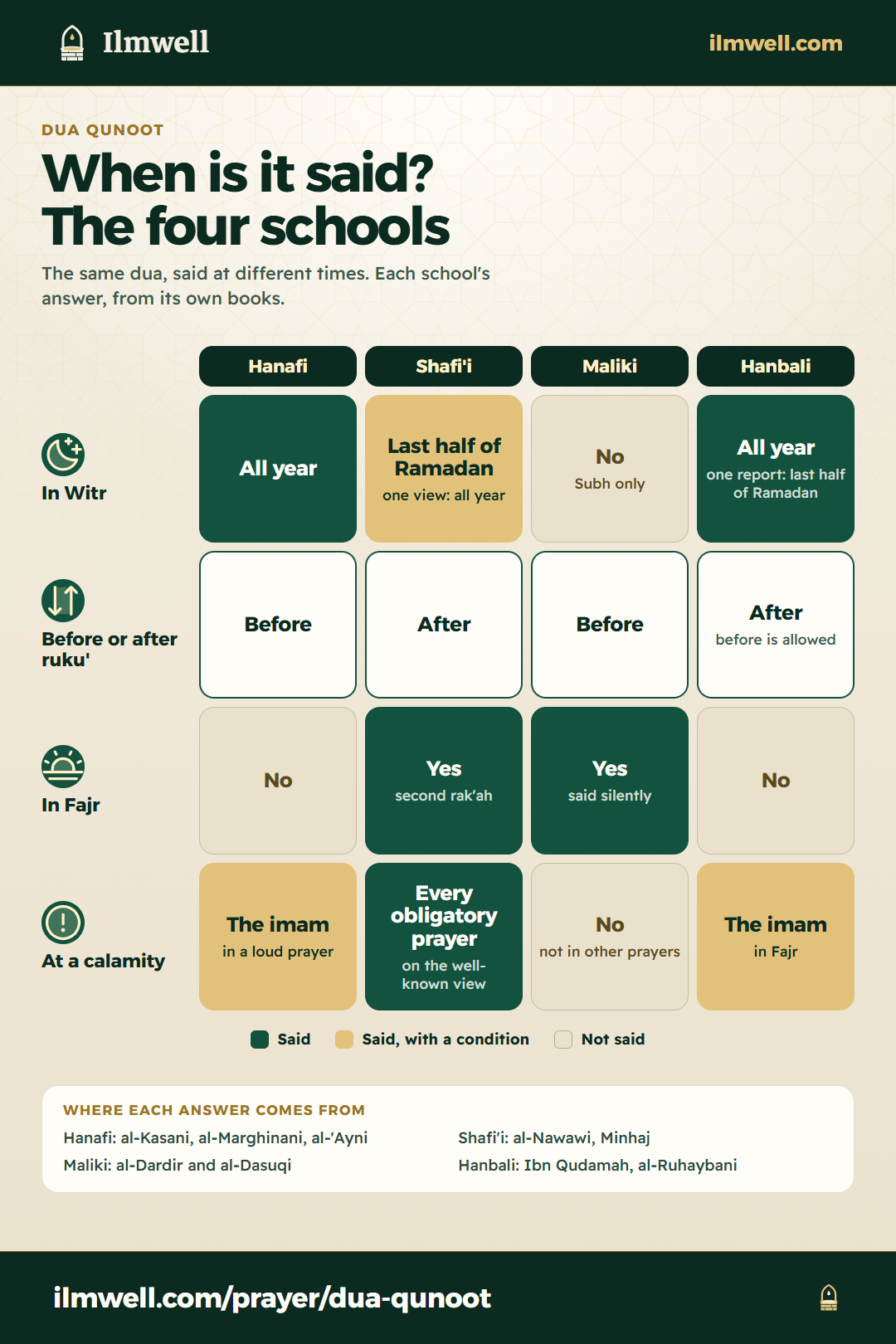
When is qunoot said? The four schools side by side
Each cell names the work it comes from. Qunoot al-nazilah, also written qunoot e nazila, is qunoot at a time of calamity.
| Hanafi | Shafi'i | Maliki | Hanbali | |
|---|---|---|---|---|
| In Witr | All year; wajib to Abu Hanifa, sunnah to his two companions, Abu Yusuf and Muhammad al-Shaybani (al-Kasani, Bada'i') | Second half of Ramadan; one view: all year (al-Nawawi, Minhaj) | None: qunoot is in Subh only (al-Dardir, al-Sharh al-Kabir) | All year; another narration from Ahmad: last half of Ramadan only (Ibn Qudamah, al-Mughni) |
| Before or after ruku' | Before, after a takbir with raised hands (al-Marghinani, al-Hidayah) | After, in the standing (al-Nawawi, Minhaj) | Recommended before ruku' (al-Dardir, al-Sharh al-Kabir) | After; before is allowed (al-Ruhaybani, Matalib Uli al-Nuha) |
| In Fajr | No qunoot in Fajr (al-Hidayah); for a calamity, see below | Sunnah, in the second rak'ah (al-Nawawi, Minhaj) | Recommended, said silently (al-Dardir, al-Sharh al-Kabir) | Not sunnah (Ibn Qudamah, al-Mughni) |
| At a calamity (nazilah) | The imam says it in a loud prayer, one recited aloud (al-'Ayni, al-Binayah) | In every obligatory prayer, on the well-known view (al-Nawawi, Minhaj) | Not in other prayers, even at a famine or plague; qunoot outside Subh is disliked (al-Dasuqi, Hashiya) | The imam may say it in Fajr, as Ahmad stated (Ibn Qudamah, al-Mughni) |
Sources 5 to 9 give each page. For your own situation, ask a scholar you trust.
I memorised Dua Qunoot at primary school and promptly forgot the second line. For about a year I would go quiet for a few seconds at that point and then catch up. I only learnt it properly by writing it out by hand.
Try it: what comes next?
If you have ever reached the second line of qunoot and felt your mind go blank, you are not alone. These four quick checks help it stick.
1What comes next after Allahumma-hdini fiman hadayt?
Answer: wa 'afini fiman 'afayt. Guide me, then grant me well-being, then take me into Your care. Source 1
2What comes next after wa qini sharra ma qadayt?
Answer: innaka taqdi wa la yuqda 'alayk. After "protect me from the evil of what You have decreed" comes "You decree, and none decrees over You". Source 1
3In the Hanafi-book wording, what comes next after Allahumma inna nasta'inuka?
Answer: wa nastahdika. Durar al-Hukkam gives: we ask You for help, and ask You for guidance, and ask Your forgiveness.
4Whose own words are Allahumma inna nasta'inuka, in the report graded authentic?
Answer: 'Umar's. They are reported as 'Umar's own qunoot. The version with the Prophet is mursal and graded weak. Source 3
Questions people ask
Is there a surah qunoot?
No. Neither wording is in the Quran: the Ilmwell team's check of the Tanzil Quran text on 21 October 2026 found none of their distinctive words. The Hanbali book Matalib Uli al-Nuha calls the two parts of Allahumma inna nasta'inuka "the two surahs of qunoot" and says they were in the mushaf, the written Quran copy, of Ubayy ibn Ka'b, may Allah be pleased with him.
What does qunoot mean?
Qunoot has several meanings in Arabic, including obedience, silence and standing in prayer. The lexicographer al-Azhari wrote that its well-known meaning is dua. In prayer it names a dua said at a set point while standing.
Sources
Every claim on this page comes from one of these. Gradings are reported with the scholar's name; we do not grade hadith ourselves.
- 1
Al-Hasan ibn 'Ali said the Messenger of Allah taught him words to say in the Witr prayer (in Ibn Jawwas's wording, in the qunoot of Witr): Allahumma ihdini fiman hadayt ... tabarakta rabbana wa ta'alayt.
Sunan Abi Dawud 1425 Book 8, Hadith 10
Graded differently. Here is who graded it which way:
- SoundAl-Albani, Darussalam, Al-Tirmidhi, Shu'ayb al-Arna'ut, Ahmad Shakir, Al-Nawawi, Ibn al-Mulaqqin, Al-Qastallani, Ibn Hajar al-'Asqalani, Ibn Baz, Ibn 'Abd al-Barr, Al-Shawkani, 'Abd al-Haqq al-Ishbili
- WeakIbn al-'Arabi
- Other remarksIbn 'Uthaymin, Jamal al-Din al-Mardawi, Ibn Daqiq al-'Id, Al-Daraqutni
See each grading in full, with its wording and where it was given
Scholars disagree about this hadith. Here is how each graded it, so you can follow the scholar you trust.
- Sahih: Al-Albani (as shown on sunnah.com for Abu Dawud 1425)
- Sahih: Darussalam, on Jami' at-Tirmidhi 464 (as shown on sunnah.com)
- Sahih: Darussalam, on Sunan an-Nasa'i 1745 (as shown on sunnah.com)
- Sahih: Darussalam, on Sunan Ibn Majah 1178 (as shown on sunnah.com)
- حسن لا نعرفه إلا من هذا الوجه (hasan; we know it only through this route): Al-Tirmidhi, Jami' at-Tirmidhi 464 (as listed on dorar.net)
- إسناده صحيح (its chain is sahih): Shu'ayb al-Arna'ut, takhrij Sunan Abi Dawud 1425 (as listed on dorar.net)
- صحيح (sahih): Al-Albani, Sahih al-Tirmidhi 464 (as listed on dorar.net)
- صحيح (sahih): Al-Albani, Sahih Ibn Majah 975 (as listed on dorar.net)
- إسناده صحيح (its chain is sahih): Al-Albani, takhrij Sahih Ibn Khuzaymah 1095 (as listed on dorar.net)
- صحيح (sahih): Al-Albani, Asl Sifat al-Salah 3/975 (as listed on dorar.net)
- إسناده صحيح (its chain is sahih): Al-Albani, Qiyam Ramadan 31 (as listed on dorar.net)
- إسناده صحيح رجاله كلهم ثقات (its chain is sahih, all its narrators trustworthy; said of the wording without wa la ya'izzu man 'adayt and the fa of fa-innaka): Al-Albani, Irwa' al-Ghalil 2/172 (as listed on dorar.net)
- صحيح (sahih): Ahmad Shakir, takhrij Jami' at-Tirmidhi 2/328 (as listed on dorar.net)
- إسناده صحيح (its chain is sahih): Ahmad Shakir, takhrij al-Musnad 3/167 (as listed on dorar.net)
- إسناده صحيح (its chain is sahih): Al-Nawawi, Khulasat al-Ahkam 1/455 (as listed on dorar.net)
- إسناده صحيح (its chain is sahih): Al-Nawawi, al-Majmu' 3/496 (as listed on dorar.net)
- إسناده صحيح (its chain is sahih): Al-Nawawi, al-Adhkar 86 (as listed on dorar.net)
- إسناده على شرط الصحيح (its chain meets the condition of the Sahih): Ibn al-Mulaqqin, Tuhfat al-Muhtaj 1/409 (as listed on dorar.net)
- [إسناده] صحيح ([its chain is] sahih): Al-Qastallani, al-Mawahib al-Ladunniyya 3/247 (as listed on dorar.net)
- حسن صحيح (hasan sahih): Ibn Hajar al-'Asqalani, as given in al-Futuhat al-Rabbaniyya 2/294 (as listed on dorar.net)
- حسن صحيح (hasan sahih): Ibn Hajar al-'Asqalani, Nata'ij al-Afkar 2/147 (as listed on dorar.net)
- إسناده صحيح (its chain is sahih): Shu'ayb al-Arna'ut, takhrij Zad al-Ma'ad 1/323 (as listed on dorar.net)
- إسناده صحيح (its chain is sahih): Shu'ayb al-Arna'ut, takhrij Zad al-Ma'ad 1/274 (as listed on dorar.net)
- إسناده صحيح (its chain is sahih): Shu'ayb al-Arna'ut, takhrij al-Musnad 1718 (as listed on dorar.net)
- إسناده صحيح (its chain is sahih): Shu'ayb al-Arna'ut, takhrij Siyar A'lam al-Nubala' 3/247 (as listed on dorar.net)
- حديث صحيح (a sahih hadith): Shu'ayb al-Arna'ut, takhrij al-'Awasim wa al-Qawasim 5/123 (as listed on dorar.net)
- صحيح (sahih): Ibn Baz, Fatawa Nur 'ala al-Darb 10/212 (as listed on dorar.net)
- جيد ثابت (good and established): Ibn Baz, Majmu' al-Shuruh al-Fiqhiyya 22/448 (as listed on dorar.net)
- روي من طرق ثابتة (narrated through established routes): Ibn 'Abd al-Barr, al-Istidhkar 2/285 (as listed on dorar.net)
- أقل أحواله إذا لم يكن صحيحا أن يكون حسنا (if it is not sahih, at the least it is hasan): Al-Shawkani, Tuhfat al-Dhakirin 215 (as listed on dorar.net)
- [أشار في المقدمة أنه صحيح الإسناد] (he indicated in his introduction that its chain is sahih): 'Abd al-Haqq al-Ishbili, al-Ahkam al-Shar'iyya al-Sughra 275 (as listed on dorar.net)
- لم يصح (it is not authentic): Ibn al-'Arabi, 'Aridat al-Ahwadhi 1/455, his commentary on Jami' at-Tirmidhi (as listed on dorar.net)
- مشهور (well known): Ibn 'Uthaymin, Fatawa Nur 'ala al-Darb 5/37 (as listed on dorar.net)
- إسناده ثقات (its narrators are trustworthy): Jamal al-Din al-Mardawi, Kifayat al-Mustaqni' 250 (as listed on dorar.net)
- هو مما ألزم الشيخان تخريجه (one of the narrations al-Bukhari and Muslim should, by their own conditions, have included): Ibn Daqiq al-'Id, al-Ilmam 1/173 (as listed on dorar.net)
- [يلزمهما إخراجه] (al-Bukhari and Muslim should have included it): Al-Daraqutni, al-Ilzamat wa al-Tatabbu' 113 (as listed on dorar.net)
- بألفاظ مختلفة تفرد به يعلى بن الحارث ... (a note on its routes and which narrators alone carry them): Al-Daraqutni, Atraf al-Ghara'ib 1/358 (as listed on dorar.net)
- 2
The phrase 'wa la ya'izzu man 'adayt' (and the one You take as an enemy is not honoured), which Sunan Abi Dawud 1425 has in the al-Hasan qunoot and al-Tirmidhi 464, al-Nasa'i 1745 and Ibn Majah 1178 do not, is graded differently on its own.
Sunan Abi Dawud 1425 Book 8, Hadith 10
Graded differently. Here is who graded it which way:
- SoundIbn Hajar al-'Asqalani, Shu'ayb al-Arna'ut, Ibn Baz, Al-Albani
- WeakIbn Baz, Al-Nawawi
See each grading in full, with its wording and where it was given
Scholars disagree about this hadith. Here is how each graded it, so you can follow the scholar you trust.
- هذه الزيادة ثابتة (this addition is established): Ibn Hajar al-'Asqalani, al-Talkhis al-Habir 1/405 (as listed on dorar.net)
- زيادة صحيحة (a sahih addition): Shu'ayb al-Arna'ut, takhrij Zad al-Ma'ad 1/324 (as listed on dorar.net)
- زيادة حسنة (a hasan addition): Shu'ayb al-Arna'ut, takhrij Zad al-Ma'ad 1/275 (as listed on dorar.net)
- [زيادة] صحيحة (a sahih addition): Ibn Baz, Masa'il Ibn Baz 97 (as listed on dorar.net)
- زيادة صحيحة ثابتة لا شك فيها (a sahih, established addition, without doubt): Al-Albani, Asl Sifat al-Salah 3/974 (as listed on dorar.net)
- هذه الزيادة ثابتة (this addition is established): Al-Albani, Sifat al-Salah 180 (as listed on dorar.net)
- في إسناده نظر (its chain is open to question): Ibn Baz, Majmu' al-Shuruh al-Fiqhiyya 22/449 (as listed on dorar.net)
- إسناده منقطع (its chain is disconnected): Ibn Baz, Majmu' al-Shuruh al-Fiqhiyya 25/259 (as listed on dorar.net)
- وجاء في رواية ضعيفة زيادة: ولا يعز من عاديت (the addition wa la ya'izzu man 'adayt came in a weak narration): Al-Nawawi, Khulasat al-Ahkam 1/455 (as listed on dorar.net)
- 3
'Ubayd ibn 'Umayr reported that 'Umar ibn al-Khattab made qunoot after ruku' with a dua that includes 'Allahumma inna nasta'inuka wa nastaghfiruka ...' and 'Allahumma iyyaka na'budu ...'; it is graded sahih as 'Umar's own words.
Al-Bayhaqi, al-Sunan al-Kubra 3268 Al-Bayhaqi, al-Sunan al-Kubra 2/210 to 211, no. 3268: the number as the Dorar fiqh encyclopedia cites it; dorar.net's hadith listing gives the page as 2/211
Authentic: sahih, with a connected chain (Al-Bayhaqi); sahih or hasan; part of it is also narrated from the Prophet as a mursal report (Ibn al-Mulaqqin); sahih, as the words of a Companion (Ibn Hajar al-'Asqalani). Remarks: part of it is narrated from the Prophet [and that is mursal] (Ibn al-Mulaqqin); a route through Ibn Abi Layla, about whom there is criticism; this route names the dawn prayer (Al-'Ayni)
- 4
A mursal report from Khalid ibn Abi 'Imran says that while the Prophet was supplicating against Mudar, Jibril signalled him to be silent and then taught him a qunoot beginning 'Allahumma inna nasta'inuka wa nastaghfiruka'; it is graded weak as mursal.
Abu Dawud, al-Marasil 192 Abu Dawud, al-Marasil 192, as dorar.net lists it
Weak: mursal: a Follower attributing it to the Prophet with the Companion missing (Al-Bayhaqi); mursal (Al-Bayhaqi); mursal; fit only as a supporting report (Al-Hazimi); [mursal] ('Abd al-Haqq al-Ishbili). Remarks: he placed it in his book of mursal reports (Abu Dawud); 'Abd al-Qahir, in its chain, is unknown (Al-Dhahabi)
- 5
Hanafi works: qunoot belongs to the Witr prayer only, in its third rak'ah before ruku', all year, after a takbir with raised hands; it is wajib for Abu Hanifa and sunnah for his two companions; the chosen way is to say it silently; at a calamity the imam makes qunoot in a loud prayer.
al-Marghinani, al-Hidayah 1/66 to 67; al-Kasani, Bada'i' al-Sana'i' 1/273; al-'Ayni, al-Binayah 2/504 Record: scholarly-qunoot-hanafi. Read on shamela.ws.
- 6
al-Kasani reports that there is no fixed dua for qunoot (al-Karkhi), while some Hanafi shaykhs excepted 'Allahumma inna nasta'inuka', on which the Companions agreed, so it is preferable to recite it, and preferable to recite after it the dua the Prophet taught al-Hasan; Durar al-Hukkam gives the 'Allahumma inna nasta'inuka' wording in full.
al-Kasani, Bada'i' al-Sana'i' 1/273; Mulla Khusraw, Durar al-Hukkam 1/113 Record: scholarly-qunoot-hanafi-wording. Read on shamela.ws; the first card is its vowelled text.
- 7
al-Nawawi (Minhaj al-Talibin): qunoot is sunnah in the standing after ruku' of the second rak'ah of Subh, with 'Allahumma ihdini fiman hadayt'; at a calamity it is prescribed in all obligatory prayers, not otherwise, on the well-known view; in Witr it is recommended at the end of the Witr in the second half of Ramadan, like the Subh qunoot, with 'Allahumma inna nasta'inuka' said as well, after it on the more correct view.
al-Nawawi, Minhaj al-Talibin, pp. 27 and 36 Record: scholarly-qunoot-shafii. Read on shamela.ws.
- 8
al-Dardir (al-Sharh al-Kabir): qunoot, meaning a dua, is recommended, said silently, in Subh only; it is recommended before ruku', and its particular wording, 'Allahumma inna nasta'inuka', is recommended. al-Dasuqi's Hashiya on the same page: not in Witr, and not in other prayers even when needed, such as at a famine or plague; qunoot outside Subh is disliked, though it does not invalidate the prayer.
al-Dardir, al-Sharh al-Kabir 1/248, with al-Dasuqi's Hashiya Record: scholarly-qunoot-maliki. Read on shamela.ws.
- 9
Hanbali works: qunoot is sunnah in Witr, in its last rak'ah, all year, after rising from ruku' (before it is allowed); in Subh and other prayers it is not sunnah; at a calamity the imam may make qunoot in Subh, as Ahmad stated; al-Ruhaybani has the qunoot said with 'the two surahs of qunoot', 'Allahumma inna nasta'inuka ...', which he says were in the mushaf of Ubayy ibn Ka'b.
Ibn Qudamah, al-Mughni 2/111 to 115; al-Ruhaybani, Matalib Uli al-Nuha 1/554 to 555 Record: scholarly-qunoot-hanbali. Read on shamela.ws.
- 10
Qunoot has several meanings in Arabic (obedience, silence, standing in prayer, and others); al-Azhari wrote that the well-known meaning is dua, and as a term it names a dua in the prayer at a particular point of the standing (Ibn 'Allan).
Dar al-Ifta al-Misriyyah, fatwa 22064, quoting al-Azhari and Ibn 'Allan Record: scholarly-qunoot-meaning.
- 11
The Ilmwell team's check of the Tanzil Quran text on 21 October 2026 found that the distinctive words of both qunoot wordings (nasta'inuka, yafjuruka, nahfidu, mulhiq, fiman hadayt) do not occur anywhere in the Quran. A search finding, not a ruling.
Tanzil Project Quran text Record: search-qunoot-surah, with every search term and result.
Next
- How to pray Witr: a scoped walkthroughGuide
- How to pray Fajr: steps and recitationsGuide
- How to perform wudu: illustrated stepsPractical guide
- Istikhara dua and how to pray istikharaPractical guide
- How many rak'ahs in each prayerGuide
- Prayer and PurificationThe hub
For your own situation, ask a scholar you trust.
Join the email list
New guides by email, now and then. No spam, and you can leave at any time.
Ilmwell is free and kept going by readers. See how to support it.