The short answer
How to pray Tahajjud: pray two by two, in the words of Sahih al-Bukhari 990, then end with witr (Sahih al-Bukhari 998). The Prophet Muhammad, peace be upon him, said Allah descends to the lowest heaven in the last third of the night and says: Who calls on Me, that I may answer him? (Sahih al-Bukhari 1145; all graded sahih)
What is the Tahajjud dua?
Ibn Abbas, may Allah be pleased with him, said that when the Prophet got up at night to pray Tahajjud, he would say this dua.
Sahih al-Bukhari 1120
اللَّهُمَّ لَكَ الْحَمْدُ أَنْتَ قَيِّمُ السَّمَوَاتِ وَالأَرْضِ وَمَنْ فِيهِنَّ وَلَكَ الْحَمْدُ، لَكَ مُلْكُ السَّمَوَاتِ وَالأَرْضِ وَمَنْ فِيهِنَّ، وَلَكَ الْحَمْدُ أَنْتَ نُورُ السَّمَوَاتِ وَالأَرْضِ، وَلَكَ الْحَمْدُ أَنْتَ الْحَقُّ، وَوَعْدُكَ الْحَقُّ، وَلِقَاؤُكَ حَقٌّ، وَقَوْلُكَ حَقٌّ، وَالْجَنَّةُ حَقٌّ، وَالنَّارُ حَقٌّ، وَالنَّبِيُّونَ حَقٌّ، وَمُحَمَّدٌ صلى الله عليه وسلم حَقٌّ، وَالسَّاعَةُ حَقٌّ، اللَّهُمَّ لَكَ أَسْلَمْتُ، وَبِكَ آمَنْتُ وَعَلَيْكَ تَوَكَّلْتُ، وَإِلَيْكَ أَنَبْتُ، وَبِكَ خَاصَمْتُ، وَإِلَيْكَ حَاكَمْتُ، فَاغْفِرْ لِي مَا قَدَّمْتُ وَمَا أَخَّرْتُ، وَمَا أَسْرَرْتُ وَمَا أَعْلَنْتُ، أَنْتَ الْمُقَدِّمُ وَأَنْتَ الْمُؤَخِّرُ، لاَ إِلَهَ إِلاَّ أَنْتَ
1AuthenticSahih al-Bukhari 1120
The Tahajjud dua in English, with transliteration
- Allāhumma laka l-ḥamd, anta qayyimu s-samāwāti wa l-arḍi wa man fīhinnO Allah, all praise is Yours. You are the Sustainer of the heavens and the earth and all who are in them.
- wa laka l-ḥamd, laka mulku s-samāwāti wa l-arḍi wa man fīhinnAll praise is Yours; Yours is the dominion of the heavens and the earth and all who are in them.
- wa laka l-ḥamd, anta nūru s-samāwāti wa l-arḍAll praise is Yours; You are the light of the heavens and the earth.
- wa laka l-ḥamd, anta l-ḥaqq, wa waʿduka l-ḥaqqAll praise is Yours; You are the Truth, and Your promise is true,
- wa liqāʾuka ḥaqq, wa qawluka ḥaqqmeeting You is true, and Your word is true,
- wa l-jannatu ḥaqq, wa n-nāru ḥaqqParadise is true, and the Fire is true,
- wa n-nabiyyūna ḥaqq, wa Muḥammadun ṣalla llāhu ʿalayhi wa sallama ḥaqq, wa s-sāʿatu ḥaqqthe prophets are true, Muhammad, peace be upon him, is true, and the Hour is true.
- Allāhumma laka aslamtu, wa bika āmantu, wa ʿalayka tawakkaltuO Allah, to You I have submitted, in You I have believed, and in You I have put my trust;
- wa ilayka anabtu, wa bika khāṣamtu, wa ilayka ḥākamtuto You I have turned, by You I have argued, and to You I have brought my case.
- fa-ghfir lī mā qaddamtu wa mā akhkhartu, wa mā asrartu wa mā aʿlantuSo forgive me what I have put forward and what I have held back, what I have hidden and what I have shown.
- anta l-muqaddimu wa anta l-muʾakhkhir, lā ilāha illā antYou bring forward and You hold back; there is no god but You.The narrator was unsure whether he said this or "la ilaha ghayruk" (there is no god other than You).
What to say when you wake at night
'Ubadah ibn al-Samit, may Allah be pleased with him, reported the Prophet saying that whoever wakes at night and says this, then says اللَّهُمَّ اغْفِرْ لِي (Allahumma ighfir li, "O Allah, forgive me") or makes a dua, is answered (transliteration only here):
Lā ilāha illā llāhu waḥdahu lā sharīka lah, lahu l-mulku wa lahu l-ḥamd, wa huwa ʿalā kulli shayʾin qadīr. Al-ḥamdu lillāh, wa subḥāna llāh, wa lā ilāha illā llāh, wa llāhu akbar, wa lā ḥawla wa lā quwwata illā billāh.
None has the right to be worshipped but Allah alone, with no partner; His is the dominion and His is the praise, and He has power over all things. Praise is for Allah, glory is to Allah, none has the right to be worshipped but Allah, Allah is greatest, and there is no might and no power except through Allah.
2AuthenticSahih al-Bukhari 1154
What is Tahajjud, and is it the same as qiyam al-layl and witr?
Tahajjud is a voluntary night prayer. Ibn Kathir explains it as prayer after sleep, which he says is how the word is known in Arabic (source 14). The word appears in Al-Isra 17:79, wa mina l-layli fa-tahajjad bihi, "and some part of the night awake for it". Also spelt tahajud; tahajjud namaz and salatul tahajjud name the same prayer.
Qiyam al-layl means "standing at night" in prayer. Ibn Kathir calls 17:79 a command to the Prophet to stand at night after the obligatory prayers (source 14). Witr is the odd-numbered prayer that closes the night (Sahih al-Bukhari 998); its status differs by school (table).
Can you pray Tahajjud without sleeping?
Ibn Kathir reports from 'Alqamah, al-Aswad and Ibrahim al-Nakha'i that Tahajjud is prayer after sleep. He quotes al-Hasan al-Basri, "it is what comes after Isha" (the last of the five daily prayers), and takes that to mean after sleep too (source 14). Ibn Qudamah writes that unrestricted voluntary prayer is prescribed through the whole night (al-Mughni, source 18). For your own practice, ask a scholar you trust.
When is Tahajjud time?
Between Isha and Fajr (the dawn prayer), with the last third of the night named in the descent hadith. 'Aisha, may Allah be pleased with her, reported the Prophet praying eleven rak'ahs (units of prayer) between finishing Isha and Fajr.
4AuthenticSahih Muslim 736b
Abu Hurayrah, may Allah be pleased with him, reported that the Messenger of Allah said:
Sahih al-Bukhari 1145
يَنْزِلُ رَبُّنَا تَبَارَكَ وَتَعَالَى كُلَّ لَيْلَةٍ إِلَى السَّمَاءِ الدُّنْيَا حِينَ يَبْقَى ثُلُثُ اللَّيْلِ الآخِرُ يَقُولُ مَنْ يَدْعُونِي فَأَسْتَجِيبَ لَهُ مَنْ يَسْأَلُنِي فَأُعْطِيَهُ مَنْ يَسْتَغْفِرُنِي فَأَغْفِرَ لَهُ
Our Lord, blessed and exalted is He, descends every night to the lowest heaven when the last third of the night remains, and says: Who calls on Me, that I may answer him? Who asks of Me, that I may give him? Who asks My forgiveness, that I may forgive him?
3AuthenticSahih al-Bukhari 1145
How do you work out the last third of the night?
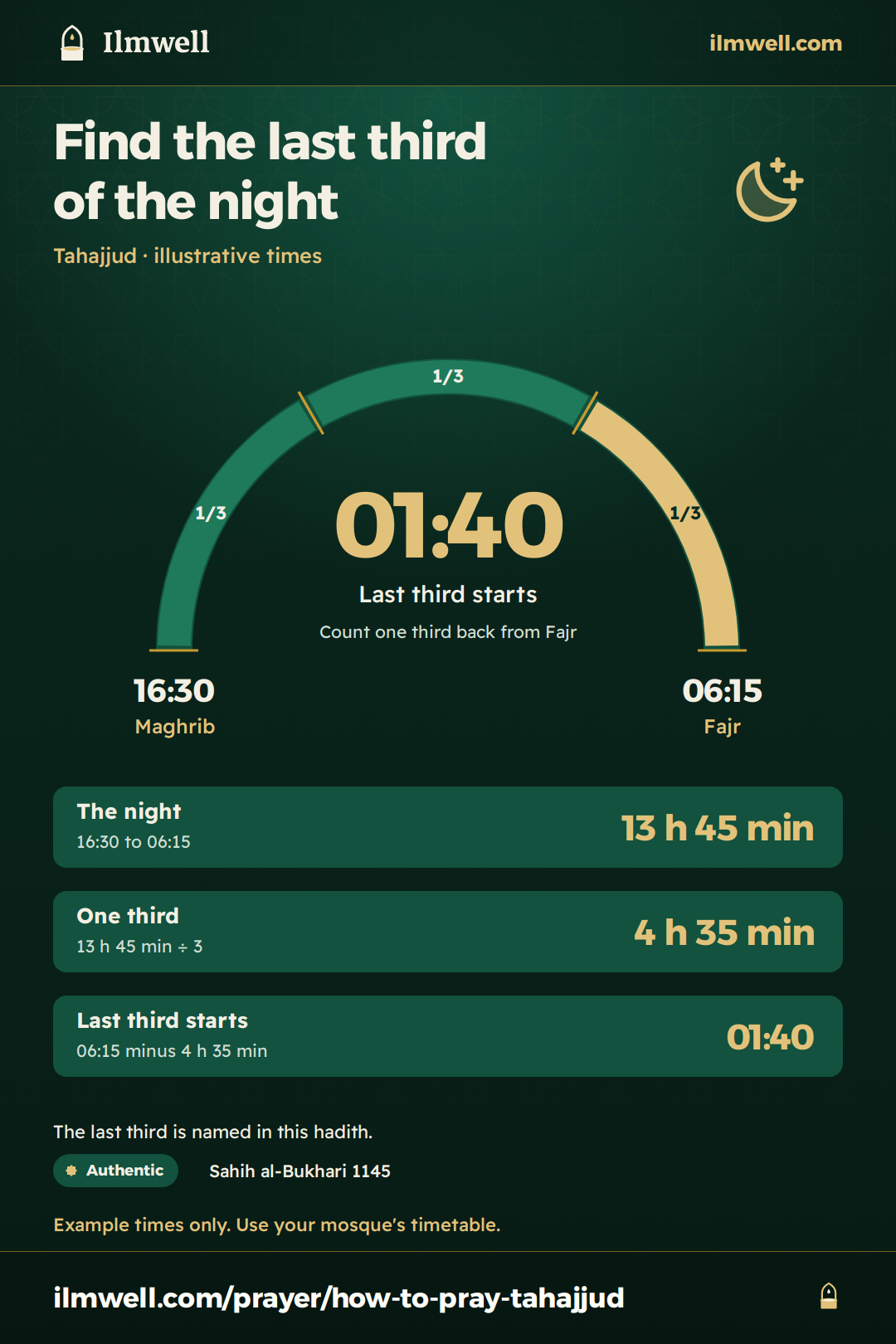
The hadith does not say how to calculate it. One way: take tonight's Maghrib (the sunset prayer) and tomorrow's Fajr from your mosque timetable, divide the time between them by three, and count one third back from Fajr. Say Maghrib is 16:30 and Fajr 06:15 (illustrative times, not today's): the night is 13 hours 45 minutes, a third is 4 hours 35 minutes, so the last third starts at 01:40.
Times change daily and by city: London, Birmingham and Bradford each have their own. This is arithmetic on two timetable times, not a ruling on where the night begins or ends; ask your mosque or a scholar you trust which times to use.
If your plan involves three alarms and a snooze button, set the first for the start of the last third, not ten minutes before Fajr.

How do you pray Tahajjud, step by step?
From the narrations; the dua is above, school differences in the table, wudu in how to perform wudu.
Wake after Isha and make wudu
Words for waking at night are above (Sahih al-Bukhari 1154): if you then make wudu and pray, your prayer is accepted.
Make the intention
'Umar, may Allah be pleased with him, reported that deeds are by intentions (Sahih al-Bukhari 1). It gives no set words for the intention.
Say the Tahajjud dua
Said on getting up at night to pray Tahajjud (Sahih al-Bukhari 1120); the narration does not say whether before the opening takbir or inside the prayer.
Pray two by two, in the hadith's words
Ibn 'Umar, may Allah be pleased with him, reported "the night prayer is two by two" (Sahih al-Bukhari 990); 'Aisha reported a salam (closing greeting) after every two (Sahih Muslim 736b). Abu Hanifa preferred fours: see the table.
Recite what is easy for you
"Recite, then, of the Quran that which is easy for you" (Al-Muzzammil 73:20, on the night vigil). No surah is fixed in the narrations on this page.
Ask in the last third
Call on Allah, ask of Him and seek His forgiveness (Sahih al-Bukhari 1145).
End with witr
"Make the last of your prayer at night witr" (Sahih al-Bukhari 998).
5AuthenticSahih al-Bukhari 990
How many rak'ahs is Tahajjud?
'Aisha said the Prophet did not go beyond eleven rak'ahs, in Ramadan or other months: four, "do not ask how beautiful and long they were", then four, then three.
8AuthenticSahih al-Bukhari 1147
Ibn Abbas reported thirteen, which a later narrator explains as at night; 'Aisha, in another report, gives thirteen at night including the witr and the two rak'ahs of Fajr.
9AuthenticSahih al-Bukhari 1138
10AuthenticSahih al-Bukhari 1140
These reports describe the Prophet's practice and do not set a number for you. Al-Nawawi's Shafi'i Minhaj puts no limit on unrestricted voluntary prayer, and gives witr one rak'ah at least and eleven at most (source 16).
Say you wake twenty minutes before Fajr. Sahih al-Bukhari 990 tells someone who fears the dawn to pray one rak'ah as witr after praying in twos. In the Hanafi school, al-Hidayah gives witr as three rak'ahs with no salam between them (source 15).
Where do the four schools differ on Tahajjud and witr?
Each cell names its work. Wajib means necessary; sunnah, a practice of the Prophet that is not obligatory.
| Hanafi | Shafi'i | Maliki | Hanbali | |
|---|---|---|---|---|
| Witr | Wajib to Abu Hanifa, sunnah to his two companions (Abu Yusuf and Muhammad al-Shaybani); three rak'ahs, no salam between them (al-Marghinani, al-Hidayah) | Voluntary (nafl), listed among the voluntary prayers; one to eleven rak'ahs (al-Nawawi, Minhaj) | Sunnah, more emphasised than the Eid, eclipse and rain prayers (al-Dardir, al-Sharh al-Kabir) | Sunnah mu'akkadah (emphasised), not wajib (Ibn Qudamah, al-Mughni) |
| Two or four at a time | Abu Hanifa: four is better, up to eight per salam; his two companions: two (al-Hidayah) | A salam after every two (Minhaj) | Two by two, in Ibn Qudamah's report of Malik's view (al-Mughni); not stated in the Maliki passages we read | Two by two only (al-Mughni) |
| Witr if you plan to wake | Late if you are used to night prayer; before sleep if unsure of waking (al-Hidayah) | Sunnah to make it the last prayer of the night; if prayed before Tahajjud, not repeated (Minhaj) | Late if you usually wake then; if prayed early, not repeated (al-Sharh al-Kabir) | After Tahajjud; early if you fear not waking; an early witr stands, then pray in twos (al-Mughni) |
Sources 15 to 18 give each page.
What are the benefits of Tahajjud?
The verse that names Tahajjud is addressed to the Prophet:
وَمِنَ ٱلَّيْلِ فَتَهَجَّدْ بِهِۦ نَافِلَةً لَّكَ عَسَىٰٓ أَن يَبْعَثَكَ رَبُّكَ مَقَامًا مَّحْمُودًا
Abu Hurayrah reported the Prophet saying: "the best prayer after the obligatory prayer is the prayer at night" (وَأَفْضَلُ الصَّلاَةِ بَعْدَ الْفَرِيضَةِ صَلاَةُ اللَّيْلِ).
11AuthenticSahih Muslim 1163
My first attempt at Tahajjud, I set three alarms, got up at the third, and prayed two rak'ahs half asleep. It was not impressive. But I went back to bed feeling I had done something, and I tried again the following week.
Try it: time, pairs and witr
Three quick checks. Each answer explains itself.
1When does the descent hadith say Allah says "Who calls on Me"?
Answer: When the last third of the night remains. Sahih al-Bukhari 1145: "when the last third of the night remains". Source 3
2How is the night prayer prayed, in the words of Sahih al-Bukhari 990?
Answer: Two by two. "The night prayer is two by two." On four at a time, see the table. Source 5
3What should be the last prayer of your night?
Answer: Witr. "Make the last of your prayer at night witr" (Sahih al-Bukhari 998). Source 6
Questions people ask
What if I miss Tahajjud?
'Aisha reported that when the Prophet missed his night prayer through pain or something else, he prayed twelve rak'ahs in the daytime (Sahih Muslim 746e, graded sahih).
Is there a dua for after Tahajjud?
The records this page uses give no set wording for after Tahajjud; the descent hadith (Sahih al-Bukhari 1145) names calling on Allah, asking and seeking forgiveness in the last third, without fixing words. A long dua Ibn Abbas heard the Prophet say one night after his prayer (Jami' at-Tirmidhi 3419) is graded differently (one grader accepts it, three call it weak, one false) and does not name Tahajjud, so it is not given here.
Sources
Every claim on this page comes from one of these. Gradings are reported with the scholar's name; we do not grade hadith ourselves.
- 1
Ibn Abbas said that when the Prophet got up at night to pray Tahajjud he would say the dua beginning 'Allahumma laka al-hamd, anta qayyim al-samawati wal-ard wa man fihinna' and ending 'la ilaha illa anta (or: la ilaha ghayruk)'.
Sahih al-Bukhari 1120 Book 19, Hadith 1
Authentic: in Sahih al-Bukhari
- 2
'Ubadah ibn al-Samit reported that the Prophet said: whoever wakes at night and says 'La ilaha illallah wahdahu la sharika lah...' then says 'Allahumma ighfir li', or makes a dua, is answered, and if he makes wudu and prays, his prayer is accepted.
Sahih al-Bukhari 1154 Book 19, Hadith 35
Authentic: in Sahih al-Bukhari
- 3
Abu Hurayrah reported that the Prophet said: our Lord, blessed and exalted, descends every night to the nearest heaven when the last third of the night remains, saying: who calls on Me, that I may answer him; who asks of Me, that I may give him; who asks My forgiveness, that I may forgive him.
Sahih al-Bukhari 1145 Book 19, Hadith 26
Authentic: in Sahih al-Bukhari
- 4
'Aisha said the Prophet used to pray, between finishing the 'Isha prayer and Fajr, eleven rak'ahs, giving the salam between every two rak'ahs and making witr with one.
Sahih Muslim 736b Book 6, Hadith 148
Authentic: in Sahih Muslim (Muslim). Remarks: Remark on a narrator: Harmalah ibn Yahya, a narrator of this wording, was spoken about, and the wording is jumbled (Ibn al-Qattan)
- 5
Ibn 'Umar reported that a man asked the Prophet about the night prayer and he said: the night prayer is two by two (mathna mathna), and when one of you fears the dawn (al-subh), he prays one rak'ah, which makes what he has prayed odd (witr).
Sahih al-Bukhari 990 Book 14, Hadith 1
Authentic: in Sahih al-Bukhari
- 6
Ibn 'Umar reported that the Prophet said: make the last of your prayer at night witr.
Sahih al-Bukhari 998 Book 14, Hadith 9
Authentic: in Sahih al-Bukhari
- 7
'Umar ibn al-Khattab heard the Prophet say that deeds are by intentions and each person has what he intended.
Sahih al-Bukhari 1 Book 1, Hadith 1
Authentic: in Sahih al-Bukhari
- 8
Abu Salamah asked 'Aisha how the Prophet prayed in Ramadan; she said he did not go beyond eleven rak'ahs in Ramadan or other months: he prayed four, do not ask about their beauty and length, then four likewise, then three; she asked whether he slept before witr and he said his eyes sleep but his heart does not.
Sahih al-Bukhari 1147 Book 19, Hadith 28
Authentic: in Sahih al-Bukhari
- 9
Ibn Abbas said the prayer of the Prophet was thirteen rak'ahs, meaning at night.
Sahih al-Bukhari 1138 Book 19, Hadith 19
Authentic: in Sahih al-Bukhari
- 10
'Aisha said the Prophet used to pray thirteen rak'ahs at night, among them the witr and the two rak'ahs of Fajr.
Sahih al-Bukhari 1140 Book 19, Hadith 21
Authentic: in Sahih al-Bukhari
- 11
Abu Hurayrah reported that the Prophet said: the best fasting after Ramadan is Allah's month al-Muharram, and the best prayer after the obligatory prayer is the prayer at night.
Sahih Muslim 1163 Book 13, Hadith 261
Authentic: in Sahih Muslim
- 12
'Aisha said that when the Prophet missed the night prayer because of pain or something else, he prayed twelve rak'ahs in the daytime.
Sahih Muslim 746e Book 6, Hadith 172
Authentic: in Sahih Muslim
- 13
Ibn Abbas said he heard the Prophet say, one night when he finished his prayer, a long dua beginning 'Allahumma inni as'aluka rahmatan min 'indika tahdi biha qalbi'.
Jami` at-Tirmidhi 3419 Book 48, Hadith 50
Graded differently. Here is who graded it which way:
- SoundIbn Khuzaymah
- WeakDarussalam, al-Albani, Shu'ayb al-Arna'ut
- No reliable basisIbn Hibban
- Other remarksal-Tirmidhi, al-Dhahabi, Ibn 'Adi, al-San'ani
See each grading in full, with its wording and where it was given
Scholars disagree about this hadith. Here is how each graded it, so you can follow the scholar you trust.
- Da'if: Darussalam (as shown on sunnah.com)
- Da'if (weak): al-Albani, al-Silsila al-Da'ifa 2916
- Da'if (weak): al-Albani, Da'if al-Jami' 1194
- Isnad da'if (weak chain): al-Albani, on Sahih Ibn Khuzaymah 1119
- A long hadith, da'if (weak): Shu'ayb al-Arna'ut, Takhrij Siyar A'lam al-Nubala' 5/444
- Batil (false): Ibn Hibban, al-Majruhin 1/274
- Sahih: included in his Sahih: Ibn Khuzaymah, Sahih Ibn Khuzaymah 2/296
- Gharib: known only through Ibn Abi Layla by this route: al-Tirmidhi, Jami' at-Tirmidhi 3419
- Remark on a narrator: Dawud ibn 'Ali is not a proof: al-Dhahabi, Mizan al-I'tidal 2/14
- Remark on a narrator: Dawud ibn 'Ali's narrations are acceptable: Ibn 'Adi, al-Kamil fi al-Du'afa' 3/555 to 556
- Remark: its chain is spoken about: al-San'ani, al-Tanwir 3/106
- 14
Ibn Kathir, explaining Al-Isra 17:79: Tahajjud is prayer after sleep, as 'Alqamah, al-Aswad, Ibrahim al-Nakha'i and others said, and that is how the word is known in Arabic; al-Hasan al-Basri said it is what comes after 'Isha, which Ibn Kathir reads as meaning after sleep.
Ibn Kathir, Tafsir al-Quran al-Azim, on Al-Isra 17:79 Record: scholarly-ibnkathir-tahajjud-sleep.
- 15
Al-Marghinani's al-Hidayah (Hanafi): witr is wajib for Abu Hanifa and sunnah for his two companions, and is three rak'ahs with no salam between them; its time is after 'Isha until dawn; one used to praying at night is recommended to delay witr to the end of the night, and one not confident of waking prays it before sleep; at night Abu Hanifa allows up to eight rak'ahs with one salam and prefers four at a time, while Abu Yusuf and Muhammad hold two at a time.
al-Marghinani, al-Hidayah 1/41, 1/66 and 1/67 Record: scholarly-tahajjud-hanafi. Read on shamela.ws.
- 16
Al-Nawawi's Minhaj al-Talibin (Shafi'i): witr is among the voluntary (nafl) prayers, at least one rak'ah and at most eleven; its time is between 'Isha and dawn; it is sunnah to make it the last prayer of the night, and one who prayed witr and then prayed Tahajjud does not repeat it; night voluntary prayer is better than day, with a salam after every two; Tahajjud is sunnah; unrestricted voluntary prayer has no limit.
al-Nawawi, Minhaj al-Talibin, pp. 36 to 37 Record: scholarly-tahajjud-shafii. Read on shamela.ws.
- 17
Al-Dardir's al-Sharh al-Kabir on Mukhtasar Khalil (Maliki): witr is a sunnah, the most emphasised of the sunnahs Khalil lists after it (Eid, eclipse, rain); its chosen time is after a valid 'Isha and the twilight, until dawn; doing it at the end of the night is recommended for one who usually wakes then; one who prayed it early and then prays later does not repeat it, and voluntary prayer after witr is allowed.
al-Dardir, al-Sharh al-Kabir 1/316 to 317, with al-Dasuqi's Hashiya Record: scholarly-tahajjud-maliki. Read on shamela.ws.
- 18
Ibn Qudamah's al-Mughni (Hanbali): night voluntary prayer is only two by two (Abu Hanifa allowed up to eight; he reports Malik and al-Shafi'i as holding two by two); unrestricted voluntary prayer is prescribed through the whole night; Ahmad said nothing after the obligatory prayers is better than standing at night; witr is not wajib, a sunnah mu'akkadah in Ahmad's words; its time is between 'Isha and dawn and it is best at the end of the night; one who prayed witr and then wakes for Tahajjud prays two by two and does not undo his witr; one who missed his Tahajjud may make it up between Fajr and Zuhr.
Ibn Qudamah, al-Mughni 2/91 to 92, 2/100 to 103, 2/117 to 120 Record: scholarly-tahajjud-hanbali. Read on shamela.ws.
- Q
Al-Isra 17:79 in full; Al-Muzzammil 73:20 in part, in English.
Tanzil Project Uthmani text, CC BY 3.0. English: adapted from Marmaduke Pickthall's translation (1930), modernised and checked against modern translations.
Next
- How to pray Witr: a scoped walkthroughGuide
- Dua qunoot: words, meaning and learning practiceDua lesson
- Istikhara dua and how to pray istikharaPractical guide
- How to perform wudu: illustrated stepsPractical guide
- Sunnah and nafl prayers: how they fit togetherGuide
- How many rak'ahs in each prayerGuide
- Surah Muzammil (Al-Muzzammil): full text and meaningQuran lesson
- Prayer and PurificationThe hub
For your own situation, ask a scholar you trust.
Join the email list
New guides by email, now and then. No spam, and you can leave at any time.
Ilmwell is free and kept going by readers. See how to support it.