The short answer
How to do ghusl: wash the hands, do wudu, wet the hair roots, pour water over the head, then over the whole body (Sahih al-Bukhari 248, graded sahih). 'Aisha, may Allah be pleased with her, reported it of the Prophet Muhammad, peace be upon him. The steps for ladies are the same; hair and periods are answered below. The four schools differ on what is required.
What are the steps of ghusl?
'Aisha's report is about washing after janabah (the state of major ritual impurity). In the order of the Arabic, it describes the Prophet doing this:
- He began by washing his hands.
- He did wudu as for prayer (see how to perform wudu).
- He put his fingers into the water and moved them through the roots of his hair.
- He poured three handfuls over his head, with both hands.
- He poured water over all his skin.
1AuthenticSahih al-Bukhari 248
The three belongs to the head: the report does not give three washes for every part. It does not mention the intention, and wudu includes rinsing the mouth and nose; how the four schools classify both is in the table further down.
What does ghusl mean?
Ibn Faris, in Maqayis al-Lughah, says the root gh-s-l points to cleansing and purifying a thing, and that ghusl is the noun 14. On this page it means the washing of the whole body that the reports below describe.
The school works read each list what makes ghusl necessary, and the lists differ in detail; al-Marghinani (Hanafi) also reports al-Shafi'i's wider rule on emission of semen 7. Janabah is the state of major ritual impurity for which ghusl is required. This page covers how to wash, not when. For your own case, ask a scholar you trust.
What does a second account add?
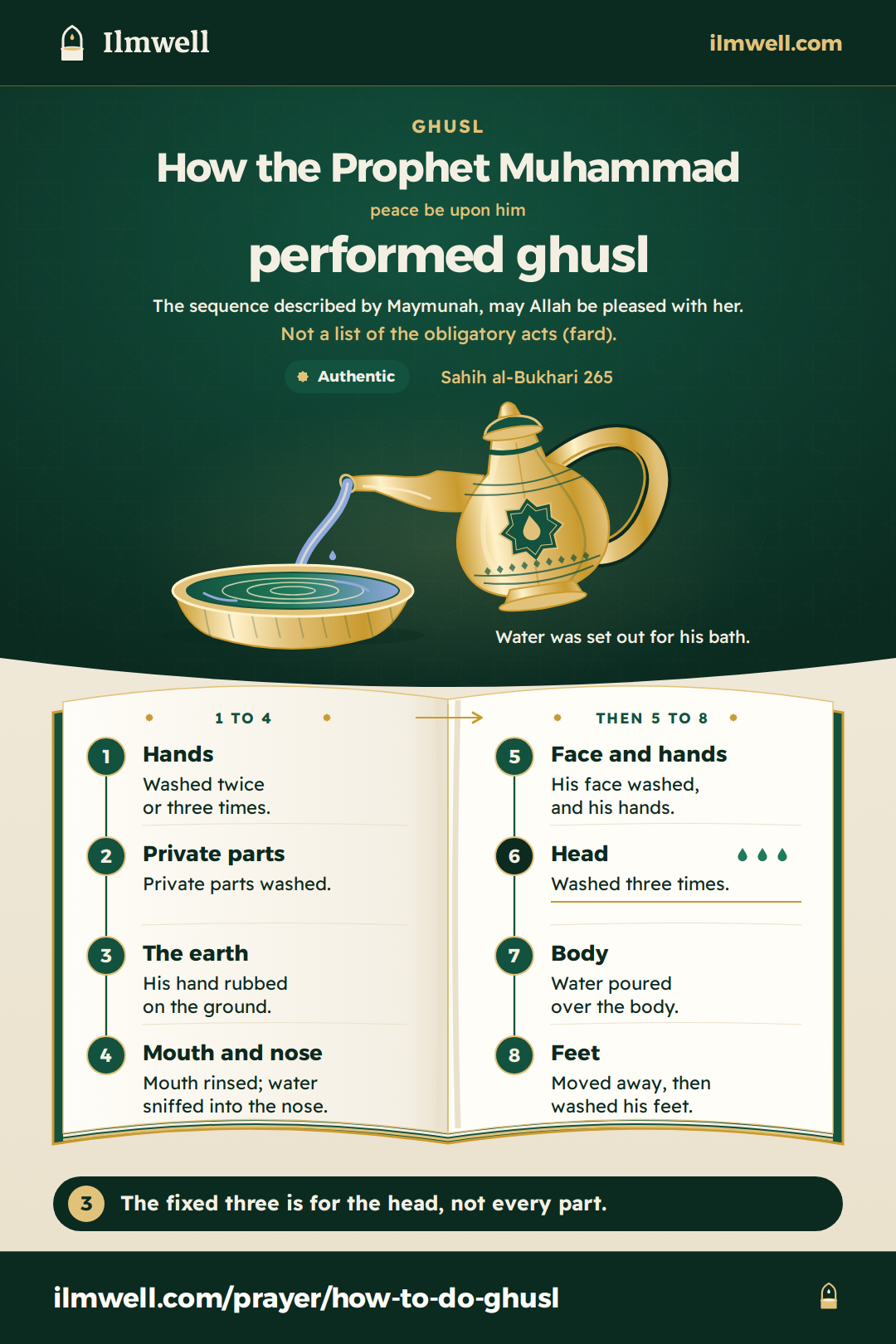
Maymunah, may Allah be pleased with her, set out water for the Prophet's bath and described what he did. The table follows the Arabic order of Sahih al-Bukhari 265, graded sahih.
| Step | What the report says |
|---|---|
| 1 Hands | Water poured over the hands, which he washed twice or three times |
| 2 Private parts | Water poured with the right hand over the left, and the private parts washed |
| 3 The earth | His hand rubbed on the ground |
| 4 Mouth and nose | The mouth rinsed and water sniffed into the nose |
| 5 Face and hands | His face washed, and his hands |
| 6 Head | The head washed three times |
| 7 Body | Water poured over the body |
| 8 Feet | He moved away from his place, then washed his feet |
2AuthenticSahih al-Bukhari 265
The Arabic gives "three" to the head, not to the face and hands, and does not name wudu.
What does each of the four schools say about ghusl?
Each column follows named works of one school. Fard and wajib are these works' words for what is required; sunnah and recommended acts complete the ghusl. A sunnah in one work is not a requirement in another.
| HanafiHidayah, Maraqi | Shafi'iMinhaj, Majmu | MalikiDardir, Dasuqi | HanbaliKashshaf, Mughni | |
|---|---|---|---|---|
| Intention | Sunnah 8 | Required, at the first fard act 1011 | Wajib 9 | Among the wajib acts of the minimal ghusl 12 |
| Mouth and nose | Fard 78 | Not wajib; sunnah 1011 | Sunnah 9 | Wajib, as in wudu 12 |
| Rubbing the body | Sunnah; wajib only in one report from Abu Yusuf 8 | Listed in the fuller ghusl; the wajib acts in al-Majmu' are three, and what exceeds them is sunnah 1011 | Wajib 9 | Recommended; not wajib if sure the water reached everywhere 12 |
| Continuity | Listed among the sunnahs 8 | Sunnah 11 | Wajib if remembered and able, a point on which the work notes a dispute. If forgotten, the sunnah is to build on a new intention 9 | Sunnah, not wajib; if what he washed dries before he finishes, he renews the intention to complete it 12 |
| Saying Allah's name | Sunnah 8 | Recommended, the sound view of the school 11 | Not in the passage read 9 | Wajib by analogy with wudu, dropped if forgotten; al-Mughni treats it as lighter 12 |
| Wudu inside the ghusl | Sunnah 8 | Sunnah; the ghusl is valid without it 11 | Recommended 9 | In the complete ghusl, not the minimal one 12 |
Al-Marghinani (Hanafi) names these as the fard of ghusl: rinsing the mouth, sniffing water into the nose and washing the rest of the body. He reports al-Shafi'i's view that the first two are sunnah, and disagrees 7. In al-Dardir's Sharh with al-Dasuqi, 1/132 to 1/136, the passage read does not mention saying Allah's name, so no Maliki position is given 9.
Does ghusl count as wudu?
In 'Aisha's report wudu is a named step. The works read (Maraqi, al-Majmu', al-Dardir and Kashshaf) treat it as a sunnah or recommended part of the fuller ghusl, as the last row of the table shows. Al-Nawawi, in al-Majmu', says a person in janabah who has not also broken wudu needs no separate wudu, and may pray with that ghusl, wudu being a sunnah within it 11. The other cases, and the other schools' answers, are not covered here. For your own case, ask a scholar you trust.
How do women do ghusl?
Asma bint Shakal, may Allah be pleased with her, also asked the Prophet about ghusl from janabah (Sahih Muslim 332c holds two questions from her; the first, about menstruation, is in the section on a period below). He said to take water and cleanse well, pour water over her head and rub it until it reaches the roots of the hair, then pour water over herself (Sahih Muslim 332c).
4AuthenticSahih Muslim 332c
Ibn Hazm called one narrator in this chain weak; Muslim included the report in his Sahih. 'Aisha, may Allah be pleased with her, who narrates it, then praised the Ansar women (the Muslim women of Madinah): shyness did not stop them learning the religion.
Do women have to undo their braids?
Umm Salamah, may Allah be pleased with her, asked the Prophet whether she should undo her tightly plaited hair for ghusl from janabah. He said no: it is enough to throw three handfuls of water over her head, then pour water over herself (Sahih Muslim 330a, graded sahih). That wording names janabah, not menstruation.
5AuthenticSahih Muslim 330a
Sahih Muslim 330b notes that in 'Abd al-Razzaq's version the question is "for menstruation and janabah", and the answer is no. That wording is graded differently: it is in Sahih Muslim, while two graders call the mention of menstruation shadh, an irregular wording.
6Graded differently Sahih Muslim 330b
| Hanafi | Shafi'i | Maliki | Hanbali |
|---|---|---|---|
| Plaits need not be undone if the water reaches the roots. Matted or heavy hair must be undone, and so must a man's plaits 78 | No need to undo them if the water reaches without undoing; she undoes them if it reaches only that way. The same for menstrual ghusl 11 | Gather, press and move the plaits so water enters; undoing is not wajib unless they are so tight, or plaited with so many threads, that water does not enter 9 | Undone for menstrual and postnatal ghusl (wajib in al-Buhuti), not for janabah if the roots are soaked. Ibn Qudamah, on menstrual ghusl, reports that the scholars of his school differ and holds the recommended view, if Allah wills 1213 |
Only the Hanbali works read separate janabah from menstruation here; the Hanafi, Shafi'i and Maliki passages read do not separate janabah from menstruation. Ask a scholar you trust how your school applies this to your hair.
How do you do ghusl after a period?
Fatimah bint Abi Hubaysh, may Allah be pleased with her, had bleeding that was not her period. The Prophet told her it was a vein and not the menses, to leave prayer when the menses came, and to wash and pray when it went (Sahih al-Bukhari 320, graded sahih). That report gives the instruction to wash, not the method.
3AuthenticSahih al-Bukhari 320
The method is in the answer to Asma bint Shakal about washing after menstruation. The Prophet said to take water and sidr and cleanse well, pour water over the head and rub it hard to the roots, then pour water over herself, then take a musk-scented piece and cleanse with it. When Asma asked how, he said "Subhan Allah, cleanse yourself with it". 'Aisha then told her "follow the trace of blood with it", in the Arabic as though concealing it. That explanation is 'Aisha's, not the Prophet's (Sahih Muslim 332c).
Al-Buhuti (Hanbali) counts sidr in menstrual ghusl, and following the trace with musk afterwards, as sunnah 12. Al-Nawawi (Shafi'i) lists following the trace with musk, or something like it, in the fuller ghusl 10.
When a period has ended, and what to do with irregular or long bleeding, is for a scholar you trust. The reports give the instruction, not the signs.
Is there a dua after ghusl?
We found no words or dua taught for ghusl in the Book of Bathing in Sahih al-Bukhari (45 narrations) or the Book of Menstruation in Sahih Muslim (157 narrations). Seven phrase searches on dorar.net, on 24 October 2026, found none either 15. We scanned for six Arabic words and did not search other collections' ghusl chapters. The accounts above give none.
Al-Shurunbulali (Hanafi) puts beginning with Bismillah among the sunnahs 8; al-Nawawi (Shafi'i) calls it recommended 11; al-Buhuti (Hanbali) counts it as wajib and dropped if forgotten 12. These are jurists' statements, not a hadith we found. The search shows what we found, not that nothing exists.
Al-Nawawi also lists saying the two testimonies of faith after finishing, which he attributes to al-Mahamili, al-Jurjani, al-Ruyani and others 11. That is a jurists' statement too, not a hadith we found.
How do you know the water reached everywhere?
Al-Buhuti (Hanbali) lists places to check so the water reaches them: the hair roots, the ears, throat, armpits, navel, between the buttocks and behind the knees, and says a strong likelihood that it reached is enough 12. Ibn Qudamah says hair padding or sidr paste that stops water reaching beneath must be removed 13, and al-Shurunbulali (Hanafi) names wax and dough on the body as barriers, and not the dye on a dyer's nail 8. Whether modern products behave the same way is a question for a scholar.
Wounds, dressings and pain
This guide gives no ruling for a wound, a dressing, a cast or pain that affects washing. Ask a scholar you trust what your school says about your case.
Nobody sat me down and explained ghusl step by step. I picked it up by watching and guessing. Reading the reports in order, and seeing where the schools differ, answered questions I had carried for years.
Try it: the reports
Three checks, each with its source.
1In the report of 'Aisha, may Allah be pleased with her (Sahih al-Bukhari 248), what is poured three times?
Answer: Handfuls of water over the head. Three handfuls over the head, with both hands. The report does not give three washes for every part. Source 1
2In the report of Maymunah, may Allah be pleased with her (Sahih al-Bukhari 265), when are the feet washed?
Answer: At the end, after he moved away from his place. He poured water over his body, moved away from where he stood, and washed his feet. Source 2
3Does the question of Umm Salamah, may Allah be pleased with her, in Sahih Muslim 330a name menstruation?
Answer: No, it names ghusl from janabah. In Muslim's main wording the question is about janabah. Sahih Muslim 330b notes that in one narrator's version it names menstruation as well, a wording that two graders call shadh, an irregular wording. Source 5
Questions people ask
Does a shower count as ghusl?
The reports describe pouring water over the head and the body (Sahih al-Bukhari 248 and 265), and the school works set what is required. Whether your shower meets your school's conditions is for a scholar you trust.
Are the steps different for women?
The reports describe the same washing. The additions for women in the sources cited here concern plaited hair (Sahih Muslim 330a) and the washing after a period (Sahih al-Bukhari 320 and Sahih Muslim 332c). For your own case, ask a scholar you trust.
Sources
Every claim on this page comes from one of these. Gradings are reported with the scholar's name; we do not grade hadith ourselves.
- 1
'Aisha, may Allah be pleased with her, reported that when the Prophet Muhammad, peace be upon him, washed from janabah he began by washing his hands, then did wudu as for prayer, then put his fingers into the water and moved them through the roots of his hair, then poured three handfuls over his head with both hands, then poured water over all his skin.
Sahih al-Bukhari 248 Book 5, Hadith 1
Authentic: in Sahih al-Bukhari (Al-Bukhari); Sahih (Al-Albani); Included in his Sahih (Ibn Hibban); Its chain is sahih on the condition of the two Shaykhs (Shu'ayb al-Arna'ut)
- 2
Maymunah, may Allah be pleased with her, reported (through Ibn Abbas, may Allah be pleased with him and his father) that she set out water for the Prophet Muhammad's bath, and he poured water over his hands and washed them twice or three times, poured with his right hand over his left and washed his private parts, rubbed his hand on the earth, rinsed his mouth and nose, washed his face and his hands, washed his head three times, poured water over his body, then moved away from his place and washed his feet.
Sahih al-Bukhari 265 Book 5, Hadith 18
Authentic: in Sahih al-Bukhari (Al-Bukhari); Sahih (Al-Albani); Its chain is sahih on the condition of the two Shaykhs (Shu'ayb al-Arna'ut); Sahih (Ibn 'Abd al-Barr)
- 3
'Aisha, may Allah be pleased with her, reported that Fatimah bint Abi Hubaysh, may Allah be pleased with her, had istihadah (bleeding that was not her period) and asked the Prophet Muhammad, peace be upon him, who said it was a vein and not the menses, that she should leave prayer when the menses came and, when it went, wash and pray.
Sahih al-Bukhari 320 Book 6, Hadith 25
Authentic: in Sahih al-Bukhari
- 4
'Aisha, may Allah be pleased with her, reported that Asma bint Shakal, may Allah be pleased with her, asked the Prophet Muhammad, peace be upon him, about washing after menstruation; he said to take water and sidr and cleanse well, pour water over the head and rub it hard to the roots, then pour water over herself, then take a piece of cloth scented with musk and cleanse with it; when Asma asked how, he said 'Subhan Allah, cleanse yourself with it' and 'Aisha told her, as if hiding it, to follow the trace of blood with it.
Sahih Muslim 332c Book 3, Hadith 72
Authentic: in Sahih Muslim (Muslim); Sahih (Shu'ayb al-Arna'ut); Sahih (Al-Albani). Remarks: A narrator in this chain, Ibrahim ibn al-Muhajir, is weak (Ibn Hazm)
- 5
Umm Salamah, may Allah be pleased with her, asked the Prophet Muhammad, peace be upon him, whether she should undo her tightly plaited hair for ghusl from janabah, and he said no: it is enough to throw three handfuls of water over her head, then pour water over herself, and she will be purified.
Sahih Muslim 330a Book 3, Hadith 66
Authentic: in Sahih Muslim (Muslim); Sahih (Al-Albani); Its chain is sahih on the condition of Muslim (Shu'ayb al-Arna'ut); Included in his Sahih (Ibn Hibban); Included in his Sahih (Ibn Khuzaymah)
- 6
Muslim notes that in 'Abd al-Razzaq's narration of the Umm Salamah report the question is whether to undo the plait for menstruation and janabah, and the Prophet answers 'no'.
Sahih Muslim 330b Book 3, Hadith 67
Graded differently. Here is who graded it which way:
- SoundMuslim
- WeakAl-Albani, Ibn Baz
- Other remarksIbn Rajab
See each grading in full, with its wording and where it was given
Scholars disagree about this hadith. Here is how each graded it, so you can follow the scholar you trust.
- Sahih (in Sahih Muslim): Muslim, by inclusion in his Sahih
- The menstruation wording is shadh, not established (Irwa' al-Ghalil 1/168): Al-Albani
- Shadh in this wording (Irwa' al-Ghalil 135): Al-Albani
- "Should I undo it for menstruation" is shadh, not good (Majmu' al-Shuruh al-Fiqhiyyah 193/19): Ibn Baz
- 'Abd al-Razzaq alone reported the word 'menstruation' from al-Thawri (Fath al-Bari 1/481): Ibn Rajab
- 7
Al-Marghinani, in al-Hidayah, says the fard of ghusl is rinsing the mouth, sniffing water into the nose and washing the rest of the body; gives the sunnah sequence (hands and private part, remove filth, wudu for prayer except the feet, water over the head and body three times, then move aside and wash the feet); and says a woman need not undo her plaits when the water reaches the roots of the hair.
al-Marghinani, al-Hidayah 1/19 Read on shamela.ws on 24 October 2026. Record: scholarly-ghusl-hanafi-hidayah.
- 8
Al-Shurunbulali, in Maraqi al-Falah, says the fard of ghusl is washing the mouth, nose and body once; that a woman's plaits need not be undone if the water reaches the roots (but matted or heavy hair must be undone, and a man's plaits must be undone); and that the sunnahs of ghusl begin with the basmalah and the intention and include wudu, rubbing the body and continuity.
al-Shurunbulali, Maraqi al-Falah, pp. 45 to 47 Read on shamela.ws on 24 October 2026. Record: scholarly-ghusl-hanafi-maraqi.
- 9
Al-Dardir, in al-Sharh al-Kabir on Mukhtasar Khalil (with al-Dasuqi's Hashiyah), counts five wajib parts of ghusl (washing the outer body with water, intention, continuity, working water through the hair, rubbing), says continuity is wajib when the person remembers and is able, says plaited hair is gathered and pressed and need not be undone, and lists rinsing the mouth and sniffing water into the nose among the sunnahs.
al-Dardir, al-Sharh al-Kabir, with al-Dasuqi, 1/132 to 1/136 Read on shamela.ws on 24 October 2026. Record: scholarly-ghusl-maliki-dardir.
- 10
Al-Nawawi, in Minhaj al-Talibin, says the least ghusl is an intention (to lift janabah, or to make permissible what needs it, or to perform the fard of ghusl) joined to the first fard act, plus covering the hair and skin; that rinsing the mouth and sniffing water into the nose are not wajib; and that the fuller ghusl includes removing filth, wudu, rubbing and three washes, with a menstruating woman following the trace with musk.
al-Nawawi, Minhaj al-Talibin, pp. 14 to 15 Read on shamela.ws on 24 October 2026. Record: scholarly-ghusl-shafii-minhaj.
- 11
Al-Nawawi, in al-Majmu', says the basmalah is recommended before ghusl (the sound view of the school), wudu, rinsing the mouth and sniffing water into the nose are sunnahs of ghusl, continuity is a sunnah in the school's view, the intention is due at the first pouring of water, a woman need not undo her plaits if water reaches them, and lists saying the two testimonies after finishing among the sunnahs left out of the Muhadhdhab.
al-Nawawi, al-Majmu' 2/181 to 2/197 Read on shamela.ws on 24 October 2026. Record: scholarly-ghusl-shafii-majmu.
- 12
Al-Buhuti, in Kashshaf al-Qina', says the basmalah is wajib in ghusl by analogy with wudu and drops through forgetting; the minimal ghusl (only the wajib acts) is intention, basmalah, then covering the whole body including the mouth and nose; rubbing is recommended and not wajib if the person is sure the water reached everywhere; continuity is a sunnah and not wajib; and a woman undoes her hair for menstrual and postnatal ghusl but not for janabah if the roots are soaked, with some of the school's companions making menstrual undoing recommended instead.
al-Buhuti, Kashshaf al-Qina' 1/208 and 1/361 to 1/368 Read on shamela.ws on 24 October 2026. Record: scholarly-ghusl-hanbali-kashshaf.
- 13
Ibn Qudamah, in al-Mughni, explains the Hanbali matn that a woman undoes her hair for menstrual ghusl but need not for janabah if she soaks the roots, reports that his school's companions differ on whether undoing for menstruation is wajib or recommended, and calls the recommended view the correct one if Allah wills.
Ibn Qudamah, al-Mughni 1/165 to 1/166 Read on shamela.ws on 24 October 2026. Record: scholarly-ghusl-hanbali-mughni.
- 14
Ibn Faris, in Mu'jam Maqayis al-Lughah, says the root gh-s-l is a sound root pointing to the cleansing and purifying of a thing, that one says 'ghasaltu al-shay' ghaslan' (I washed the thing), and that al-ghusl is the noun.
Ibn Faris, Mu'jam Maqayis al-Lughah 4/424 Read on shamela.ws on 24 October 2026. Record: scholarly-ibnfaris-ghasala-root.
- 15
The Ilmwell team's check on 24 October 2026 found no narration giving words or a dua to say before or after ghusl in the Book of Bathing in Sahih al-Bukhari (45 narrations, 248 to 293) or the Book of Menstruation in Sahih Muslim (157 narrations, 293a to 376d), and no such narration in seven dorar.net phrase searches; what we did find is that the school works read for this page mention the basmalah before ghusl (Hanafi, Shafi'i, Hanbali) and, in one Shafi'i work, the two testimonies after finishing.
Ilmwell team search, 24 October 2026 Record: search-ghusl-dua.
Next
For your own situation, ask a scholar you trust.
Join the email list
New guides by email, now and then. No spam, and you can leave at any time.
Ilmwell is free and kept going by readers. See how to support it.