The short answer
How to perform Umrah (also spelt umra): the works read here describe ihram, the talbiyah, seven circuits, two rak'ahs, seven lengths between Safa and Marwah, then shaving or shortening. Sahih al-Bukhari 1645 (graded sahih) reports the Prophet Muhammad, peace be upon him, doing the circling, the prayer and the walking. The four schools differ on the ruling and the hair.
How do you perform Umrah step by step?
Steps drawn from Sahih al-Bukhari are reports, not one school's way. A line marked with a school follows only that school's work. This is a learning guide, not a ruling from us, and the table after the steps shows where the works differ.
- Enter ihram at the miqat. Ihram is the state of consecration you enter for the rite, and the miqat is the boundary place where it begins. Ibn Abbas, may Allah be pleased with him, names four miqats in Sahih al-Bukhari 1524 (graded sahih): Dhul-Hulayfah for the people of Madinah, al-Juhfah for Sham, Qarn al-Manazil for Najd and Yalamlam for Yemen. They serve those people and others who pass them intending Hajj or Umrah. These are places on land, not flight routes, so ask your group leader or a scholar you trust which applies to you. Ibn Abd al-Barr (Maliki) says a Makkan may not enter ihram for Umrah until he goes out to al-Hill, the land outside the sacred boundary of Makkah. 115
- Say the talbiyah. Ibn 'Umar, may Allah be pleased with him, reports the words in Sahih al-Bukhari 1549 (graded sahih). They are written out below the steps. 2
- Circle the Kaaba (tawaf). Asked about a man in Umrah, Ibn 'Umar says the Prophet went round the House seven times (Sahih al-Bukhari 1645, graded sahih). Sahih al-Bukhari 1616 adds that on first arriving, in Hajj or Umrah, he went briskly for three circuits and walked four. Ibn Qasim al-Ghazzi (Shafi'i) describes starting at the Black Stone with the House on your left (in his list of Hajj pillars; he lists tawaf among Umrah's pillars too). 'Aisha, may Allah be pleased with her, says in Sahih al-Bukhari 1641 that on reaching Makkah for his Hajj the Prophet began with wudu (see how to perform wudu). Ask your teacher what your school requires for tawaf. 34185
- Pray two rak'ahs. A rak'ah is one cycle of standing, bowing and prostrating. Sahih al-Bukhari 1645 has the Prophet praying two rak'ahs behind the Maqam (the Station of Ibrahim), while the Arabic of Sahih al-Bukhari 1616 says he prostrated two prostrations. Ibn Qasim al-Ghazzi (Shafi'i) says behind the Station of Ibrahim, peace be upon him, and if that is not possible the Hijr, otherwise the mosque, otherwise anywhere in the Haram or elsewhere (listed among the sunnahs of Hajj). 321
- Go between Safa and Marwah (sa'i). Ibn 'Umar reports the Prophet doing this seven times after the prayer (Sahih al-Bukhari 1645). Al-Baqarah 2:158 names the two places, and the count is explained below.
- Shave or shorten your hair. Sahih al-Bukhari 1727 (graded sahih) records the Prophet praying for mercy on those who shave. Asked about those who shorten, he repeated it, then included them when asked again. In Sahih al-Bukhari 1691, from the Farewell Hajj, he tells those who had not brought a sacrificial animal to go round the House and between Safa and Marwah, shorten their hair and leave ihram (a Hajj instruction, shown here for the hair). The works differ on the hair. 67
What are the words of the talbiyah?
لَبَّيْكَ اللَّهُمَّ لَبَّيْكَ، لَبَّيْكَ لاَ شَرِيكَ لَكَ لَبَّيْكَ، إِنَّ الْحَمْدَ وَالنِّعْمَةَ لَكَ وَالْمُلْكَ، لاَ شَرِيكَ لَكَ
Labbayka Allāhumma labbayk, labbayka lā sharīka laka labbayk, inna l-ḥamda wa n-niʿmata laka wa l-mulk, lā sharīka lak.
Meaning (our rendering): Here I am, O Allah, here I am. Here I am, You have no partner, here I am. Indeed, all praise and favour are Yours, and all sovereignty. You have no partner.
2AuthenticSahih al-Bukhari 1549
What do the four schools' works say about Umrah?
Each column follows the named works of one school. A cell gives what that work says, in short. It is not a ruling from us and it does not cover every view inside a school.
| HanafiHidayah | Shafi'iMinhaj, Fath al-Qarib | MalikiKafi | HanbaliKashshaf al-Qina' | |
|---|---|---|---|---|
| Ruling on Umrah | Sunnah (recommended). Al-Marghinani reports that al-Shafi'i says fard (obligatory) 13 | Fard, in the more apparent view of the school 17 | Not fard, but wajib in the manner of a sunnah that no one able to do it may leave. A group of the people of Madinah hold it fard 14 | Obligatory, once in a lifetime. For a Makkan the work states it is obligatory, then reports Ahmad's own statement that it is not 23 |
| Entering ihram | Intention alone is not enough until the talbiyah is said. A remembrance meant as glorification, in Persian or Arabic, also serves 11 | Ihram is a pillar of Umrah, and the Hajj list joins it to the intention. The talbiyah is among the sunnahs of Hajj in this work 181921 | Not covered in the passages read | Ihram is the intention for the rite, even if you have not taken off the clothes forbidden to one in ihram (said in its Hajj pillars) 24 |
| What the rite consists of | Ihram from the miqat, tawaf, sa'i, then shaving or shortening, after which you are free of ihram (described under tamattu'; the author says Umrah alone is done the same way) 12 | Pillars: ihram, tawaf and sa'i, with shaving or shortening in the preferred of two sayings 19 | Ihram and the talbiyah, seven circuits, seven lengths, then shaving or shortening 16 | Pillars: ihram, tawaf and sa'i. Obligations: ihram from al-Hill (outside the sacred boundary), and shaving or shortening 25 |
| When the talbiyah stops | When tawaf begins 12 | Not covered in the passages read | When tawaf begins, or if he wishes when he sees the House or enters the mosque (said of ihram from al-Tan'im) 15 | When tawaf begins 26 |
Where sources differ: al-Marghinani (Hanafi) reports that Malik held there is no shaving, because Umrah is tawaf and sa'i only 12. Ibn Abd al-Barr (Maliki), in al-Kafi, describes shaving or shortening as completing the Umrah 16. We show both and do not reconcile them.
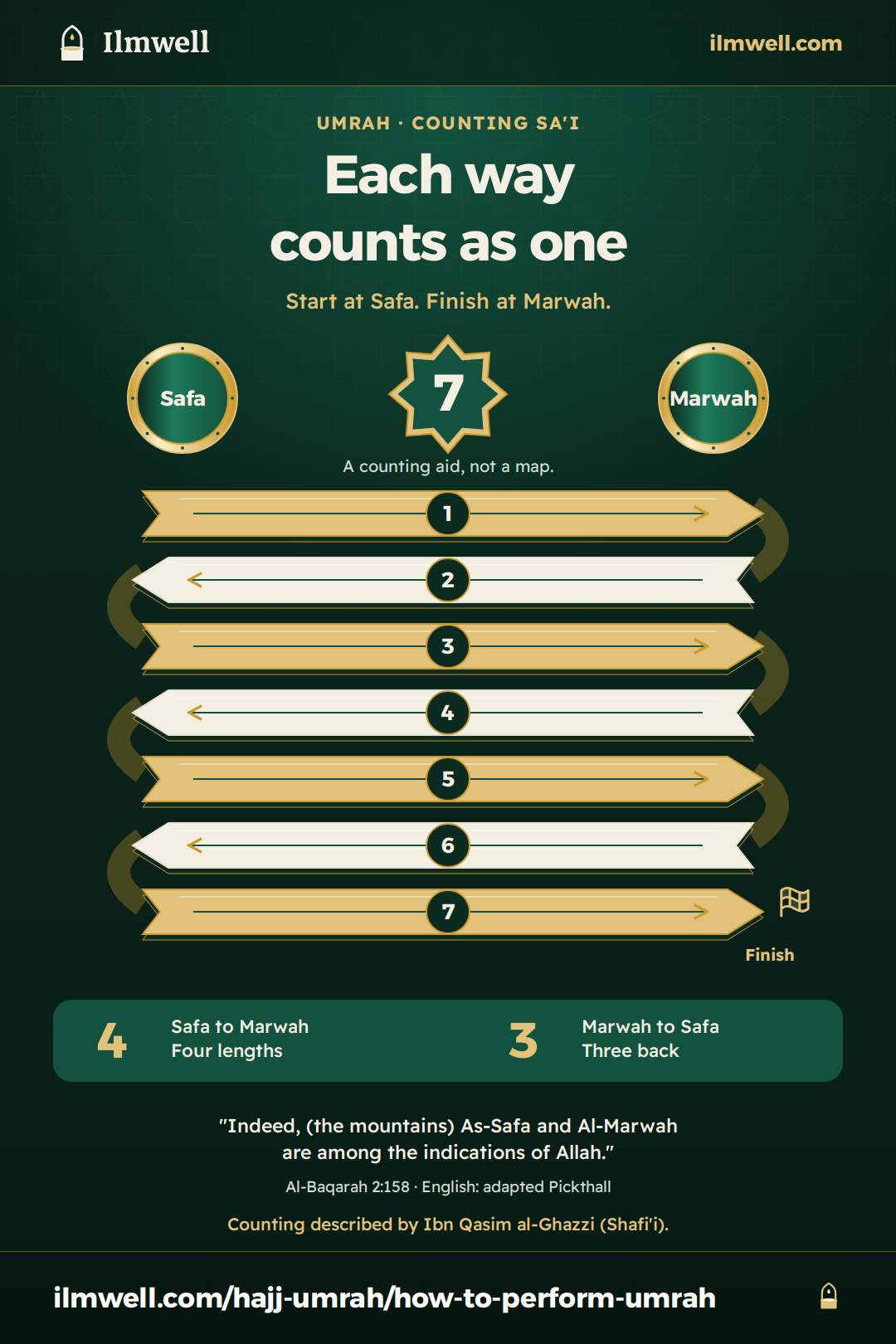
How are the seven lengths between Safa and Marwah counted?
۞ إِنَّ ٱلصَّفَا وَٱلْمَرْوَةَ مِن شَعَآئِرِ ٱللَّهِ ۖ فَمَنْ حَجَّ ٱلْبَيْتَ أَوِ ٱعْتَمَرَ فَلَا جُنَاحَ عَلَيْهِ أَن يَطَّوَّفَ بِهِمَا ۚ وَمَن تَطَوَّعَ خَيْرًا فَإِنَّ ٱللَّهَ شَاكِرٌ عَلِيمٌ
Ibn Qasim al-Ghazzi (Shafi'i) says to start at Safa and finish at Marwah, going from Safa to Marwah counting as one and the return as another 19. We did not read this counting in the other three works. The table is our counting aid from that description. It is not a map and gives no distances, routes or coordinates.
| Length | Direction |
|---|---|
| One | Safa to Marwah |
| Two | Marwah to Safa |
| Three | Safa to Marwah |
| Four | Marwah to Safa |
| Five | Safa to Marwah |
| Six | Marwah to Safa |
| Seven | Safa to Marwah, and you finish at Marwah |

Do you have to shave your head for Umrah?
Each of the four works read here names shaving or shortening for the end of Umrah, and Sahih al-Bukhari 1727 mentions both. The works differ on which is better and on the amount, so do not take one school's figure for another's.
| HanafiHidayah | Shafi'iMinhaj, Fath al-Qarib | MalikiKafi | HanbaliKashshaf al-Qina' |
|---|---|---|---|
| Shaves or shortens, then is free of ihram. No amount is given in the passage read 12 | Shaving is better for a man, shortening for a woman. The least is removing three hairs of the head (said in its list for Hajj) 20 | Shaving, though shortening suffices and shaving is described as better. No amount is given 16 | Shaves or shortens (an obligation of Umrah). If shortening, from all the hair of the head; a woman, a fingertip's length or less from the ends of her plaits (said in its Hajj passage) 252728 |
If shaving is a worry for you, for health, hair or any other reason, bring it to a scholar you trust before you travel.
What is Umrah, and how does it differ from Hajj?
Al-Buhuti (Hanbali) gives Umrah in language as a visit, and i'tamara as "he visited" 22. The Quran names it beside Hajj in Al-Baqarah 2:196, which opens:
وَأَتِمُّوا۟ ٱلْحَجَّ وَٱلْعُمْرَةَ لِلَّهِ
Perform the pilgrimage and the visit (to Makka) for Allah.
| Hajj | Umrah | |
|---|---|---|
| In the Hanbali work's words | Heading to Makkah for the rites at a particular time 22 | A visit to the House in a particular way 22 |
| Time | Shawwal, Dhu al-Qa'dah and ten nights of Dhu al-Hijjah (Fath al-Qarib) 20 | The whole year for its ihram (Fath al-Qarib) 20 |
| Standing at Arafah | A pillar in both Fath al-Qarib and Kashshaf al-Qina' 1824 | Not among the pillars of Umrah in either 1925 |
| Number of pillars | Four in both works 1824 | Three in both works: ihram, tawaf and sa'i 1925 |
Hajj is a rite in its own right, and this page is not a guide to it.
What should women check before Umrah?
Umrah for ladies follows the same steps; where the works read here differ for women is the hair and the clothes. On the hair, the Shafi'i and Hanbali works read here both speak of shortening for a woman. The face veil and gloves are in the clothes section.
'Aisha says in Sahih al-Bukhari 1650 (graded sahih) that she reached Makkah menstruating and had not gone round the House or between Safa and Marwah. The Prophet told her to do as the pilgrim does, except not to go round the House until she was pure. His words speak of what "the pilgrim" does, and the report gives no rule for an Umrah with fixed dates. 9
If your dates and your cycle might meet
This page gives no ruling on it and no advice on medicines. A scholar you trust can go through your case before you book, and a doctor can advise on any medicine.
What can you wear in ihram, and what about sandals and shoes?
A man asks the Prophet what to wear in ihram. In Sahih al-Bukhari 1838 (graded sahih), Ibn 'Umar reports the answer: do not wear a shirt, trousers, turbans or hooded cloaks. Someone with no sandals wears leather socks, cut below the ankles. Do not wear anything touched by saffron or wars. The woman in ihram is not to wear a face veil (niqab) or gloves. Al-Bukhari adds that Malik reports the face-veil clause as Ibn 'Umar's own words. 8
Sandals and leather socks are the only footwear the report names. It says nothing of any modern shoe or slipper, so ask a scholar you trust about the footwear you plan to wear. No product is recommended here.
What duas and what intention go with Umrah?
The talbiyah is the one set of words in these reports. Sahih al-Bukhari 1645 and 1616 record no words for the circuits, the prayer or the lengths, and 1549 gives no fixed wording for the intention.
Al-Marghinani (Hanafi) says intention alone does not make a person enter ihram until the talbiyah, and for Hajj he gives a supplication that begins "O Allah, I want Hajj" (our rendering) 11. Al-Buhuti (Hanbali) calls ihram the intention for the rite 24. The passages read for Umrah give no fixed spoken sentence for it. Ask your teacher what your group says. For further duas, look for a book that names the report behind each one.
When is Umrah performed, and what about Ramadan?
Ibn Qasim al-Ghazzi (Shafi'i) says the whole year is a time for the ihram of Umrah 20. Al-Marghinani (Hanafi) says it is permitted all year except five days he calls disliked: the day of Arafah, the day of sacrifice and the days of tashriq 13. Ibn Abd al-Barr (Maliki) says it may be done before, with or after Hajj, in the Hajj months and outside them 14.
In Sahih al-Bukhari 1782 (graded sahih), Ibn Abbas reports the Prophet asking a woman of the Ansar what kept her from Hajj with them. He told her to make Umrah in Ramadan when it came, for an Umrah in Ramadan is a Hajj, "or words to that effect" (the narrator's doubt). The report does not say it replaces a Hajj that is due, and gives no reward figure. 10
How long does Umrah take?
The sources read here give counts, not a duration: seven circuits, seven lengths, the prayer, and the entry to and exit from ihram. Your group leader can tell you what to expect for your own group.
What should you prepare before you leave?
This is our learning checklist, not a packing list or a travel guarantee.
- Find out which miqat applies to you, and learn the talbiyah.
- Learn the count with the table: seven circuits, seven lengths.
- Ask your teacher about ihram, clothing and the hair in your school.
- Bring health and mobility questions to a doctor. Bring questions about the rites if you are ill, elderly, disabled or on your period to a scholar you trust.
- Check current requirements on Nusuk, which presents itself as the official platform for Hajj and Umrah. 29
What helped most when learning the steps of Umrah was seeing them as one short sequence rather than a long list of rules. Once the order made sense, the details had somewhere to sit.
Try it: count the rite
Three checks, each with its source.
1Does going from Safa to Marwah and back count as one length in Fath al-Qarib?
Answer: No, two. Going from Safa to Marwah counts as one and the return as another, seven in all, starting at Safa and ending at Marwah. Source 19
2Where does Sahih al-Bukhari 1645 say the Prophet prayed the two rak'ahs after the circuits?
Answer: Behind the Maqam. Behind the Maqam. The report is Ibn 'Umar's answer to a question about a man in Umrah. Source 3
3Which of the works read here gives a three-hair minimum?
Answer: Fath al-Qarib (Shafi'i). Only Fath al-Qarib states it in the passages read. The Hanafi and Maliki passages give no amount, and Kashshaf al-Qina' speaks of shortening from all the hair. Source 20
Questions people ask
Does a woman need a mahram for Umrah?
Mahram means a close relative a woman travels with. This page does not give a ruling on it, and the question is a fair one to bring to a scholar you trust. For current travel requirements, check the official platform (Nusuk) before you travel.
What if I lose count of the circuits or miss a step?
Please do not worry. This page gives no ruling on a missed step or an uncertain count. A scholar you trust can go through what happened, and your group leader can help you find one while you are there.
Sources
Every claim on this page comes from one of these. Gradings are reported with the scholar's name; we do not grade hadith ourselves.
- 1
Ibn Abbas reports that the Prophet set Dhul-Hulayfah, al-Juhfah, Qarn al-Manazil and Yalamlam as the miqats for the people of Madinah, Sham, Najd and Yemen, and for others who pass them intending Hajj or Umrah.
Sahih al-Bukhari 1524 Book 25, Hadith 12
Authentic: in Sahih al-Bukhari (Al-Bukhari); [صحيح] (sahih), Sahih al-Bukhari 1524 (Al-Bukhari)
- 2
Ibn 'Umar reports that the talbiyah of the Prophet was: Labbayka Allahumma labbayk, labbayka la sharika laka labbayk, inna l-hamda wa n-ni'mata laka wa l-mulk, la sharika lak.
Sahih al-Bukhari 1549 Book 25, Hadith 35
Authentic: in Sahih al-Bukhari (Al-Bukhari); صحيح (sahih), Takhrij al-Musnad 5024, same wording from Ibn 'Umar (Shu'ayb al-Arna'ut); [صحيح] (sahih), Sahih al-Bukhari 1549 (Al-Bukhari)
- 3
Asked about a man in Umrah who had gone round the House but not between Safa and Marwah, Ibn 'Umar replied that the Prophet came, went round the House seven times, prayed two rak'ahs behind the Maqam and went between Safa and Marwah seven times, and recited that the Messenger of Allah is a good example; Jabir (may Allah be pleased with him) said the man should not approach his wife until he had gone between Safa and Marwah.
Sahih al-Bukhari 1645 Book 25, Hadith 127
Authentic: in Sahih al-Bukhari (Al-Bukhari); [صحيح] (sahih), Sahih al-Bukhari 1645 (Al-Bukhari)
- 4
Ibn 'Umar reports that when the Prophet went round the House in Hajj or Umrah on first arriving, he went briskly for three circuits and walked four, then prayed two rak'ahs, then went between Safa and Marwah.
Sahih al-Bukhari 1616 Book 25, Hadith 101
Authentic: in Sahih al-Bukhari (Al-Bukhari); [صحيح] (sahih), Sahih al-Bukhari 1616 (Al-Bukhari)
- 5
'Urwa ibn al-Zubayr reports that 'Aisha told him that when the Prophet made his Hajj, the first thing he did on arriving was to make wudu, then go round the House.
Sahih al-Bukhari 1641 Book 25, Hadith 124
Authentic: in Sahih al-Bukhari (Al-Bukhari); [صحيح] (sahih), Sahih al-Bukhari 1641 (Al-Bukhari)
- 6
Ibn 'Umar reports that the Prophet said, O Allah, have mercy on those who shave their heads; when asked about those who shorten, he repeated it, then said: and those who shorten.
Sahih al-Bukhari 1727 Book 25, Hadith 205
Authentic: in Sahih al-Bukhari (Al-Bukhari); [صحيح] (sahih), Sahih al-Bukhari 1727; dorar.net adds that the closing reports of al-Layth and Ubayd Allah are mu'allaq (Al-Bukhari)
- 7
Ibn 'Umar reports that in the Farewell Hajj the Prophet told those who had not brought a sacrificial animal to go round the House and between Safa and Marwah, shorten their hair and leave ihram, and later enter ihram for Hajj; he himself touched the corner first, went briskly for three circuits and walked four, prayed two rak'ahs at the Maqam and went between Safa and Marwah seven times.
Sahih al-Bukhari 1691 Book 25, Hadith 170
Authentic: in Sahih al-Bukhari (Al-Bukhari); [صحيح] (sahih), Sahih al-Bukhari 1691 (Al-Bukhari)
- 8
Ibn 'Umar reports the Prophet's answer on what to wear in ihram: no shirt, trousers, turbans or hooded cloaks, leather socks cut below the ankles only for one who has no sandals, nothing touched by saffron or wars, and the woman in ihram does not wear a face veil (niqab) or gloves.
Sahih al-Bukhari 1838 Book 28, Hadith 18
Authentic: in Sahih al-Bukhari (Al-Bukhari); [صحيح] (sahih), Sahih al-Bukhari 1838 (Al-Bukhari)
- 9
'Aisha reports that she reached Makkah menstruating and had not gone round the House or between Safa and Marwah; the Prophet told her to do as the pilgrim does, except that she should not go round the House until she was pure.
Sahih al-Bukhari 1650 Book 25, Hadith 131
Authentic: in Sahih al-Bukhari (Al-Bukhari); [صحيح] (sahih), Sahih al-Bukhari 1650 (Al-Bukhari)
- 10
Ibn Abbas reports that the Prophet asked an Ansari woman what kept her from Hajj with them, and told her that when Ramadan came she should make Umrah in it, for an Umrah in Ramadan is a Hajj, or words to that effect.
Sahih al-Bukhari 1782 Book 26, Hadith 9
Authentic: in Sahih al-Bukhari (Al-Bukhari); [صحيح] (sahih), Sahih al-Bukhari 1782 (Al-Bukhari)
- 11
Al-Marghinani (Hanafi), in al-Hidayah, says a person does not enter ihram by intention alone until he says the talbiyah, and that entry can also be by a remembrance meant as glorification other than the talbiyah; after the two rak'ahs of ihram he gives a supplication worded for Hajj.
al-Marghinani, al-Hidayah 1/135 (intention and the talbiyah) Read on shamela.ws on 25 October 2026. Record: scholarly-umrah-hanafi-hidayah-ihram.
- 12
Al-Marghinani (Hanafi), in al-Hidayah, describes Umrah as ihram from the miqat, entering Makkah, tawaf, sa'i, then shaving or shortening, after which the person is free of ihram; he cuts the talbiyah when he begins tawaf, and he reports that Malik held there is no shaving.
al-Marghinani, al-Hidayah 1/153 (the sequence of Umrah) Read on shamela.ws on 25 October 2026. Record: scholarly-umrah-hanafi-hidayah-sequence.
- 13
Al-Marghinani (Hanafi), in al-Hidayah, says Umrah is sunnah (reporting that al-Shafi'i says fard), that it is permitted throughout the year except five days on which he says doing it is disliked, and that it is tawaf and sa'i.
al-Marghinani, al-Hidayah 1/178 (the ruling and the disliked days) Read on shamela.ws on 25 October 2026. Record: scholarly-umrah-hanafi-hidayah-ruling-time.
- 14
Ibn 'Abd al-Barr (Maliki), in al-Kafi, says that in Malik's view and his companions' Umrah is not fard but is wajib with the strength of a sunnah that no one able to do it may leave, that a group of the people of Madinah hold it fard like Hajj, and that it may be done before, with or after Hajj, in the Hajj months and outside them.
Ibn 'Abd al-Barr, al-Kafi 1/416 (the ruling and the times) Read on shamela.ws on 25 October 2026. Record: scholarly-umrah-maliki-kafi-ruling.
- 15
Ibn 'Abd al-Barr (Maliki), in al-Kafi, says the miqat is better than al-Ji'rana and al-Tan'im for Umrah, that a Makkan may not enter ihram for Umrah until he goes out to the Hill, and that the pilgrim cuts the talbiyah when he begins tawaf or, if he wishes, when he sees the House or enters the mosque (for one who enters ihram from al-Tan'im).
Ibn 'Abd al-Barr, al-Kafi 1/417 (the Hill and the end of the talbiyah) Read on shamela.ws on 25 October 2026. Record: scholarly-umrah-maliki-kafi-talbiyah.
- 16
Ibn 'Abd al-Barr (Maliki), in al-Kafi, says that after tawaf of seven and sa'i of seven the pilgrim shaves his head and his Umrah is complete; if he shortens his hair that suffices, and shaving is better.
Ibn 'Abd al-Barr, al-Kafi 1/417 (the circuits, the lengths and the hair) Read on shamela.ws on 25 October 2026. Record: scholarly-umrah-maliki-kafi-sequence.
- 17
Al-Nawawi (Shafi'i), in Minhaj al-Talibin, opens the book of Hajj by saying it is fard and Umrah is the same in the more apparent view.
al-Nawawi, Minhaj al-Talibin, p. 82 (the ruling) Read on shamela.ws on 25 October 2026. Record: scholarly-umrah-shafii-minhaj-ruling.
- 18
Ibn Qasim al-Ghazzi (Shafi'i), in Fath al-Qarib, lists the pillars of Hajj as four, beginning with ihram with intention and standing at Arafah, and describes tawaf as seven circuits with the House on the person's left, beginning at the Black Stone.
Ibn Qasim al-Ghazzi, Fath al-Qarib, p. 145 (the Hajj pillars and tawaf) Read on shamela.ws on 25 October 2026. Record: scholarly-umrah-shafii-fathqarib-hajj-tawaf.
- 19
Ibn Qasim al-Ghazzi (Shafi'i), in Fath al-Qarib, says sa'i is seven, beginning at Safa and ending at Marwah, going from Safa to Marwah counting as one and the return as another; and lists the pillars of Umrah as ihram, tawaf and sa'i, with shaving or shortening in one of two sayings, which he calls the preferred.
Ibn Qasim al-Ghazzi, Fath al-Qarib, p. 147 (the count of sa'i and the Umrah pillars) Read on shamela.ws on 25 October 2026. Record: scholarly-umrah-shafii-fathqarib-sai-pillars.
- 20
Ibn Qasim al-Ghazzi (Shafi'i), in Fath al-Qarib, gives the time of Hajj as Shawwal, Dhu al-Qa'dah and ten nights of Dhu al-Hijjah and says the whole year is a time for the ihram of Umrah; he says the better course is shaving for a man and shortening for a woman, and that the least removal is three hairs of the head.
Ibn Qasim al-Ghazzi, Fath al-Qarib, pp. 148 to 149 (the times and the hair) Read on shamela.ws on 25 October 2026. Record: scholarly-umrah-shafii-fathqarib-hair-time.
- 21
Ibn Qasim al-Ghazzi (Shafi'i), in Fath al-Qarib, lists the talbiyah (to be said often while in ihram) and the two rak'ahs of tawaf (behind the Station of Ibrahim) among the sunnahs of Hajj.
Ibn Qasim al-Ghazzi, Fath al-Qarib, p. 152 (the talbiyah and the two rak'ahs) Read on shamela.ws on 25 October 2026. Record: scholarly-umrah-shafii-fathqarib-talbiyah-rakahs.
- 22
Al-Buhuti (Hanbali), in Kashshaf al-Qina', defines Hajj in the rite as heading to Makkah for the rites at a particular time, gives the meaning of Umrah in language as 'visit' (saying i'tamarahu is said for 'he visited it'), and defines it in the rite as a visit to the House in a particular way.
al-Buhuti, Kashshaf al-Qina' 6/9, 6/12 and 6/13 (the meanings) Read on shamela.ws on 25 October 2026. Record: scholarly-umrah-hanbali-kashshaf-meaning.
- 23
Al-Buhuti (Hanbali), in Kashshaf al-Qina', says Umrah is obligatory on a Makkan as on others, then reports Ahmad's own statement that it is not obligatory on a Makkan, and says Hajj and Umrah are each due once in a lifetime.
al-Buhuti, Kashshaf al-Qina' 6/13, 6/15 and 6/16 (the ruling) Read on shamela.ws on 25 October 2026. Record: scholarly-umrah-hanbali-kashshaf-ruling.
- 24
Al-Buhuti (Hanbali), in Kashshaf al-Qina', lists standing at Arafah first among the four pillars of Hajj, and says ihram is the intention for the rite even if the person has not taken off the clothes forbidden to one in ihram.
al-Buhuti, Kashshaf al-Qina' 6/358 (the Hajj pillars and ihram) Read on shamela.ws on 25 October 2026. Record: scholarly-umrah-hanbali-kashshaf-ihram-arafah.
- 25
Al-Buhuti (Hanbali), in Kashshaf al-Qina', lists the pillars of Umrah as three (ihram, tawaf and sa'i) and its obligations (wajibat) as two: ihram from the Hill, and shaving or shortening.
al-Buhuti, Kashshaf al-Qina' 6/359 (the pillars and obligations of Umrah) Read on shamela.ws on 25 October 2026. Record: scholarly-umrah-hanbali-kashshaf-pillars.
- 26
Al-Buhuti (Hanbali), in Kashshaf al-Qina', says the person doing tamattu' or Umrah cuts the talbiyah when he begins tawaf.
al-Buhuti, Kashshaf al-Qina' 6/272 (the end of the talbiyah) Read on shamela.ws on 25 October 2026. Record: scholarly-umrah-hanbali-kashshaf-talbiyah-end.
- 27
Al-Buhuti (Hanbali), in Kashshaf al-Qina', says a person who made tawaf and sa'i for an Umrah that is not a tamattu' becomes free of ihram, meaning he shaves or shortens.
al-Buhuti, Kashshaf al-Qina' 6/271 (shaving or shortening for Umrah) Read on shamela.ws on 25 October 2026. Record: scholarly-umrah-hanbali-kashshaf-halq-umrah.
- 28
Al-Buhuti (Hanbali), in Kashshaf al-Qina', says that if a person shortens, it is from all the hair of his head, and that a woman shortens from her hair by a fingertip's length or less from the ends of her plaits.
al-Buhuti, Kashshaf al-Qina' 6/309 (how to shorten) Read on shamela.ws on 25 October 2026. Record: scholarly-umrah-hanbali-kashshaf-shorten.
- 29
The Nusuk home page (nusuk.sa), read on 25 October 2026, describes Nusuk as the official platform for Hajj and Umrah under the supervision of the Ministry of Hajj and Umrah, and lists a service to request an Umrah permit.
Nusuk home page, nusuk.sa Read on 25 October 2026. Record: reference-nusuk-official-platform.
- 30
Quran Arabic and English for Al-Baqarah 2:158 in full and for the opening words of Al-Baqarah 2:196.
Tanzil Project Uthmani text, CC BY 3.0. English: adapted from Marmaduke Pickthall's translation (1930), modernised and checked against modern translations.
Next
- How to perform wudu: illustrated stepsGuide
- Travel dua: the words and their sourceDua lesson
- The five pillars of IslamExplainer
- How to pray Salah: the whole prayerGuide
- The Kaaba: history and its place in worshipGuide
- Zamzam: its story and source contextNext in this volume
- Masjid al-Haram: Makkah, the Kaaba and their meaning
For your own situation, ask a scholar you trust.
Join the email list
New guides by email, now and then. No spam, and you can leave at any time.
Ilmwell is free and kept going by readers. See how to support it.