The short answer
Aqiqah in Islam is the slaughter of an animal for a newborn. The four classical works read here differ on its status, the number of sheep and later days; the tables below set them out. Jami' at-Tirmidhi 1513 (graded hasan or sahih, that is good or sound) reports two matching sheep for a boy and one for a girl.
What is aqiqah (aqeeqah), and what does the word mean?
Ibn Qudamah's al-Mughni (Hanbali) gives the aqiqah as the animal slaughtered for the newborn. It adds that it is also said to be the food made, and invited to, for the newborn, and quotes Abu 'Ubayd that the original sense is the hair on the newborn 6. The word is also spelt aqeeqah, aqeeqa or aqiqa in English.
According to Ibn Qudamah, the Arabs named the animal slaughtered when the child's hair was shaved an aqiqah. Quoting Ibn 'Abd al-Barr, he adds that Ahmad (Imam Ahmad ibn Hanbal) rejected that explanation and said the aqiqah is the slaughter itself, giving as the reason that the root 'aqq means to cut 6. Ibn 'Abd al-Barr's al-Kafi gives the meaning as slaughter for the newborn on his seventh day 4.
Is aqiqah a sunnah? What the four schools say
One classical work for each school, each in its own words. Wajib means required in these works, and sunnah means a recommended practice of the Prophet Muhammad, peace be upon him. The table does not blend them.
| School and work | What the work says |
|---|---|
| HanafiIbn 'Abidin, Radd al-Muhtar | He reports that Ghurar al-Afkar gives aqiqah as mubah (permitted) according to Jami' al-Mahbubi or as tatawwu' (voluntary) according to Sharh al-Tahawi, and says what he set out earlier supports tatawwu'. He reads the words 'he does not do aqiqah' (la ya'iqqu) as meaning 'not as a sunnah'. He adds that even if it is called mubah, the intention of thanks makes it a qurba (an act of seeking nearness to Allah). 3 |
| MalikiIbn 'Abd al-Barr, al-Kafi | A desired sunnah (sunnah marghub fiha). 4 |
| Shafi'ial-Shirazi, al-Muhadhdhab, and al-Nawawi, al-Majmu' | Al-Shirazi's text: a sunnah, and not wajib. Al-Nawawi, in his own commentary: recommended and a confirmed sunnah (sunnah mu'akkadah). 5 |
| HanbaliIbn Qudamah, al-Mughni | A sunnah, in the text he comments on. He says it is a sunnah in the view of most scholars, and argues that it is recommended and not wajib. 6 |
Aqiqah for a boy or a girl: how many sheep?
Yusuf ibn Mahak narrates that they went in to Hafsah bint 'Abd al-Rahman and asked her about the aqiqah. She told them that 'Aisha, may Allah be pleased with her, had told her that the Prophet Muhammad, peace be upon him, ordered them: for a boy, two matching sheep, and for a girl, one sheep.
1AuthenticJami' at-Tirmidhi 1513
The report gives the numbers; this page draws no conclusion about boys and girls from them. The four works differ on which number is the sunnah:
| School and work | What the work says |
|---|---|
| HanafiIbn 'Abidin, Radd al-Muhtar (6/336) | In a closing section he marks as summarised from Ghurar al-Afkar: one sheep fit for a udhiyyah (the Eid al-Adha sacrifice), slaughtered for male and female alike. 3 |
| MalikiIbn 'Abd al-Barr, al-Kafi | One sheep each for a boy and a girl, which are equal in Malik's view. Two for a boy would be good. 4 |
| Shafi'ial-Shirazi, al-Muhadhdhab, and al-Nawawi, al-Majmu' | Al-Shirazi's text: the sunnah is two for a boy and one for a girl, and one sheep for each is also valid. Al-Nawawi: one sheep for a boy attains the basis of the sunnah. 5 |
| HanbaliIbn Qudamah, al-Mughni | Two for a boy and one for a girl, in the text he comments on. He says it is recommended that the two be alike, as Ahmad explains 'matching'. If he does otherwise, or sacrifices a single ram, it suffices. 6 |
When is aqiqah done, and can it be delayed?
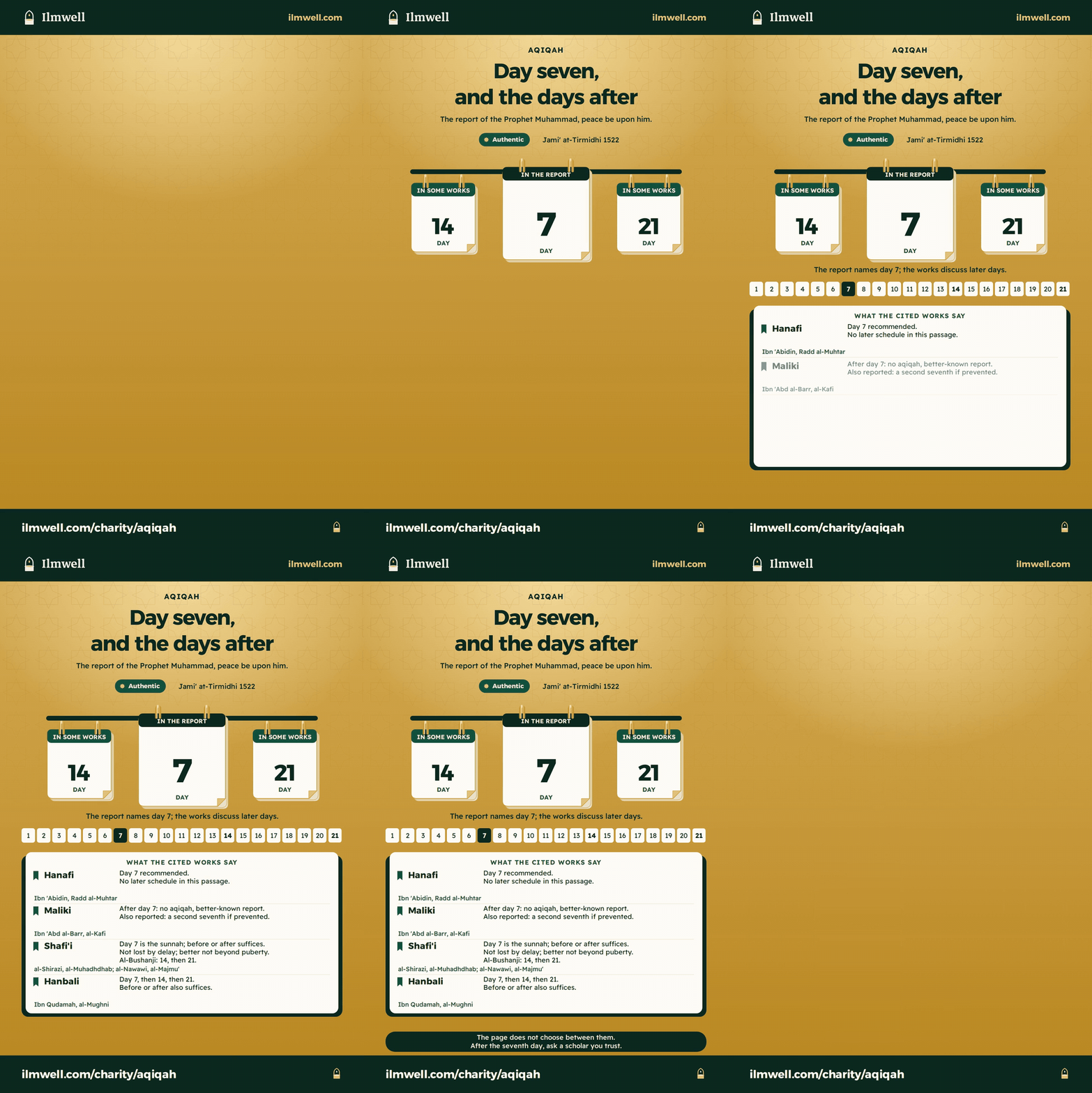
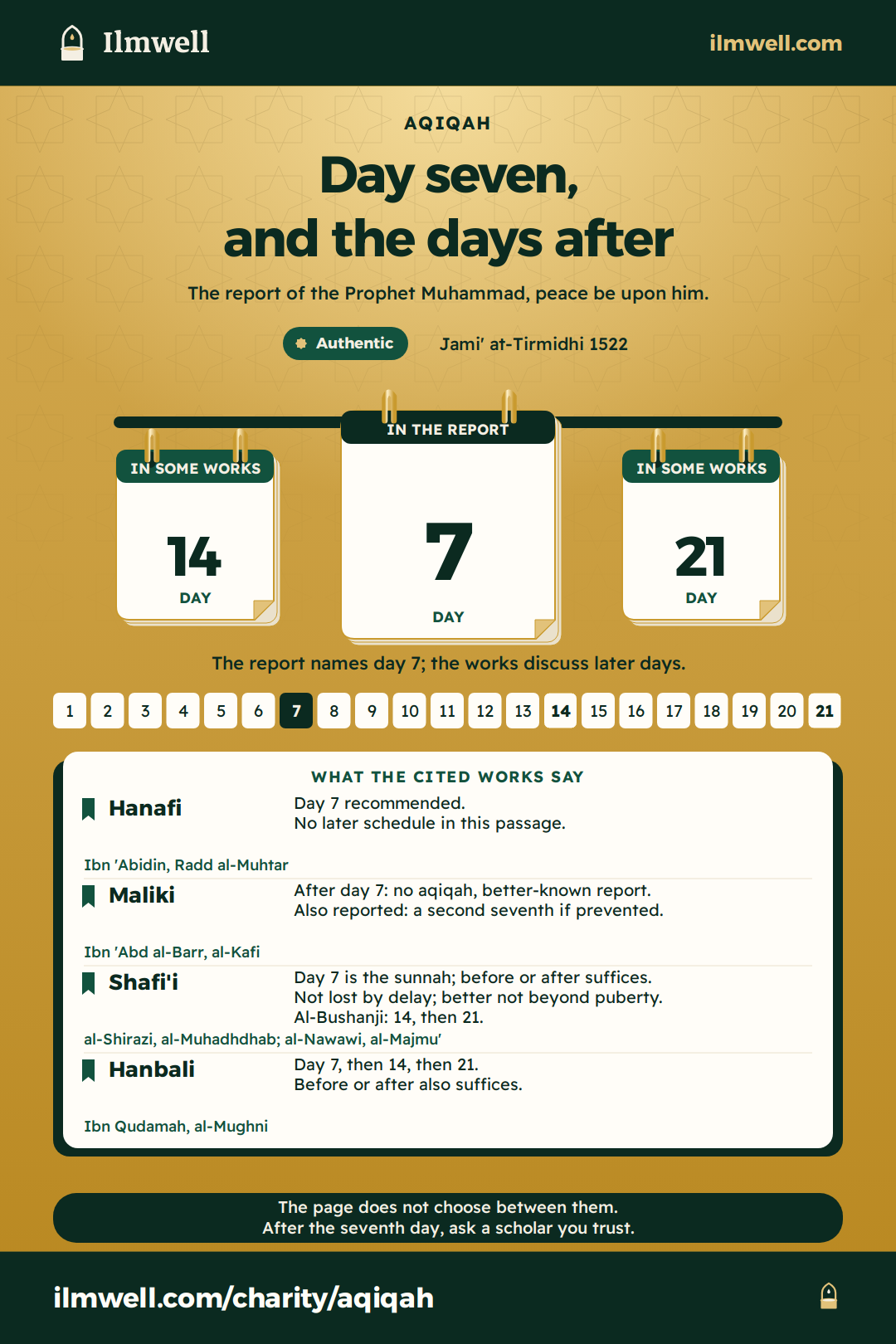
Samurah ibn Jundub, may Allah be pleased with him, reported that the Prophet Muhammad, peace be upon him, said: the boy is held in pledge by his aqiqah. A sacrifice is made for him on the seventh day, he is named, and his head is shaved.
2AuthenticJami' at-Tirmidhi 1522
Every grading recorded for this report is hasan (good) or sahih (sound). The source list also keeps remarks from later scholars, among them criticism of one narrator in the chain, Isma'il ibn Muslim. Those are not verdicts on the report. This page does not explain the phrase "held in pledge" and gives no ruling on it. If it worries you, or the seventh day has passed, or cost is a worry, ask a scholar you trust.
The seventh day is the only day named in the two reports on this page. The works differ on later days:
| School and work | What the work says |
|---|---|
| HanafiIbn 'Abidin, Radd al-Muhtar | In a closing section he marks as summarised from Ghurar al-Afkar, it is recommended (yustahabbu) to name the child on the seventh day, shave the head and slaughter at the shaving. The passage gives no schedule for later days. 3 |
| MalikiIbn 'Abd al-Barr, al-Kafi | No aqiqah after the seventh day, which he calls the better-known report from Malik. It has also been reported that it is done in a second seventh (a second period of seven days) if something prevented the first. 4 |
| Shafi'ial-Shirazi, al-Muhadhdhab, and al-Nawawi, al-Majmu' | Al-Shirazi's text: the sunnah is the seventh day, and slaughter before or after it suffices. Al-Nawawi reports the school's companions (its scholars) saying it is not lost by delay and that it is recommended not to delay it beyond puberty. He also reports that al-Bushanji (printed al-Bushayhi in the transcription), one of the school's imams, said the fourteenth, then the twenty-first, and records another view that the choice is lost after three sevenths. 5 |
| HanbaliIbn Qudamah, al-Mughni | 'Our companions' (the Hanbali scholars) say the sunnah is the seventh day, then the fourteenth, then the twenty-first. Slaughter before or after also suffices, because the aim is achieved. He gives 'Aisha's saying as the evidence for the fourteenth and twenty-first. 6 |
This page does not choose between them. It does not cover stillbirth, miscarriage, adoption, twins, an aqiqah for an older child or an adult, or who pays. For any of these, or if the seventh day has passed in your family, ask a scholar you trust.
Is there a set aqiqah ceremony?
The works say what to do with the meat and allow an invitation. None of the passages quoted here sets a guest list, a venue or a programme, and neither report above mentions a gathering.
| School and work | What the work says |
|---|---|
| HanafiIbn 'Abidin, Radd al-Muhtar | The text says it is the same whether the meat is given out raw or cooked and whether an invitation is made or not. 3 |
| MalikiIbn 'Abd al-Barr, al-Kafi | It is eaten from and fed from, and gifts of it go to the neighbours, raw or cooked. If he invites people to it without boasting, there is no harm. 4 |
| Shafi'ial-Shirazi, al-Muhadhdhab, and al-Nawawi, al-Majmu' | Al-Shirazi's text: it is recommended that he eats from it, gifts it and gives in charity from it. Al-Nawawi reports the school's companions saying that sending the meat and broth to the poor is better than inviting people to it, and that if he invites a group it is permitted. 5 |
| HanbaliIbn Qudamah, al-Mughni | If he cooks it, invites his brothers and they eat it, that is good. He also gives its way in eating, gifting and giving in charity as that of the udhiyyah. 6 |
What does the seventh-day report leave out?
Jami' at-Tirmidhi 1522 (graded hasan or sahih) names three things: the sacrifice, the naming and the shaving of the head. It gives no name to choose, no number of animals and no rule for later days. Questions about the hair beyond the shaving, or about names, are not covered here.
When I first heard the word aqiqah it was said as a family occasion, and nobody explained the details. Reading what the report says, and where the schools differ, helped me see what belongs to the report and what belongs to custom.
Try it: three questions
Pick an answer; each one explains itself.
1Which report gives two matching sheep for a boy and one for a girl?
Answer: Jami' at-Tirmidhi 1513. Jami' at-Tirmidhi 1513 (graded hasan or sahih) gives the numbers. Tirmidhi 1522 names the seventh day, the naming and the shaving. Source 1
2Which day does Jami' at-Tirmidhi 1522 (graded hasan or sahih) name?
Answer: The seventh. The seventh. The fourteenth and twenty-first come from later works: Ibn Qudamah's al-Mughni gives the saying of 'Aisha, may Allah be pleased with her, as his evidence, and al-Nawawi reports them as one imam's view in al-Majmu'. Source 2
3Do the four works read here give one identical rule for a delayed aqiqah?
Answer: No. No. The Maliki work records no aqiqah after the seventh as the better-known report; the Shafi'i and Hanbali works accept slaughter before or after; the Hanafi passage gives no later-day schedule (sources 4, 5, 6 and 3).
Questions people ask
What animal is used for an aqiqah?
Each of the four works compares it with the udhiyyah. Ibn 'Abidin (Hanafi) describes a sheep fit for a udhiyyah. Ibn 'Abd al-Barr (Maliki) says it is from the animals valid as a udhiyyah. Al-Nawawi (Shafi'i) says what suffices for an aqiqah is what suffices for a udhiyyah. Ibn Qudamah (Hanbali) says its ruling is the udhiyyah's in its age and in the defects avoided.
Do any of these works call aqiqah obligatory?
None of the four works read for this page does. Al-Shirazi (Shafi'i) says it is not wajib, and Ibn Qudamah (Hanbali) argues that it is recommended and not wajib. Ibn Qudamah also reports that al-Hasan and Dawud held it wajib, a view he answers. Ibn 'Abidin (Hanafi) gives it as mubah or tatawwu'.
Can a donation replace the sacrifice?
The passages quoted on this page describe slaughtering an animal and sharing it. They do not discuss paying someone else to do it. Ibn Qudamah (Hanbali) reports Ahmad as saying the aqiqah is better than giving its value in charity. For a donation or an agent, ask a scholar you trust.
Sources
Every claim on this page comes from one of these. Gradings are reported with the scholar's name; we do not grade hadith ourselves.
- 1
'Aisha, may Allah be pleased with her, told Hafsah bint 'Abd al-Rahman that the Messenger of Allah ordered them, for a boy, two matching sheep and, for a girl, one sheep.
Jami' at-Tirmidhi 1513 Book 19, Hadith 24
Authentic: Hasan (Darussalam); hasan sahih (Al-Tirmidhi); sahih (Al-Albani); its chain is sahih (Shu'ayb al-Arna'ut). Remarks: [أشار في المقدمة أنه صحيح الإسناد] (he indicated in his introduction that it is sahih in its chain). A general note ('Abd al-Haqq al-Ishbili)
- 2
Samurah ibn Jundub, may Allah be pleased with him, reported that the Prophet Muhammad, peace be upon him, said that a boy is held in pledge by his aqiqah: on the seventh day a sacrifice is made for him, he is named, and his head is shaved.
Jami' at-Tirmidhi 1522 Book 19, Hadith 34
Authentic: Sahih (Darussalam); hasan sahih (Al-Tirmidhi); sahih (Ibn Baz); sahih (Al-Albani); sahih (Muhammad Jar Allah al-Su'di); its chain is sahih (Al-Albani); its chain is sahih (Shu'ayb al-Arna'ut). Remarks: [فيه] إسماعيل بن مسلم قال الحافظ كان ضعيف الحديث (in its chain is Isma'il ibn Muslim; the Hafiz said he was weak in hadith). A remark on one narrator, not a verdict on the report (Al-Mubarakfuri); [فيه] إسماعيل بن مسلم غير محتج به (in its chain is Isma'il ibn Muslim, who is not relied on as proof). A remark on one narrator, not a verdict on the report (Ibn 'Abd al-Hadi); من رواية الحسن عن سمرة وهو مدلس لكن في البخاري أن الحسن سمع حديث العقيقة من سمرة (al-Hasan's report from Samurah; he is a mudallis, but Bukhari has that he heard the aqiqah hadith from Samurah). A remark on a link, not a verdict (Al-Munawi); أعل بأنه من رواية الحسن عن سمرة وهو مدلس لكن في البخاري أن الحسن سمع حديث العقيقة من سمرة (criticised as al-Hasan's report from Samurah; he is a mudallis, but Bukhari has that he heard the aqiqah hadith from Samurah). A remark on a link, not a verdict (Al-San'ani); [حسن كما قال في المقدمة] ([hasan, as he said in the introduction]). A general note (Ibn Hajar al-'Asqalani); رجاله ثقات (its men are trustworthy). A remark on the narrators (Ibn Hajar al-'Asqalani); يروى في الحديث: (ويدمى) مكان قوله: (ويسمى). وضعفوا رواية من رواه (ويدمى) وقالوا: إنما هو (ويسمى) ('smeared with blood' is reported in place of 'named'; the 'smeared' report was weakened). A remark on a variant, not a verdict (Al-Baghawi)
- 3
Hanafi: the classification (mubah or tatawwu', and how the intention changes it), one sheep for male and female alike, the day for naming, shaving and slaughter, the meat and the invitation.
Ibn 'Abidin, Radd al-Muhtar 6/336 and 6/326 (shamela.ws, book 21613) Read on 24 October 2026. Record: scholarly-aqiqah-hanafi-radd-almuhtar.
- 4
Maliki: a desired sunnah, the meaning of the word, no aqiqah after the seventh day and the other report, one sheep each, eating, feeding and inviting.
Ibn 'Abd al-Barr, al-Kafi, Bab al-'Aqiqah, pages 425 to 426 (shamela.ws, book 7367) Read on 24 October 2026. Record: scholarly-aqiqah-maliki-kafi.
- 5
Shafi'i: al-Shirazi's text (sunnah, not wajib, two and one, the seventh day, before or after) and al-Nawawi's own commentary (a confirmed sunnah, one sheep for a boy, delay, al-Bushanji's view, inviting).
al-Shirazi, al-Muhadhdhab, as printed in al-Nawawi, al-Majmu' 8/426 to 431 (shamela.ws, book 2186) Read on 24 October 2026. Record: scholarly-aqiqah-shafii-majmu.
- 6
Hanbali: the meaning of the word, a sunnah, recommended and not wajib, two matching sheep and one, the seventh, fourteenth and twenty-first, and the gathering.
Ibn Qudamah, al-Mughni 9/458 to 463 (shamela.ws, book 8463) Read on 24 October 2026. Record: scholarly-aqiqah-hanbali-mughni.
Next
- Nikah, mahr and walimahExplainer
- Sadaqah jariyah: meaning and examplesExplainer
- Dua for parentsDua
- Start at AlifThe hub
For your own situation, ask a scholar you trust.
Join the email list
New guides by email, now and then. No spam, and you can leave at any time.
Ilmwell is free and kept going by readers. See how to support it.