The short answer
Sadaqah jariyah means ongoing charity. Sahih Muslim 1631 (graded sahih) names it among three things whose benefit continues after death, with knowledge people benefit from and a righteous child who prays for the deceased. Al-Nawawi, as the Jordan Iftaa Department quotes him, identifies it with the waqf (endowment); the Dorar hadith commentary says "the waqf and others".
What does sadaqah jariyah mean?
Sadaqah is charity. The Dorar hadith commentary on Muslim 1631 describes the jariyah kind as charity whose benefit flows on, so that its reward lasts, "such as the waqf and others" (source 5). You may also see it written sadaqa jariya or sadaqah jariya. Those spellings are the same Arabic phrase, which the hadith has as:
Sahih Muslim 1631
صَدَقَةٍ جَارِيَةٍ
ṣadaqatin jāriyatin
ongoing charity (in the hadith, with its case endings)
The Jordan Iftaa Department quotes al-Nawawi as saying the sadaqah jariyah is the waqf (source 6). Dorar's wording leaves room for other kinds: "the waqf and others". A waqf is an endowment: in the report of the Khaybar land below, the land is kept and what it yields is given.
A note from us, not from a source: a monthly donation describes a payment schedule, while ongoing charity describes continuing benefit. A monthly gift might support such a project, but the direct debit itself does not tell you what happens to the money.
What does the sadaqah jariyah hadith say?
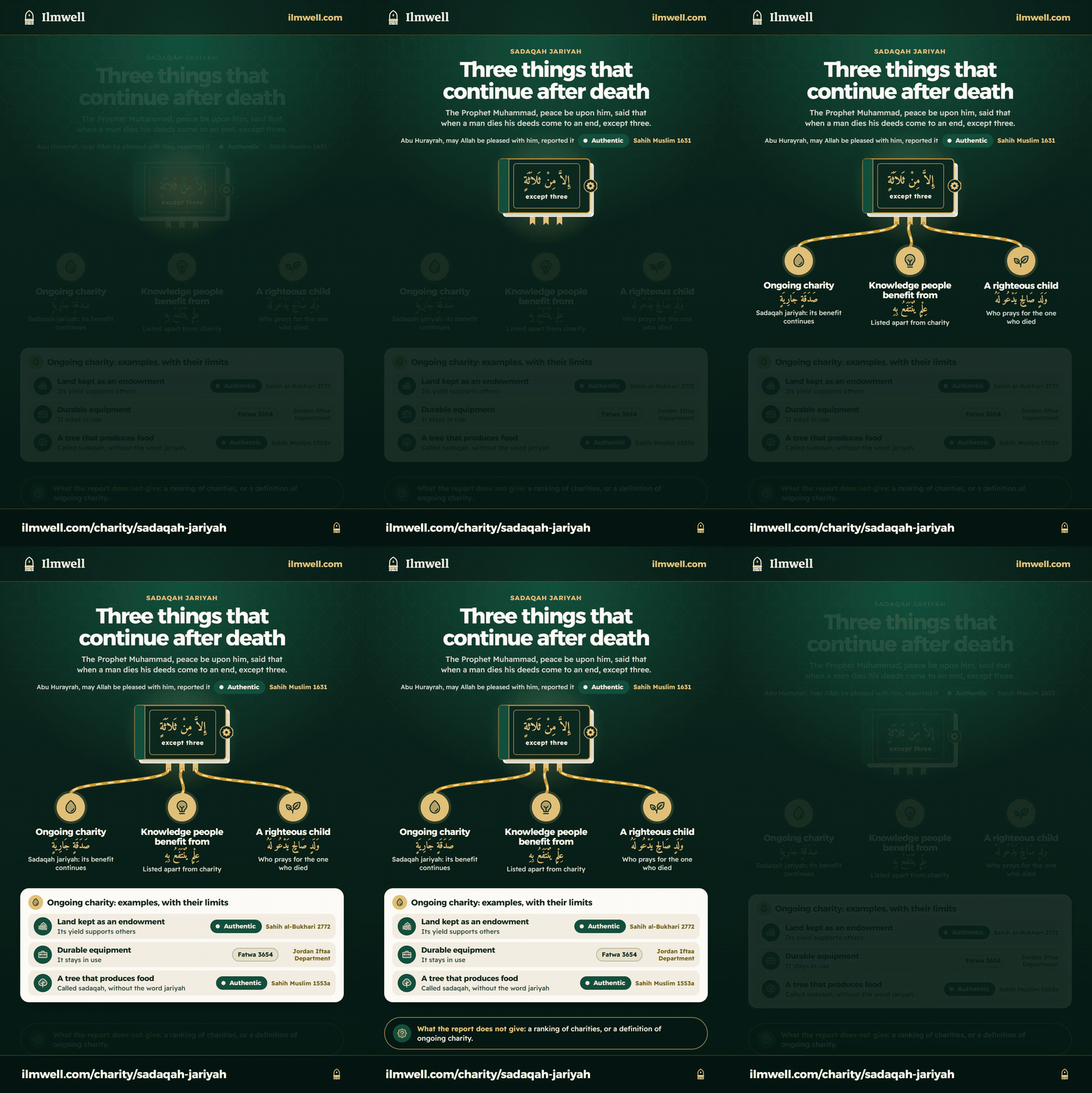
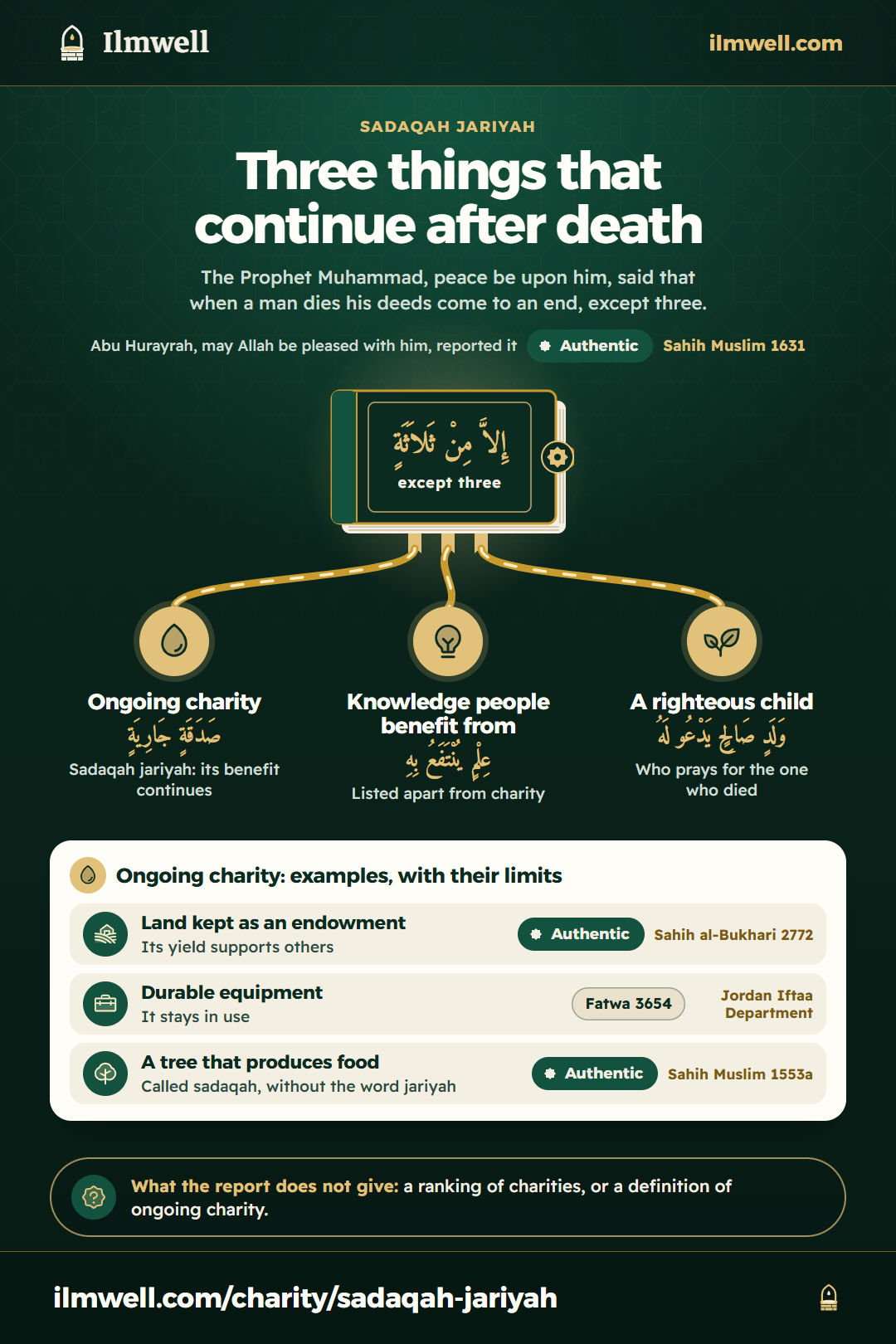
The Prophet Muhammad, peace be upon him, said that when a man dies his deeds come to an end except three: ongoing charity, knowledge from which people benefit, and a righteous child who prays for him. Abu Hurayrah, may Allah be pleased with him, reported this in Sahih Muslim 1631. A hadith is a transmitted report about the Prophet.
1AuthenticSahih Muslim 1631
| Named in the report | What to keep distinct |
|---|---|
| Ongoing charity | The charitable benefit continues |
| Knowledge that benefits others | The report lists this separately from charity |
| A righteous child praying for the deceased | The report names the child's prayer |
Keep its three categories apart. Teaching useful knowledge can keep benefiting people, but that does not turn the report into a list of three kinds of cash donation.
What are examples of ongoing charity?
An endowment whose proceeds help people is the example the sources discuss first. Other projects need a closer look at what is provided, who uses it and how the benefit continues.
'Umar ibn al-Khattab, may Allah be pleased with him, got a piece of land at Khaybar and asked the Prophet what to do with it. The Prophet told him that if he wished he could keep the land as an endowment for charitable purposes. 'Umar set it as an endowment on the condition that it would not be sold, given away or inherited, with its yield for the poor, kinsmen, freeing slaves, the cause of Allah, travellers and guests.
2AuthenticSahih al-Bukhari 2772
That is a clear picture of an endowment: the land stays, and what it produces supports others.
| Example | How the benefit can continue | Evidence and limits |
|---|---|---|
| Land kept as an endowment | Its yield supports charitable recipients | 'Umar's land, Sahih al-Bukhari 2772, sahih |
| Durable equipment for people in need | The item stays in use | Discussed in the Jordan Iftaa Department fatwa (source 6) |
| A tree that produces food | People, birds or animals eat from it | Sahih Muslim 1553a, sahih, calls this a charity (sadaqah), not specifically a jariyah one, and does not call every planting scheme an endowment |
Anas, may Allah be pleased with him, reported the Prophet saying that a Muslim who plants a tree or cultivates land from which a bird, a person or an animal eats has that as a charity (sadaqah) on his behalf. The report does not use the word jariyah.
4AuthenticSahih Muslim 1553a
A modern project still needs to show what it provides and who benefits.
Is feeding someone sadaqah jariyah?
The Jordan Iftaa Department was asked about charities spending donations on appliances, small projects, training and a soup kitchen. It separates a charity that keeps its benefit for a period, such as appliances, equipment and furniture, from one that is used up, calling the first the sadaqah jariyah and the second ordinary voluntary charity. It does not mention feeding as such, and it says the donor earns the reward of charity through all of those uses (source 6). The distinction is about the form of the charity, not about whether feeding someone is worth doing.
Consider two appeals. One buys today's meals. Another supplies durable equipment used to prepare meals over time. Ask what each donation pays for. Both may help people; the way the benefit lasts differs.
Sahih Muslim 1631 gives no ranking of projects. It does not show that a particular charity, price or advertised package is best for every donor.
Can you give charity for someone who has died?
In the case reported, yes. 'Aisha, may Allah be pleased with her, reported that a man asked the Prophet whether his mother, who had died suddenly, would be rewarded if he gave charity on her behalf, and the Prophet said yes.
3AuthenticSahih al-Bukhari 1388
The report gives this answer for a mother who died suddenly, and it names no scheme or amount. This page cites no scholar on wider cases. Muslim 1631 is about a person's own deeds ending at death, while Bukhari 1388 is about giving on someone's behalf after death, so they answer different questions. Keep a third question apart too: whether a particular project has continuing benefit. That has to be looked at project by project.
Can you give for a living parent?
Egypt's Dar Al-Ifta describes three routes for voluntary charity, which it says Muslim scholars are unanimous on: giving the money to your parents as a gift so they can give it on, giving it to them so they authorise you to donate it on their behalf, or a supplication asking Allah to reward them as He rewarded you. Separately, it says scholars have disagreed about dedicating the reward of a deed to the living, which Hanafi and some Hanbali scholars permit (source 7). This concerns voluntary charity, not zakat. The report about the deceased mother does not itself answer this separate question. Ask a qualified scholar how to arrange it for your circumstances.
How can you assess a project before donating?
Start with a plain question: what will my contribution pay for? A project should be able to say how the money is used and how the benefit is expected to continue. These questions are practical due diligence from us, not a religious test quoted from the hadith:
- Who needs the service or item, and how was that need identified?
- Who will own, run and maintain it?
- Is there an allowance for repairs or replacement?
- What happens if the project closes or cannot go ahead?
- How will donors learn what was delivered?
If the money is meant as zakat, or comes from an estate, ask a qualified scholar about that situation. This page does not show that a project meets the separate requirements for those funds.
My mum planted a tree in the mosque garden when I was small and kept calling it sadaqah jariyah. I thought she was joking. I walk past that tree now and understand she was not.
Try it: the distinction
Pick an answer; each one explains itself.
1A donation repeats every month. Does that alone make it ongoing charity?
Answer: No, the schedule does not show whether the benefit continues. Ongoing charity is about benefit that continues. A payment schedule does not show that. Source 1
2Does the hadith list beneficial knowledge separately from ongoing charity?
Answer: Yes. Sahih Muslim 1631 names three: ongoing charity, knowledge from which people benefit, and a righteous child who prays for him. Source 1
3Can charity be given for a mother who has died?
Answer: Yes, the Prophet said so in Sahih al-Bukhari 1388. A man asked whether his mother, who had died suddenly, would be rewarded if he gave charity for her, and the Prophet said yes. Source 3
Questions people ask
What does sadaqah jariyah mean?
Sadaqah jariyah means ongoing charity. Sahih Muslim 1631 (graded sahih) names it as one of three things whose benefit continues after death. The spellings sadaqa jariya and sadaqah jariya mean the same thing.
Is a monthly donation sadaqah jariyah?
A monthly donation describes a payment schedule. Ongoing charity describes continuing benefit. A monthly gift might support a project with lasting benefit, but the schedule alone does not show it.
Can I give sadaqah jariyah for someone who has died?
In the case reported, yes. In Sahih al-Bukhari 1388 (graded sahih) the Prophet, peace be upon him, told a man that his mother, who had died suddenly, would be rewarded if he gave charity for her. The report is about her; for a living parent, see the answer on this page.
Sources
Every claim on this page comes from one of these. Gradings are reported with the scholar's name; we do not grade hadith ourselves.
- 1
Abu Hurayrah, may Allah be pleased with him, reported that the Prophet said that when a man dies his deeds come to an end except three: recurring charity (sadaqah jariyah), knowledge from which people benefit, or a righteous child who prays for him.
Sahih Muslim 1631 Book 25, Hadith 20
Authentic: in Sahih Muslim
- 2
Ibn Umar, may Allah be pleased with him, reported that when Umar, may Allah be pleased with him, acquired land at Khaybar the Prophet told him that, if he wished, he could keep the land as an endowment (waqf) for charitable purposes, and Umar set it as an endowment on the condition that it not be sold, given away or inherited, with its yield for the poor, kinsmen, freeing slaves, the cause of Allah, travellers and guests.
Sahih al-Bukhari 2772 Book 55, Hadith 35
Authentic: in Sahih al-Bukhari
- 3
Aisha, may Allah be pleased with her, reported that a man asked the Prophet whether his mother, who had died suddenly, would receive a reward if he gave charity on her behalf, and the Prophet said yes.
Sahih al-Bukhari 1388 Book 23, Hadith 140
Authentic: in Sahih al-Bukhari
- 4
Anas, may Allah be pleased with him, reported that the Prophet said a Muslim who plants a tree or cultivates land from which a bird, a person or an animal eats has that as a charity on his behalf.
Sahih Muslim 1553a Book 22, Hadith 12
Authentic: in Sahih Muslim
- 5
The Dorar hadith commentary on Sahih Muslim 1631 describes the ongoing charity (sadaqah jariyah) as charity whose benefit flows on and whose reward lasts, 'such as the waqf and others', and the beneficial knowledge and righteous child as the other two.
Dorar (al-Durar al-Saniyya) hadith commentary on Sahih Muslim 1631 Record: scholarly-dorar-sharh-muslim-1631-781.
- 6
The Jordan General Iftaa Department, fatwa 3654 (1 November 2021), quotes al-Nawawi in Sharh Sahih Muslim 11/85 that 'the sadaqah jariyah is the waqf', and says the sadaqah jariyah is what keeps its benefit for a period of time, such as equipment and furniture, while what is used up is ordinary voluntary charity.
Jordan General Iftaa Department, fatwa 3654, 1 November 2021, quoting al-Nawawi, Sharh Sahih Muslim 11/85 Record: scholarly-jordan-iftaa-sadaqah-jariyah-3654. Read in Arabic; al-Nawawi is read only as quoted there.
- 7
Egypt's Dar Al-Ifta, fatwa 7750 (23 February 2015), gives three routes for voluntary charity on behalf of living parents, which it says Muslim scholars are unanimous on: giving them the money as a gift so they give it on, giving them the money so they commission the giver to donate it for them, or a supplication asking Allah to reward them. Separately it says scholars have disagreed on dedicating the reward of a deed to the living, which Hanafi and some Hanbali scholars permit.
Egypt's Dar Al-Ifta, fatwa 7750, 23 February 2015 Record: scholarly-dar-alifta-7750-living-parents.
Next
For your own situation, ask a scholar you trust.
Join the email list
New guides by email, now and then. No spam, and you can leave at any time.
Ilmwell is free and kept going by readers. See how to support it.