The short answer
Islamic calligraphy is the art of writing as used in Islamic art, which the V&A says appears across all art forms and materials. By no means is all Arabic calligraphy religious, the V&A adds: poems, praise for rulers and aphorisms also appear. Below, museum pages describe Kufic, Naskh, Thuluth, Nastaliq and Diwani.
What is Islamic calligraphy?
The V&A describes calligraphy as the art of writing and says it appears across all art forms and materials, beyond pen and paper. It says the skill lies in the balance calligraphers struck between transmitting a text and expressing its meaning through a formal aesthetic code. 1
The Met's Department of Islamic Art says that it is significant that the Quran was transmitted in Arabic, that the Arabic script has the potential for ornamental forms, and that calligraphy is principally a means to transmit a text, albeit in a decorative form. 2
The V&A says the Quran's holy status explains why calligraphy matters, yet by no means is all Arabic calligraphy religious in content. Inscriptions on works of art can also include poems, praise for rulers and aphorisms. 1
The Smithsonian's National Museum of Asian Art says scripts in the Arabic alphabet were used for both religious and secular texts, and that in Iran they were used for writing Arabic and Persian until the fourteenth century. 3 Nastaliq and Diwani, below, come from Persian and Ottoman settings in the pages cited.
What are the main styles of Islamic calligraphy?
This table is our own introductory comparison. Each row reports only what the named page says about that script. The pages cited do not set out full definitions, and a style name does not mean every object looks alike.
| Style | What the cited page says |
|---|---|
| Kufic | The Met describes the Kufic of its eighth to ninth century Quran folio as wide and elongated, set in a horizontal format, with coloured dots and marks to help the reader. It says scribes developed the horizontal format and kufic script during the Umayyad period, after the earliest surviving Qurans in hijazi script. 5 |
| Naskh | In the Met's catalogue entry for the Hamdullah album, several lines of a small script (naskh) are framed by one or two lines in a larger script. 6 |
| Thuluth | The Met names thuluth, or muhaqqaq, as the larger framing script in that album, and lists thuluth among the scripts on the mixed sheet below. Neither entry describes its letter shapes, so this page does not. 6 7 |
| Nastaliq | The Smithsonian's National Museum of Asian Art says a new script called naskh-i ta'liq emerged around 1350, later shortened to nasta'liq, with sinuous lines and short vertical strokes that suited the copying of Persian verse. 3 |
| Diwani | Muhannad Salhi of the Library of Congress writes that Diwani, as its name suggests, refers to the official Ottoman chancery and was favoured for official court documents. It is a highly structured, extremely cursive script written with undotted letters often joined unconventionally. 4 |
The Met's entries also name muhaqqaq and ta'liq shikasta, without describing them. 6 7 The Met's description of the mixed sheet names four scripts on one folio, so a single object can carry more than one style name. 7
What do three museum photographs show?
The photographs are from the Metropolitan Museum of Art. Each caption gives the Met's title, date, place and credit line, with a link to the Met's own page for the object. The dates identify the objects shown. They are not dates for the invention of a script.
An early Kufic Quran folio
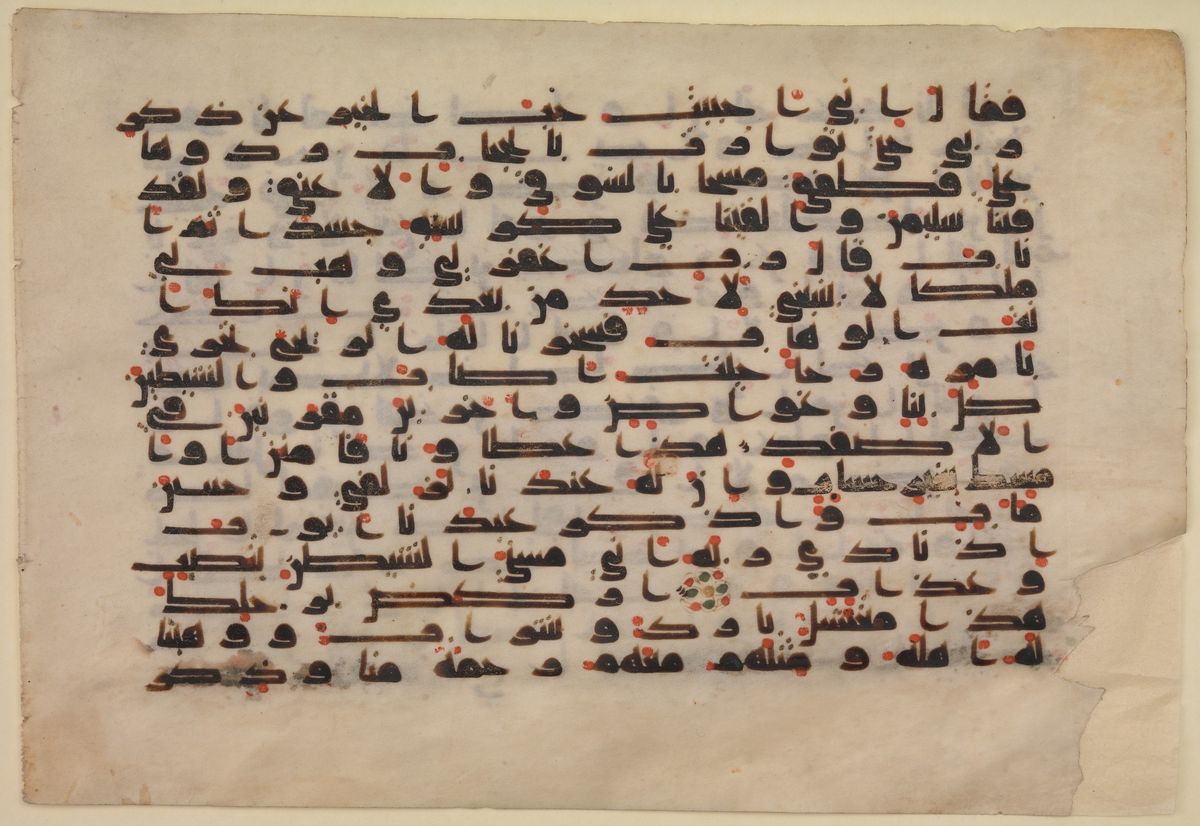
The Met says the earliest surviving Qurans were copied in a tall, streamlined script known as hijazi on a vertical parchment support. Scribes then developed the horizontal format and kufic script of the kind seen in this folio. The Met says the earliest script lacked dots and signs indicating vowels and specific consonants, and that this folio includes coloured dots and marks to help the reader follow the text. 5
Look at how the lettering fills each line and where the coloured dots sit beside the black letters. This is one folio. Because the Met itself names hijazi as earlier, it is not offered here as evidence that Kufic was the first script used for the Quran.
Naskh with a larger framing script
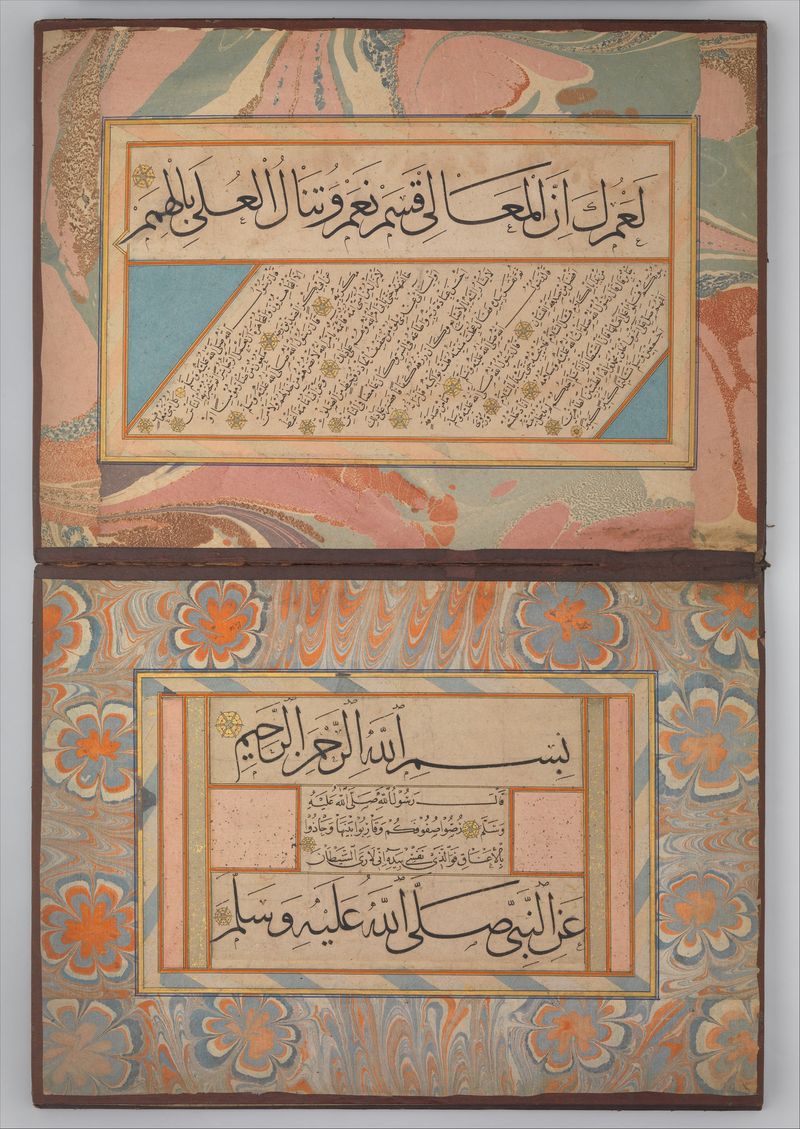
This album contains samples written by Shaykh Hamdullah, whom the Met calls the most famous Ottoman calligrapher, and the text comes from the Hadith, the Met says. On each page, several lines of small naskh are framed by one or two lines of a larger script, thuluth or muhaqqaq, and pasted onto sheets of marbled paper, each with a different pattern. 6
In the photograph, scale separates the lines, and the marbled paper is part of the page's setting. This page has not checked the wording of the texts shown and does not quote or rely on them.
A sheet with several scripts and hands
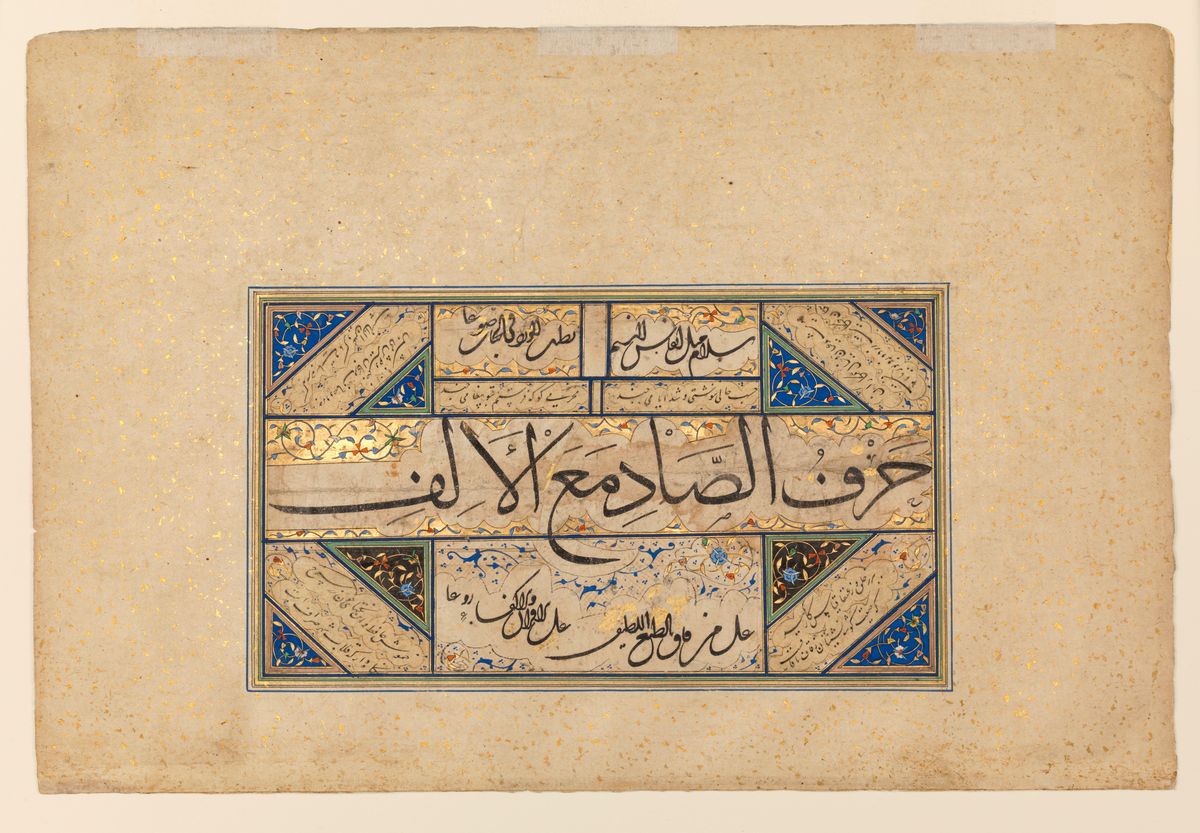
The Met says poetry, calligraphic exercises and headings are pasted onto both sides of this folio and that the text, written in several different hands, includes nasta'liq, ta'liq shikasta, muhaqqaq and thuluth scripts. It says the calligrapher Sultan Muhammad Nur wrote a poem diagonally, and that the large writing beside it is an exercise in which the letter shin is repeated several times. The photograph may show the other side of the folio. 7
The photograph shows one side of the folio, and the Met's description covers both sides without saying where in this picture the diagonal poem sits. The sheet is not a single hand in a single script.
How did calligraphy develop?
These points come from the pages cited, not from us. Where a source gives no date, none is given.
- The V&A says that by the eighth century a distinctive Quran manuscript form had been established, and that it continued until the tenth century, when a series of changes in materials, script and format made Quran copies more like other fine manuscripts. 1
- The V&A says more fluid styles of script were developed from about the same time as those tenth-century changes, and that by the thirteenth century they had replaced the older hands in Quran production. A gradual process of refinement eventually gave rise to distinctive regional or dynastic styles. 1
- The Smithsonian's National Museum of Asian Art says nasta'liq emerged around 1350, and that by 1430 it was used throughout the Persian-speaking world, from Istanbul to Delhi. From the second half of the fifteenth century, it says, calligraphers enlarged the scale of the letters and made bold displays of a few lines of poetry on a single sheet. 3
- Muhannad Salhi of the Library of Congress places Diwani in the Ottoman Empire, as the script of the official chancery. 4
The V&A's account describes gradual change rather than one replacement date. 1
How was calligraphy learnt?
The Smithsonian's National Museum of Asian Art says students of nasta'liq (shagird) learned the principles of the style from a master (ustad). Only after years of diligent practice, guided by a skilled teacher, could a pupil try to become an accomplished calligrapher, who would in turn train students. It says calligraphers carefully selected reeds to shape into pens (qalam) and trimmed the tips with a sharp knife. 3
The Met lists calligraphic exercises among the items pasted onto the mixed sheet above. 7
How can you look at a calligraphic page?
This is our own looking exercise, to use with the three photographs. It asks what you can see, then sends you to the museum record for what the page cannot show.
- Find the structure. Are the lines long and horizontal, in separate panels, or at an angle?
- Compare scales. Where does larger writing sit beside smaller writing?
- Separate the writing from its setting. Notice borders, colour, gold and spacing as well as the letters.
- Read the record. Check the date, place, maker and script names in the museum's entry before you give an object a label.
Can you reuse these photographs?
The Met's Open Access page says it makes all images of public-domain artworks available for unrestricted use under Creative Commons Zero (CC0). 8 The Met's pages for the three objects above are marked Public Domain, and its collection data says the same. That applies to these three photographs only, resized by us. It says nothing about images from the V&A, the Smithsonian or the Library of Congress, which this page does not use.
I used to walk past calligraphy in mosques and museums without knowing there were different styles with their own names. Learning to tell a few apart made me stop and look for longer.
Try it: three questions
Pick an answer; each one explains itself.
1Is all Arabic calligraphy religious in content?
Answer: No. The V&A says by no means is all Arabic calligraphy religious in content: inscriptions on works of art can also include poems, praise for rulers and aphorisms.
2In the Met's catalogue entry for the Hamdullah album, which larger script frames the small naskh lines?
Answer: Thuluth or muhaqqaq. The Met says several lines of small naskh are framed by one or two lines in a larger script, thuluth or muhaqqaq.
3Does the Met describe the mixed sheet (object 1982.120.4) as written in one hand?
Answer: No, several hands. The Met says its text was written in several different hands and includes nasta'liq, ta'liq shikasta, muhaqqaq and thuluth scripts.
Sources
Every claim on this page comes from one of these. Gradings are reported with the scholar's name; we do not grade hadith ourselves.
- 1
Calligraphy as the art of writing across materials; the Quran manuscript form and the move to more fluid scripts; poems, praise for rulers and aphorisms as non-religious content.
Victoria and Albert Museum, Victoria and Albert Museum, "Calligraphy in Islamic art" (web article, last updated 17 April 2024) Read on 26 October 2026 from the page itself. Record: reference-vam-calligraphy-islamic-art.
- 2
Calligraphy as principally a means to transmit a text, in a decorative form; the Quran transmitted in Arabic; ornament; not every viewer could read an inscription.
The Metropolitan Museum of Art, The Metropolitan Museum of Art, Timeline of Art History, "Calligraphy in Islamic Art" (Department of Islamic Art, 1 October 2001) Read on 26 October 2026. The Met site showed a bot-check page that day, so the text was read from the Internet Archive's copy of the same address; object data was also read from the Met collection API. Record: reference-met-essay-calligraphy-islamic-art.
- 3
Nasta'liq: emergence around 1350, its sinuous lines and short vertical strokes, spread by 1430, and teaching from master to pupil with reed pens.
Smithsonian National Museum of Asian Art, Smithsonian National Museum of Asian Art, "Nasta'liq: The Genius of Persian Calligraphy", section "Masters & Pupils" (online exhibition) Read on 26 October 2026 from the page itself. Record: reference-si-nastaliq-masters-pupils.
- 4
Diwani: the Ottoman chancery script, its cursive, undotted letters and use for official court documents.
Muhannad Salhi, Muhannad Salhi, "Written in Istanbul: Arabic, Persian, and Ottoman Calligraphy Sheets at the Library of Congress - Part 3", 4 Corners of the World (Library of Congress blog), 24 May 2021 Read on 26 October 2026 from the page itself. Record: reference-loc-written-in-istanbul-part-3.
- 5
The Kufic folio: title, date, place, credit line, horizontal format, wide elongated lettering, coloured dots and marks, and the Met's note on earlier hijazi Qur'ans.
The Metropolitan Museum of Art, The Metropolitan Museum of Art, "Folio from a Qur'an Manuscript", object 1984.504.1 Read on 26 October 2026. The Met site showed a bot-check page that day, so the text was read from the Internet Archive's copy of the same address; object data was also read from the Met collection API. Record: reference-met-1984-504-1-quran-folio.
- 6
The Hamdullah album: title, date, place, credit line, small naskh framed by a larger script (thuluth or muhaqqaq), marbled paper, hadith as the text.
The Metropolitan Museum of Art, The Metropolitan Museum of Art, "Album of Calligraphies Including Poetry and Prophetic Traditions (Hadith)", Shaikh Hamdullah ibn Mustafa Dede, object 1982.120.3 Read on 26 October 2026. The Met site showed a bot-check page that day, so the text was read from the Internet Archive's copy of the same address; object data was also read from the Met collection API. Record: reference-met-1982-120-3-hamdullah-album.
- 7
The mixed-script sheet: title, date, attribution, credit line, several hands and scripts, a diagonal poem, calligraphic exercises.
The Metropolitan Museum of Art, The Metropolitan Museum of Art, "Page of Calligraphy", Sultan Muhammad Nur, object 1982.120.4 Read on 26 October 2026. The Met site showed a bot-check page that day, so the text was read from the Internet Archive's copy of the same address; object data was also read from the Met collection API. Record: reference-met-1982-120-4-page-of-calligraphy.
- 8
The Met's Open Access policy: images of public-domain works available under CC0.
The Metropolitan Museum of Art, The Metropolitan Museum of Art, "Open Access at The Met" (policy page) Read on 26 October 2026. The Met site showed a bot-check page that day, so the text was read from the Internet Archive's copy of the same address; object data was also read from the Met collection API. Record: reference-met-open-access.
Next
- The Islamic Golden AgeNext in this volume
- Quran and SurahsVolume III
- The Prophets and Islamic historyThe hub
Join the email list
New guides by email, now and then. No spam, and you can leave at any time.
Ilmwell is free and kept going by readers. See how to support it.