The short answer
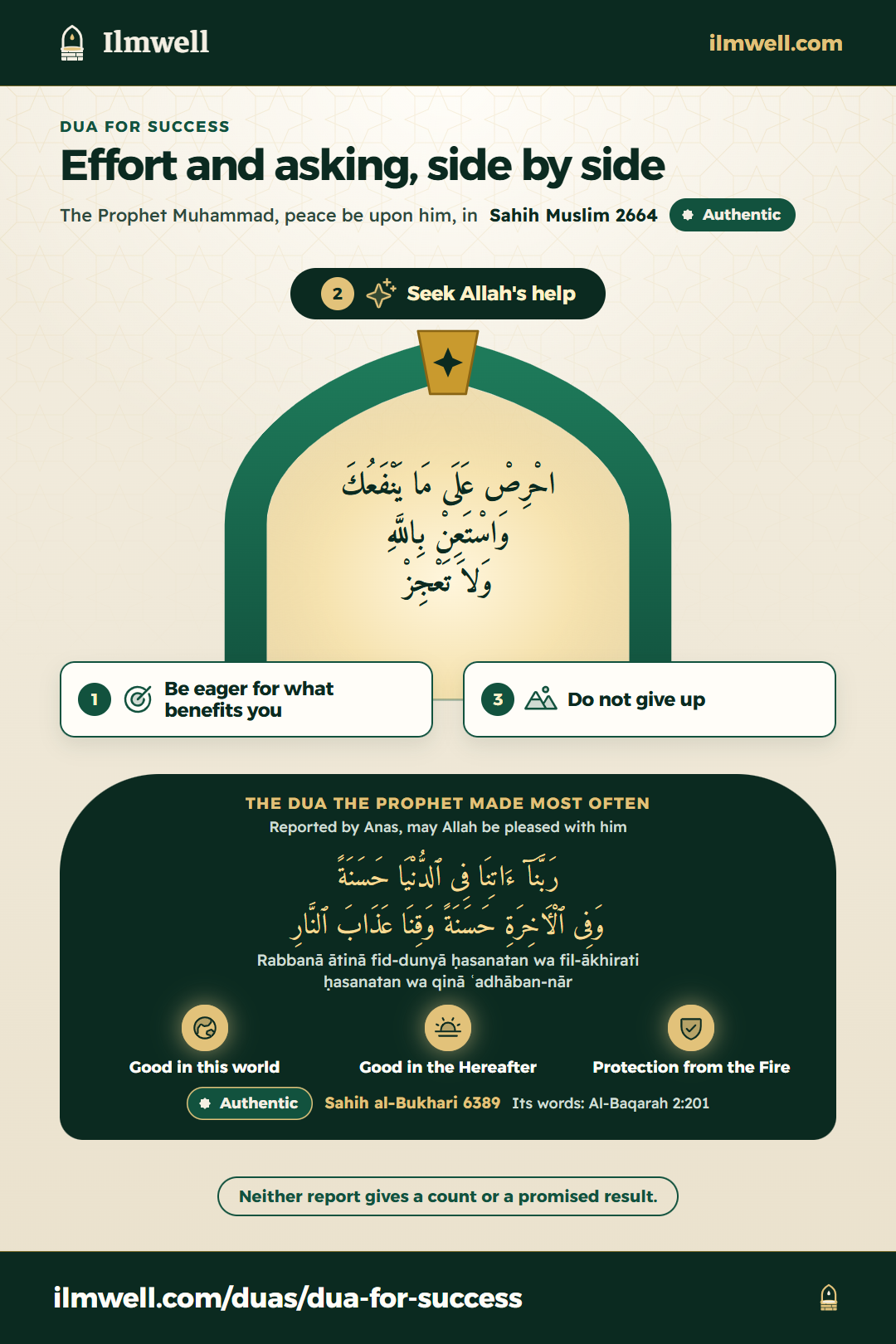
A dua for success from the Quran is Rabbana atina fid-dunya hasanatan wa fil-akhirati hasanatan wa qina 'adhaban-nar (Al-Baqarah 2:201), a request for good in this world and the Hereafter. In Sahih al-Bukhari 6389, graded sahih, Anas, may Allah be pleased with him, says the Prophet Muhammad, peace be upon him, made this supplication most often.
What is the dua for success in Arabic?
These are the closing words of Al-Baqarah 2:201, taken from the Quran text on this site.
Al-Baqarah 2:201
رَبَّنَآ ءَاتِنَا فِى ٱلدُّنْيَا حَسَنَةً وَفِى ٱلْـَٔاخِرَةِ حَسَنَةً وَقِنَا عَذَابَ ٱلنَّارِ
Rabbanā ātinā fid-dunyā ḥasanatan wa fil-ākhirati ḥasanatan wa qinā ʿadhāban-nār.
Our Lord! Give to us in the world that which is good and in the Hereafter that which is good, and guard us from the doom of Fire.
Say it in four parts: Rabbanā ātinā, "our Lord, give us"; fid-dunyā ḥasanatan, "good in this world"; wa fil-ākhirati ḥasanatan, "and good in the Hereafter"; and wa qinā ʿadhāban-nār, "and protect us from the punishment of the Fire". These are our own words for the parts.
In Anas's report the Prophet's wording opens with Allāhumma, "O Allah", before Rabbanā. The report says how often he made it; it gives no count and promises no reward.
1AuthenticSahih al-Bukhari 6389
The verse comes straight after a description of people who ask only for this world (2:200). Al-Baqarah 2:202 says of those who ask for both: "For them there is in store a goodly portion out of that which they have earned."
What does success mean in the Quran?
Falāḥ is one of the Quran's words for success, and Surah Al-Mu'minun opens with its verb, aflaḥa.
قَدْ أَفْلَحَ ٱلْمُؤْمِنُونَ
The verses after it describe those believers, beginning with humility in prayer. Al Imran 3:185 describes success in the Hereafter: "Whoever is removed from the Fire and is made to enter paradise, he indeed is triumphant." Al-Baqarah 2:201 asks for the same two things in its own words: good in the Hereafter and protection from the Fire.
Is there one dua for success in everything?
None of the sources on this page ties a dua to success in every matter, and none promises a result. Al-Baqarah 2:201 asks in general terms, for good in this world and the next, and names no single goal.
For one task, the Quran gives the words of Musa (Moses), peace be upon him, after Allah told him to go to Pharaoh (Ta Ha 20:24):
Ta Ha 20:25 to 28
رَبِّ ٱشْرَحْ لِى صَدْرِى وَيَسِّرْ لِىٓ أَمْرِى وَٱحْلُلْ عُقْدَةً مِّن لِّسَانِى يَفْقَهُوا۟ قَوْلِى
Rabbish-raḥ lī ṣadrī, wa yassir lī amrī, waḥlul ʿuqdatan min lisānī, yafqahū qawlī.
My Lord! relieve my mind And ease my task for me; And loose a knot from my tongue, That they may understand my saying.
What does Islam teach about effort and trusting Allah?
In Sahih Muslim 2664, graded sahih, Abu Hurayrah, may Allah be pleased with him, reports the Prophet saying that the strong believer is better and more beloved to Allah than the weak, with good in each. He goes on:
Sahih Muslim 2664, graded sahih
احْرِصْ عَلَى مَا يَنْفَعُكَ وَاسْتَعِنْ بِاللَّهِ وَلاَ تَعْجِزْ
Iḥriṣ ʿalā mā yanfaʿuka, wastaʿin billāhi wa lā taʿjiz.
Be eager for what benefits you, seek Allah's help, and do not give up.
2AuthenticSahih Muslim 2664
If something befalls you, the same report says not to say "if I had done this, it would have been such and such", but to say that Allah decreed, and did what He willed. It does not say what makes a believer strong.
Say you have a driving test on Monday. The lessons are the effort and the dua is the asking: the report puts the two side by side.
On reliance, Jami at-Tirmidhi 2344 is graded hasan or sahih. In it 'Umar ibn al-Khattab, may Allah be pleased with him, reports the Prophet saying that people who relied on Allah as He should be relied on would be provided for as birds are. The birds go out hungry and come back full. The tawakkul guide covers reliance in full.
4AuthenticJami' at-Tirmidhi 2344
Anas also reports a supplication the Prophet used to say, seeking refuge from eight things, laziness among them:
Sahih al-Bukhari 6369, graded sahih
اللَّهُمَّ إِنِّي أَعُوذُ بِكَ مِنَ الْهَمِّ وَالْحَزَنِ، وَالْعَجْزِ وَالْكَسَلِ، وَالْجُبْنِ وَالْبُخْلِ، وَضَلَعِ الدَّيْنِ، وَغَلَبَةِ الرِّجَالِ
Allāhumma innī aʿūdhu bika minal-hammi wal-ḥazan, wal-ʿajzi wal-kasal, wal-jubni wal-bukhl, wa ḍalaʿid-dayni wa ghalabatir-rijāl.
O Allah, I seek refuge with You from worry and grief, from incapacity and laziness, from cowardice and miserliness, from the burden of debt and from being overpowered by men.
3AuthenticSahih al-Bukhari 6369
The report names no time of day or occasion for it.

Is there a dua for success in business?
No report on this page is a dua for business as such. A related one is a request for good provision. Umm Salamah, may Allah be pleased with her, reports that when the Prophet prayed the dawn prayer and gave the salam, he used to say:
Sunan Ibn Majah 925, graded differently
اللَّهُمَّ إِنِّي أَسْأَلُكَ عِلْمًا نَافِعًا، وَرِزْقًا طَيِّبًا، وَعَمَلاً مُتَقَبَّلاً
Allāhumma innī asʾaluka ʿilman nāfiʿan, wa rizqan ṭayyiban, wa ʿamalan mutaqabbalan.
O Allah, I ask You for beneficial knowledge, good provision and accepted deeds.
5Graded differently Sunan Ibn Majah 925
Graders differ on it. Three accept it and five weaken it. Three of those five point to one narrator, a freed slave of Umm Salamah, whom the chain does not name and whom they call unknown. Rizq means provision in general, not business profit alone, and the report promises no income.
Which duas do people use for exams and job interviews?
For study, the Quran tells the Prophet to say Rabbi zidnī ʿilmā, "My Lord! Increase me in knowledge" (Ta Ha 20:114). Musa's words above ask for an eased task and to be understood. For a choice between two options, such as two job offers, there is the istikhara prayer. None of these comes with a promised result.
Try it: three quick questions
Pick an answer; each one explains itself.
1Which verse holds "Rabbana atina fid-dunya hasanatan wa fil-akhirati hasanatan"?
Answer: Al-Baqarah 2:201. It is Al-Baqarah 2:201. Ta Ha 20:114 has "My Lord! Increase me in knowledge", and 23:1 opens "Successful indeed are the believers".
2In Sahih Muslim 2664, what does the Prophet put side by side?
Answer: Being eager for what benefits you, seeking Allah's help and not giving up. The report joins effort with asking Allah's help and tells the listener not to give up. It names no count and no routine. Source 2
3What did Musa ask for in Ta Ha 20:25 to 28?
Answer: A relieved mind, an eased task and speech that is understood. He asked Allah to relieve his mind, ease his task and loose a knot from his tongue so that he would be understood.
Questions people ask
What is the dua for victory and success?
Al-Baqarah 2:250 gives the words of the believers who went out with Talut (Saul) against Jalut (Goliath) and his army: "Our Lord! Bestow on us endurance, make our foothold sure, and give us help against the disbelieving folk." The verse ties the words to that battle; it does not promise victory to anyone who says them.
How many times should I say a dua for success?
None of the Quran passages or hadith reports on this page gives a repetition count for these duas. If someone recommends a number, ask which source gives it. For your own practice, a scholar you trust can advise you.
What if my dua for success seems unanswered?
Sahih Muslim 2735c, graded sahih, says a servant's supplication keeps being answered unless he asks for sin or for cutting family ties, or grows impatient, says he has prayed again and again without an answer, and gives up. It names no timetable.
Sources
Every claim on this page comes from one of these. Gradings are reported with the scholar's name; we do not grade hadith ourselves.
- 1
Anas ibn Malik said the supplication the Prophet made most often was: Allahumma rabbana atina fi d-dunya hasanah, wa fi l-akhirati hasanah, wa qina 'adhaba n-nar.
Sahih al-Bukhari 6389 Book 80, Hadith 84
Authentic: in Sahih al-Bukhari (Al-Bukhari); Sahih (Al-Bukhari); sahih (Al-Albani); its chain is sahih to the standard of al-Bukhari and Muslim (Shu'ayb al-Arna'ut)
- 2
Abu Hurayrah reported the Prophet saying that the strong believer is better and more beloved to Allah than the weak believer, and there is good in each; be eager for what benefits you, seek Allah's help and do not give up; and if something befalls you, do not say 'if only I had done this, it would have been so', but say 'Allah decreed, and He did what He willed', because 'if' opens the work of Shaytan.
Sahih Muslim 2664 Book 46, Hadith 52
Authentic: in Sahih Muslim
- 3
Anas ibn Malik said the Prophet used to say: O Allah, I seek refuge with You from worry and grief, from incapacity and laziness, from cowardice and miserliness, from the burden of debt and from being overpowered by men.
Sahih al-Bukhari 6369 Book 80, Hadith 66
Authentic: in Sahih al-Bukhari
- 4
'Umar ibn al-Khattab relates that the Prophet said: if you relied on Allah with the reliance due to Him, you would be provided for as the birds are provided for, which go out hungry and come back full.
Jami' at-Tirmidhi 2344 Book 36, Hadith 41
Authentic: hasan sahih; known only through this route (Al-Tirmidhi); Hasan (Darussalam); sahih (Al-Albani); its chain indicated as sahih in his introduction; the brackets are dorar.net's (Abd al-Haqq al-Ishbili). Remarks: narrators Abu Tamim and 'Abdullah ibn Hubayrah: Muslim narrated from them, and more than one authority declared them reliable (Ibn Rajab)
- 5
Umm Salamah reported that the Prophet, when he prayed the dawn prayer (Subh) and gave the salam, used to say: O Allah, I ask You for beneficial knowledge, good provision and accepted deeds.
Sunan Ibn Majah 925 Book 5, Hadith 123
Graded differently. Here is who graded it which way:
- SoundDarussalam, Al-Albani, Ibn Hajar al-'Asqalani
- Weak chain, strengthenedIbn Hajar al-'Asqalani
- WeakShu'ayb al-Arna'ut, Ibn Baz, Ibn 'Uthaymin, Al-Shawkani, Al-Ruba'i
- Other remarksAl-Albani
See each grading in full, with its wording and where it was given
Scholars disagree about this hadith. Here is how each graded it, so you can follow the scholar you trust.
- Sahih (Darussalam): Darussalam, as shown on sunnah.com
- صحيح (sahih): Al-Albani, Sahih Ibn Majah 762 (as listed on dorar.net)
- حسن وله شاهد (hasan, and it has a supporting report): Ibn Hajar al-'Asqalani, Nata'ij al-Afkar 2/329 (as listed on dorar.net)
- حسن لشاهده (hasan through its supporting report): Ibn Hajar al-'Asqalani, al-Futuhat al-Rabbaniyya 3/70 (as listed on dorar.net)
- إسناده ضعيف (its chain is weak): Shu'ayb al-Arna'ut, takhrij al-Musnad 26602 and 26731 (as listed on dorar.net)
- ضعيف (weak): Ibn Baz, Majmu' al-Shuruh al-Fiqhiyya 6/509 (as listed on dorar.net)
- فيه مولى أم سلمة وهو مجهول (it contains the freed slave of Umm Salamah, who is unknown): Ibn 'Uthaymin, Majmu' Fatawa 13/277 (as listed on dorar.net)
- رجاله ثقات لولا جهالة مولى أم سلمة (its narrators are reliable, were it not that the freed slave of Umm Salamah is unknown): Al-Shawkani, Nayl al-Awtar 2/350 (as listed on dorar.net)
- إسناد رجاله ثقات إلا مولى أم سلمة وهو مجهول (a chain whose narrators are reliable except the freed slave of Umm Salamah, who is unknown): Al-Ruba'i, Fath al-Ghaffar 1/390 (as listed on dorar.net)
- إسناده فيه نظر، لكن رواه الطبراني بسند صحيح بلفظ كان يقول بعد الفجر (its chain needs examination, but al-Tabarani reported it with a sahih chain in the wording "he used to say after Fajr"): Al-Albani, Hidayat al-Ruwat 2432 (as listed on dorar.net)
- 6
Abu Hurayrah reports that a servant's supplication keeps being answered unless he asks for sin or the severing of family ties, or grows impatient by saying he prayed without a response and then gives up
Sahih Muslim 2735c Book 48, Hadith 127
Authentic: in Sahih Muslim
- Q
Quran Arabic and English for Al-Baqarah 2:200 to 202 and 2:249 to 250, Al Imran 3:185, Ta Ha 20:24 to 28 and 20:114, and Al-Mu'minun 23:1 to 2.
Tanzil Project Uthmani text, CC BY 3.0. English: adapted from Marmaduke Pickthall's translation (1930), modernised and checked against modern translations.
Next
- Tawakkul: what reliance on Allah meansBelief guide
- Istikhara: the prayer for a decisionPrayer guide
- Hasbunallahu wa ni'mal wakeel: meaning, Arabic and sourcePhrase lesson
- Duas, Remembrance and PhrasesThe hub
For your own situation, ask a scholar you trust.
Join the email list
New guides by email, now and then. No spam, and you can leave at any time.
Ilmwell is free and kept going by readers. See how to support it.