The short answer
Al-Jurjani's al-Ta'rifat defines halal as what the Sharia (Islamic law) leaves free to do, and Ibn Faris's dictionary calls haram its opposite, from a root meaning prevention and strictness. In plain terms, halal is the permitted and haram the prohibited. Sahih al-Bukhari 52, graded sahih, names doubtful matters between the two.
What does halal mean?
Al-Jurjani (d. 816 AH, a year in the Islamic Hijri calendar), in his dictionary of technical terms al-Ta'rifat, gives two definitions one after the other: halal is everything a person is not punished for using, and it is what the Sharia has left free to do. He adds that the word is taken from hall, "opening" 3.
al-Ta'rifat, p. 92
الحلال: ما أطلق الشرع فعله، مأخوذ من: الحل، وهو الفتح
al-ḥalālu mā aṭlaqa sh-sharʿu fiʿlahu, ma'khūdhun mina l-ḥalli, wa-huwa l-fatḥ
Halal: what the Sharia has left free to do, taken from al-hall, which is opening. (Our translation.)
Ibn Faris (d. 395 AH), in his dictionary of word roots Mu'jam Maqayis al-Lughah, traces every branch of the root h-l-l back to opening something. Halal, he says, is the opposite of haram, as if from halaltu al-shay', "I released the thing", when you made it permitted and gave it room 4.
Neither definition names a food or a product. Permitted is also not the same as required or recommended: those are separate categories, set out below.
What does haram mean in Arabic and in Islam?
In Arabic, Ibn Faris writes that the letters ha', ra' and mim are one root meaning prevention and strictness, and that al-haram is the opposite of al-halal 5.
Mu'jam Maqayis al-Lughah, vol. 2, p. 45
الحاء والراء والميم أصلٌ واحد، وهو المنْع والتشديد. فالحرام: ضِدّ الحلال
al-ḥā'u wa-r-rā'u wa-l-mīmu aṣlun wāḥidun, wa-huwa l-manʿu wa-t-tashdīd. fa-l-ḥarāmu ḍiddu l-ḥalāl
Ha', ra' and mim are one root: prevention and strictness. So al-haram is the opposite of al-halal. (Our translation.)
In Islamic law, al-Mahalli (d. 864 AH), a Shafi'i scholar, explains in his commentary on al-Juwayni's al-Waraqat that the prohibited (al-mahzur) means al-hurmah (prohibition). He defines it as what a person is rewarded for leaving, in obedience, and punished for doing 6. He adds that it is enough for the definition if the punishment exists for one wrongdoer while others are pardoned (the editor marks this clause as missing from two manuscripts; it also appears under wajib).
A definition of a category is not a prediction about any one person.
What does Masjid al-Haram mean?
Al-Baqarah 2:144 names al-masjid al-haram as the direction to turn to in prayer. This site's English reads: "So turn your face toward the Inviolable Place of Worship".
Al-Baqarah 2:144
ٱلْمَسْجِدِ ٱلْحَرَامِ
al-masjidi l-ḥarām
the Inviolable Place of Worship (this site's translation)
The name uses the same root as haram, and the translation renders it "inviolable", not "forbidden". Ibn Faris explains a related use of the root: the two Harams, Makkah and Madinah, are so called for their sanctity, because it is forbidden to commit a wrong in them or to shelter someone who does 5.
Is everything either halal or haram?
No. Works on usul al-fiqh (the principles of fiqh, Islamic jurisprudence) sort rulings into more than two kinds, and the works of different schools do not use the terms in exactly the same way.
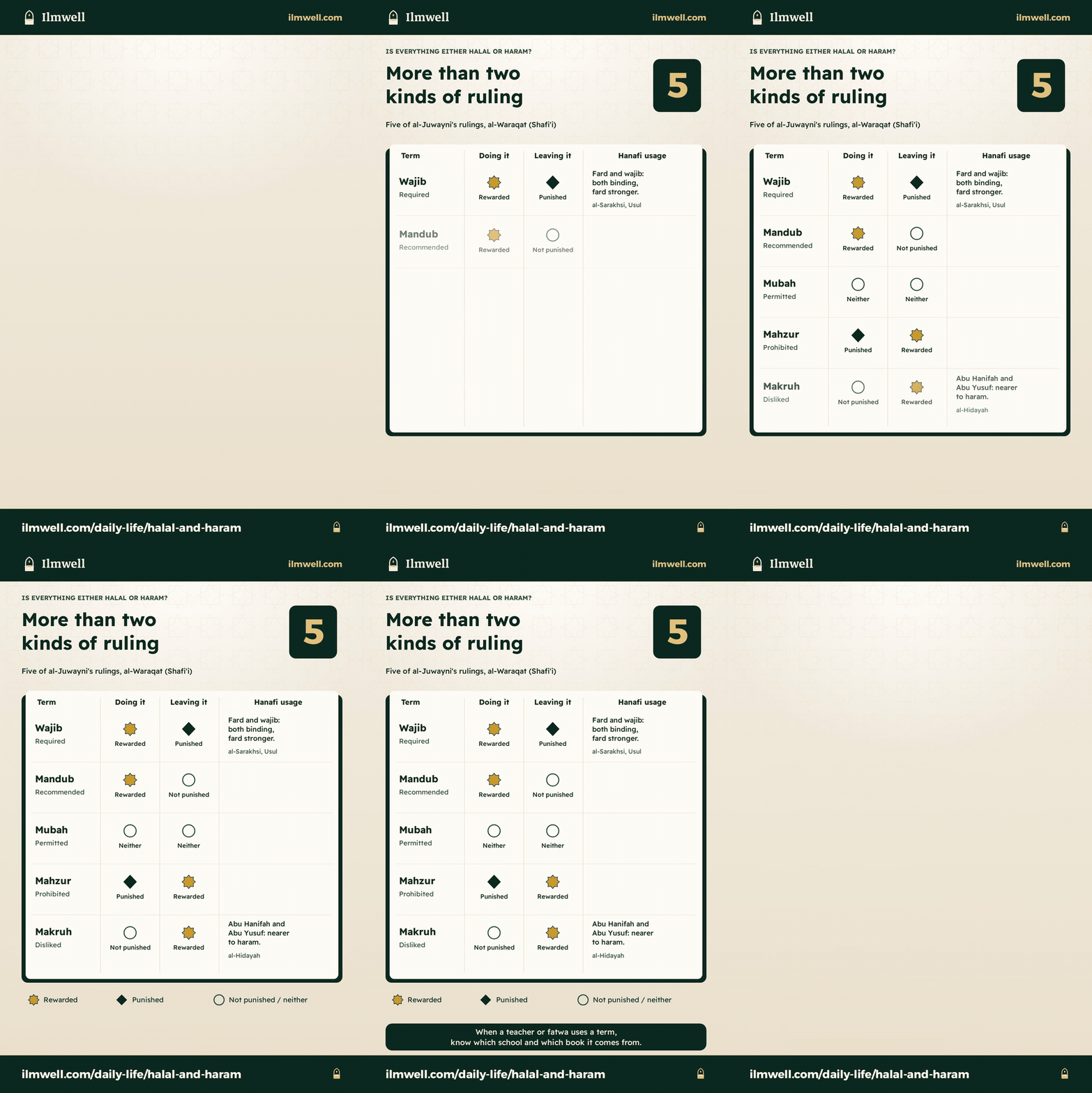
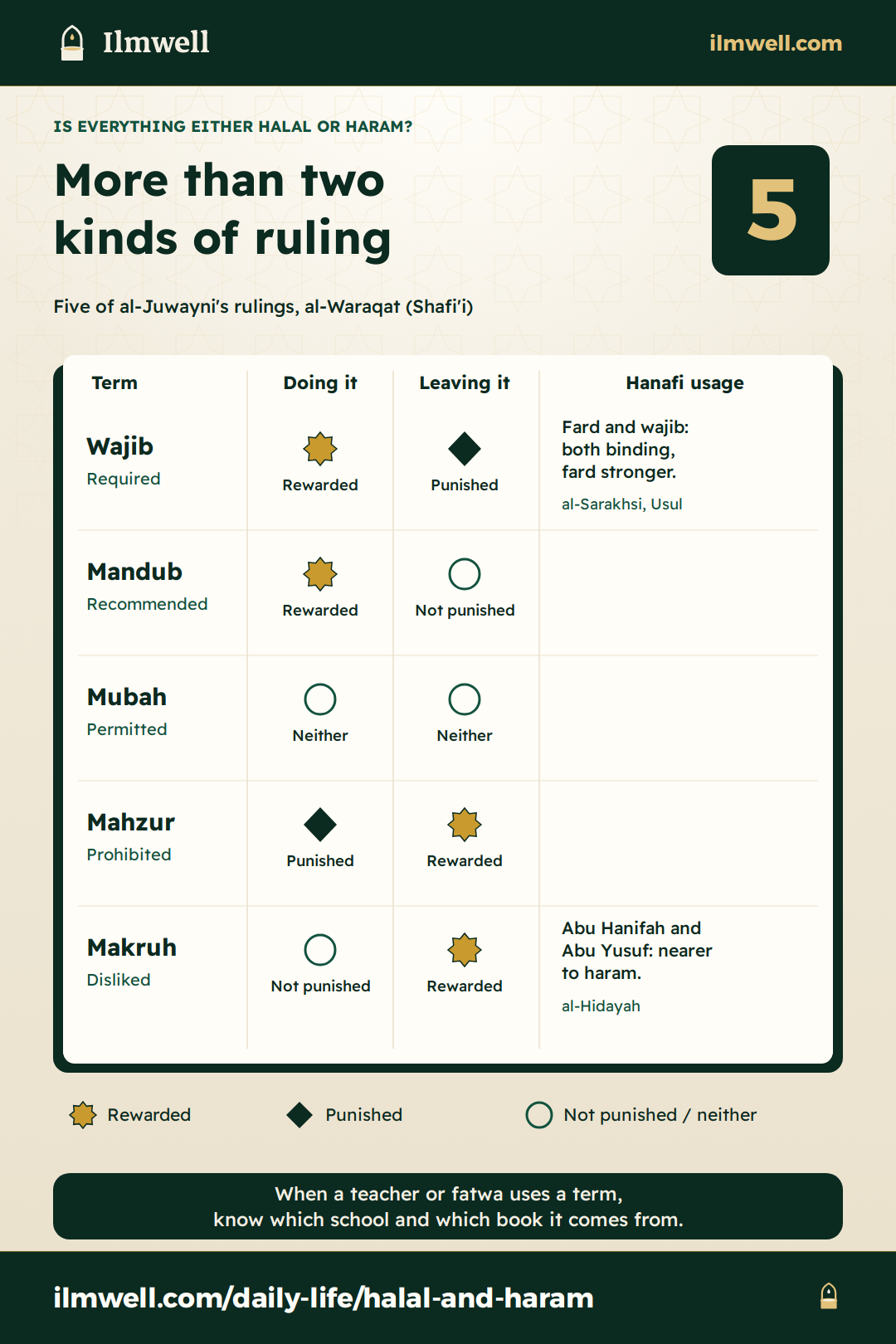
Al-Juwayni (d. 478 AH), a Shafi'i scholar, lists seven rulings in al-Waraqat. Five of them sort acts by reward and punishment 7.
| Term | In English | According to al-Juwayni |
|---|---|---|
| Wajib | Required | Rewarded for doing it, punished for leaving it |
| Mandub | Recommended | Rewarded for doing it, not punished for leaving it |
| Mubah | Permitted | Neither rewarded nor punished, either way |
| Mahzur | Prohibited | Rewarded for leaving it, punished for doing it |
| Makruh | Disliked | Rewarded for leaving it, not punished for doing it |
Hanafi usul, as al-Sarakhsi (d. 483 AH) sets it out in his Usul, splits the required in two. A fard is established by evidence that gives certain knowledge; a wajib by evidence that obliges action but, because of a doubt in its route, not certain knowledge. Both are binding, he writes, but the fard has the stronger effect 8.
On makruh, al-Marghinani (d. 593 AH) opens the book on karahiyah in the Hanafi al-Hidayah by reporting that Muhammad al-Shaybani is narrated as saying every makruh is haram, though he did not call it haram because he found no decisive text for it, and that Abu Hanifah and Abu Yusuf held it to be nearer to haram 9.
So makruh is described differently in al-Juwayni's list and in this Hanafi passage. When a teacher or a fatwa uses one of these terms, it helps to know which school and which book it comes from.
What are doubtful matters?
Al-Nu'man ibn Bashir, may Allah be pleased with him, said he heard the Prophet Muhammad, peace be upon him, say that the halal is clear and the haram is clear, and between them are doubtful matters that many people do not know (Sahih al-Bukhari 52, graded sahih).
Sahih al-Bukhari 52, graded sahih
الْحَلاَلُ بَيِّنٌ وَالْحَرَامُ بَيِّنٌ، وَبَيْنَهُمَا مُشَبَّهَاتٌ لاَ يَعْلَمُهَا كَثِيرٌ مِنَ النَّاسِ
al-ḥalālu bayyinun wa-l-ḥarāmu bayyinun, wa-baynahumā mushabbahātun lā yaʿlamuhā kathīrun mina n-nās
The halal is clear and the haram is clear, and between them are doubtful matters that many people do not know. (Our translation.)
1AuthenticSahih al-Bukhari 52
The report goes on: whoever guards against the doubtful matters keeps his religion and his honour clear, and whoever falls into them is like a shepherd grazing around a protected pasture, about to fall into it. Every king has such a pasture, and Allah's pasture on His earth is what He has made prohibited. It ends with the heart: a lump of flesh in the body which, when sound, leaves the whole body sound, and when corrupt, the whole body corrupt.
Sahih Muslim 1599a, also graded sahih, carries the same report in a different wording. There, whoever falls into the doubtful matters "falls into the haram".
2AuthenticSahih Muslim 1599a
Neither wording names a food, a product or an ingredient, and neither says who settles a doubtful case. Bukhari's wording does not say that something you have not yet checked is haram; Muslim's adds that whoever falls into the doubtful matters falls into the haram. They separate what is clear from what is unclear to many people. How one unclear case is settled is a question for a scholar.
Is everything halal unless proven haram?
The two classical works cited here give different answers.
Al-Suyuti (d. 911 AH), in his Shafi'i al-Ashbah wa-l-Naza'ir, states it as a maxim: the default in things is permissibility until evidence shows prohibition. He calls this "our school", and says that according to Abu Hanifah the default is prohibition until evidence shows permissibility. The difference, he writes, shows in matters the texts are silent about 10.
Shafi'i al-Ashbah wa-l-Naza'ir, p. 60
الْأَصْلُ فِي الْأَشْيَاءِ الْإِبَاحَةُ حَتَّى يَدُلُّ الدَّلِيلُ عَلَى التَّحْرِيمِ
al-aṣlu fī l-ashyā'i l-ibāḥatu ḥattā yadull ad-dalīlu ʿalā t-taḥrīm
The default in things is permissibility until evidence shows prohibition. (Our translation.)
Ibn Nujaym (d. 970 AH), in his Hanafi al-Ashbah wa-l-Naza'ir, puts the same point as a question, and notes that it is the Shafi'is who attribute the prohibition view to Abu Hanifah. He then quotes his own commentary on al-Manar, which gives other answers: that things are originally permitted according to some Hanafis, among them al-Karkhi, and that "our companions" (the Hanafi scholars) held the default to be suspension (tawaqquf) 11.
So "everything is halal unless proven haram" is a maxim al-Suyuti gives for the Shafi'i school, and Ibn Nujaym's Hanafi book records more than one answer. Neither book's maxim is a verdict on any product.
Who decides what is halal and haram?
An-Nahl 16:116 warns against calling things lawful and forbidden by one's own words, and so inventing a lie against Allah.
وَلَا تَقُولُوا۟ لِمَا تَصِفُ أَلْسِنَتُكُمُ ٱلْكَذِبَ هَـٰذَا حَلَـٰلٌ وَهَـٰذَا حَرَامٌ لِّتَفْتَرُوا۟ عَلَى ٱللَّهِ ٱلْكَذِبَ ۚ إِنَّ ٱلَّذِينَ يَفْتَرُونَ عَلَى ٱللَّهِ ٱلْكَذِبَ لَا يُفْلِحُونَ
The verse is about inventing such labels. It does not list what is lawful or forbidden.
On how a qualified answer is given, Ibn al-Salah (d. 643 AH) writes in Adab al-Mufti wa-l-Mustafti that when a question has distinctions in it, the answer must not be given without qualification, which he calls an error 12. The mufti (the scholar giving the answer) may ask the questioner for the details and write the question down before answering, which he calls better and safer. Or he may answer only the case he knows applies, but say "this is if such and such".
How do you ask about a halal or haram question?
The five steps below are our own checklist for preparing a question for a scholar you trust. They follow Ibn al-Salah's point that the details of a case shape its answer. They are not a way to reach a ruling yourself.
- Name the actual thing. The action, transaction, ingredient or product, not a broad category.
- Give the facts that could change the answer. For a product, the label as printed and where it was bought; for an agreement or an action, the circumstances.
- Separate what you know from what you were told. Say what you checked yourself and what still needs checking.
- Say which school you follow, if you follow one. The terms and defaults on this page differ between works of different schools.
- Keep the conditions with the answer. If the answer is "this is if such and such", pass it on with its conditions, not as a general verdict.
An everyday picture (ours): "is this dessert halal?" asked across a shop counter and the same question asked with the tub's printed ingredient list in hand are different questions. The second gives the person answering the facts. This page gives no verdict on either.
Is halal only about food?
No. Al-Jurjani's first definition speaks of "everything" a person is not punished for using, and his second of what the Sharia leaves free to do, with no mention of food 3.
The Quran also speaks of food directly. Al-Baqarah 2:168 says: "O mankind! Eat of that which is lawful and wholesome in the earth". Al-Maidah 5:3 also lists foods that are forbidden. Those foods are covered on their own pages.
Questions about particular foods, ingredients and products have their own pages, starting with How to check a product is halal in the UK (coming soon).
For a long time I thought everything was either clearly halal or clearly haram. Learning that the hadith itself names a doubtful middle, and what to do with it, made a lot of everyday questions calmer.
Try it: five questions
Five quick questions. Pick an answer; each one explains itself.
1In al-Jurjani's al-Ta'rifat, the word halal is taken from what?
Answer: Hall, opening. He writes that halal is taken from al-hall, which is opening (source 3).
2In Sahih al-Bukhari 52, graded sahih, what lies between the clear halal and the clear haram?
Answer: Doubtful matters that many people do not know. Doubtful matters (mushabbahat) that many people do not know. The report names no food or product. Source 1
3In al-Sarakhsi's Hanafi usul, what tells a fard apart from a wajib?
Answer: Whether the evidence gives certain knowledge. Both are binding; a fard rests on evidence giving certain knowledge, a wajib on evidence with a doubt in its route (source 8).
4In source 10, the maxim that the default in things is permissibility is called "our school". Which school is that?
Answer: Shafi'i. The Shafi'i; he reports the opposite default from Abu Hanifah, and Ibn Nujaym quotes other Hanafi answers (sources 10 and 11).
5When a mufti answers only the case he knows applies, what does Ibn al-Salah say he should add?
Answer: "This is if such and such". He says the answer keeps its condition: "this is if such and such" (source 12).
Questions people ask
How can you tell if something is halal or haram?
Sahih al-Bukhari 52, graded sahih, records the Prophet Muhammad, peace be upon him, saying that the halal is clear and the haram is clear, with doubtful matters between them that many people do not know. For a particular food, product or transaction, take the full facts to a scholar you trust, because an answer to one case depends on its details. If you are unsure about something in your own life, there is no shame in asking.
Does halal mean healthy?
Not by definition. Halal is a religious classification of what is permitted, and al-Jurjani's definitions of the word, as this page reads them, say nothing about health or nutrition. A question about health or diet needs its own evidence: for that, speak to your GP or a dietitian.
Sources
Every claim on this page comes from one of these. Gradings are reported with the scholar's name; we do not grade hadith ourselves.
- 1
Al-Nu'man ibn Bashir heard the Prophet say that the halal is clear and the haram is clear, and between them are doubtful matters (mushabbahat) that many people do not know.
Sahih al-Bukhari 52 Book 2, Hadith 45
Authentic: in Sahih al-Bukhari
- 2
In Sahih Muslim's wording of al-Nu'man ibn Bashir's report, whoever falls into the doubtful matters (al-shubuhat) falls into the haram.
Sahih Muslim 1599a Book 22, Hadith 133
Authentic: in Sahih Muslim
- 3
Two definitions of halal: everything one is not punished for using, and what the Sharia leaves free to do, from hall, opening.
'Ali ibn Muhammad al-Sharif al-Jurjani (d. 816 AH), Kitab al-Ta'rifat, corrected by a group of scholars under the publisher's supervision, Dar al-Kutub al-'Ilmiyyah, Beirut, 1st edition, 1403 AH / 1983 (shamela.ws numbering follows the print), p. 92, bab al-ha', entry 'al-halal' Read on 25 October 2026. Record: scholarly-jurjani-tarifat-halal.
- 4
The root h-l-l goes back to opening; halal is the opposite of haram, as if from releasing a thing and making it permitted.
Ahmad ibn Faris ibn Zakariyya (d. 395 AH), Mu'jam Maqayis al-Lughah, ed. 'Abd al-Salam Muhammad Harun, 2nd edition, Mustafa al-Babi al-Halabi, Cairo, 1389 to 1392 AH / 1969 to 1972 (shamela.ws numbering follows the print), vol. 2, p. 20, entry 'hl' Read on 25 October 2026. Record: scholarly-ibnfaris-hll-root.
- 5
The root h-r-m is prevention and strictness; haram is the opposite of halal; the two Harams, Makkah and Madinah, named for their sanctity.
Ahmad ibn Faris ibn Zakariyya (d. 395 AH), Mu'jam Maqayis al-Lughah, ed. 'Abd al-Salam Muhammad Harun, 2nd edition, Mustafa al-Babi al-Halabi, Cairo, 1389 to 1392 AH / 1969 to 1972 (shamela.ws numbering follows the print), vol. 2, p. 45, entry 'hrm' Read on 25 October 2026. Record: scholarly-ibnfaris-hrm-root.
- 6
The prohibited (al-mahzur, al-hurmah): rewarded for leaving it in obedience, punished for doing it; punishment for one wrongdoer with others pardoned is enough for the definition.
Jalal al-Din Muhammad ibn Ahmad al-Mahalli al-Shafi'i (d. 864 AH), Sharh al-Waraqat fi Usul al-Fiqh, ed. Husam al-Din ibn Musa 'Afanah, Jami'at al-Quds, 1st edition, 1420 AH / 1999 (shamela.ws numbering follows the print), pp. 74 to 75, section 'Ta'rif al-mahzur' Read on 25 October 2026. Record: scholarly-mahalli-waraqat-mahzur.
- 7
The seven rulings and their definitions (five are quoted here).
'Abd al-Malik ibn 'Abdullah al-Juwayni, Imam al-Haramayn (d. 478 AH), al-Waraqat, ed. 'Abd al-Latif Muhammad al-'Abd (shamela.ws numbering follows the print), p. 8 (section 'Anwa' al-hukm') Read on 21 October 2026. Record: scholarly-juwayni-seven-rulings.
- 8
Fard and wajib: both binding, told apart by whether the evidence gives certain knowledge.
Abu Bakr Muhammad ibn Ahmad al-Sarakhsi (d. 483 AH), Usul al-Sarakhsi, ed. Abu al-Wafa al-Afghani, Lajnat Ihya' al-Ma'arif al-Nu'maniyyah, Hyderabad (reprinted Dar al-Ma'rifah, Beirut) (shamela.ws numbering follows the print), vol. 1, pp. 110 to 111, 'Fasl fi bayan al-mashru'at min al-'ibadat wa-ahkamiha' Read on 25 October 2026. Record: scholarly-sarakhsi-fard-wajib.
- 9
The meaning of makruh at the head of the book on karahiyah: the reports from Muhammad, Abu Hanifah and Abu Yusuf.
Burhan al-Din 'Ali ibn Abi Bakr al-Marghinani (d. 593 AH), al-Hidayah fi Sharh Bidayat al-Mubtadi, ed. Talal Yusuf, Dar Ihya' al-Turath al-'Arabi, Beirut, 1st edition, 1425 AH / 2004 (shamela.ws numbering follows the print), vol. 4, p. 363, opening of 'Kitab al-Karahiyah' Read on 25 October 2026. Record: scholarly-marghinani-hidayah-makruh.
- 10
The maxim that the default in things is permissibility, called "our school", with his report of Abu Hanifah's view.
Jalal al-Din 'Abd al-Rahman al-Suyuti (d. 911 AH), al-Ashbah wa-l-Naza'ir fi Qawa'id wa-Furu' Fiqh al-Shafi'iyyah, Dar al-Kutub al-'Ilmiyyah, 1st edition, 1403 AH / 1983 (shamela.ws numbering follows the print), p. 60, 'Qa'idah: al-asl fi al-ashya' al-ibahah hatta yadull al-dalil 'ala al-tahrim' Read on 25 October 2026. Record: scholarly-suyuti-ashbah-ibaha.
- 11
The same maxim posed as a question, with the Hanafi answers he quotes: permissibility (al-Karkhi among others) and suspension.
Zayn al-Din ibn Ibrahim ibn Muhammad, known as Ibn Nujaym (d. 970 AH), al-Ashbah wa-l-Naza'ir 'ala Madhhab Abi Hanifah al-Nu'man, notes by Zakariyya 'Umayrat, Dar al-Kutub al-'Ilmiyyah, Beirut, 1st edition, 1419 AH / 1999 (shamela.ws numbering follows the print), pp. 56 to 57, 'Qa'idah: hal al-asl fi al-ashya' al-ibahah' Read on 25 October 2026. Record: scholarly-ibnnujaym-ashbah-ibaha.
- 12
A question with distinctions must not get an unqualified answer; ask for the details, or answer one case and state its conditions.
Abu 'Amr 'Uthman ibn 'Abd al-Rahman, known as Ibn al-Salah al-Shahrazuri (d. 643 AH), Adab al-Mufti wa-l-Mustafti, ed. Muwaffaq ibn 'Abdullah ibn 'Abd al-Qadir, Maktabat al-'Ulum wa-l-Hikam, Madinah / 'Alam al-Kutub, 1st edition, 1407 AH / 1986 (shamela.ws numbering follows the print), p. 135, 'al-Qawl fi kayfiyyat al-fatwa wa-adabiha', the second point Read on 25 October 2026. Record: scholarly-ibnsalah-adab-mufti-tafsil.
- Q
Quran Arabic for the words al-masjid al-haram in Al-Baqarah 2:144 and for An-Nahl 16:116; English for An-Nahl 16:116 and phrases from Al-Baqarah 2:144, Al-Baqarah 2:168 and Al-Maidah 5:3.
Tanzil Project Uthmani text, CC BY 3.0. English: adapted from Marmaduke Pickthall's translation (1930), modernised and checked against modern translations.
Next
- Sharia law explainedExplainer
- What is a hadith?Explainer
- Duas before and after eatingDua lesson
- Start at AlifThe hub
For your own situation, ask a scholar you trust.
Join the email list
New guides by email, now and then. No spam, and you can leave at any time.
Ilmwell is free and kept going by readers. See how to support it.