The short answer
The shahada is the testimony of faith, first of the five things Islam is built on in Sahih al-Bukhari 8, graded sahih (the five pillars). In English: "I bear witness that there is no god but Allah, and I bear witness that Muhammad is the Messenger of Allah." Said aloud: ashhadu an la ilaha illallah, wa ashhadu anna Muhammadan rasulullah.
How is the shahada written in Arabic?
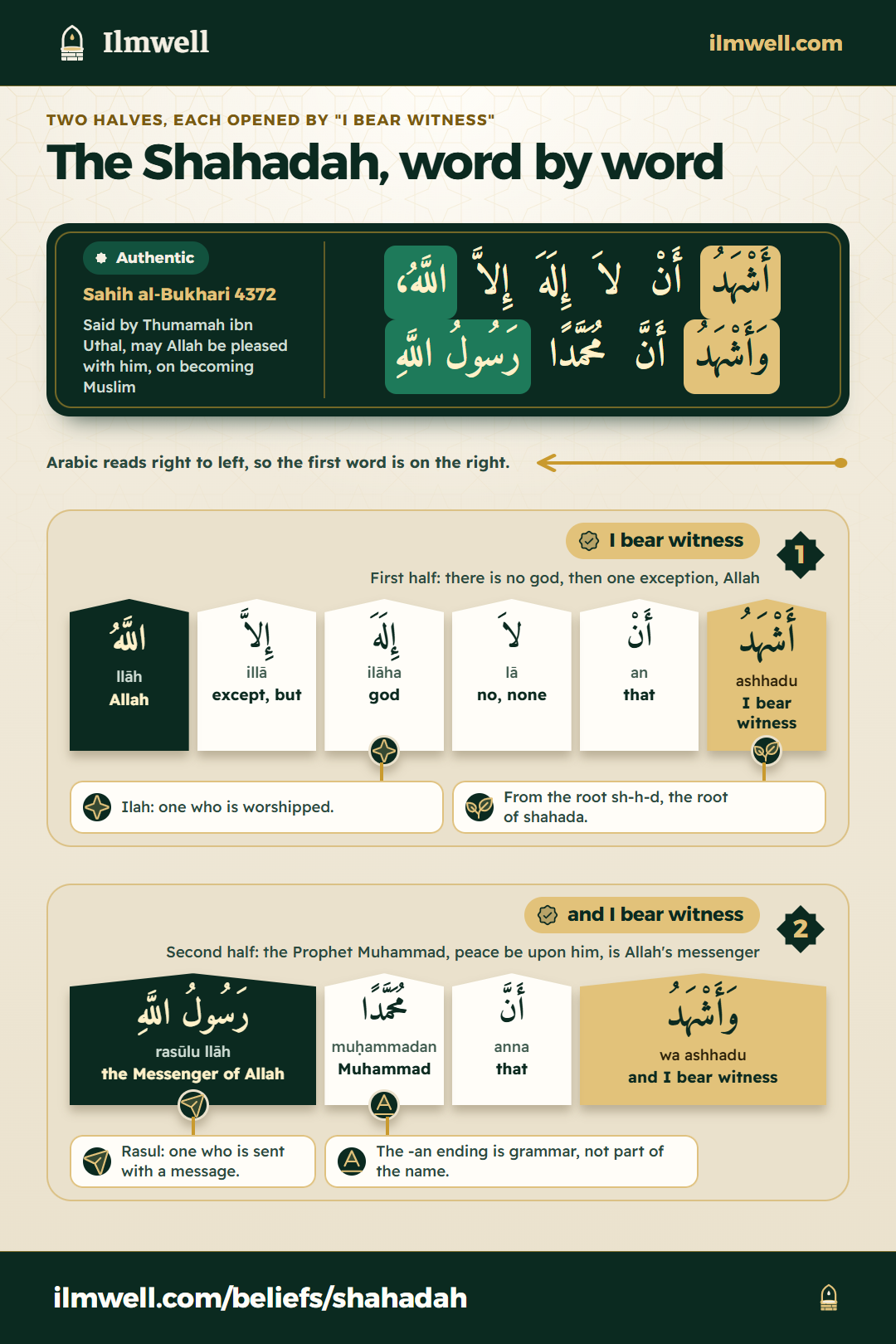
Sahih al-Bukhari 4372
أَشْهَدُ أَنْ لاَ إِلَهَ إِلاَّ اللَّهُ، وَأَشْهَدُ أَنَّ مُحَمَّدًا رَسُولُ اللَّهِ
ashhadu an lā ilāha illā llāh, wa ashhadu anna muḥammadan rasūlu llāh
I bear witness that there is no god but Allah, and I bear witness that Muhammad is the Messenger of Allah.
These are the words Thumamah ibn Uthal, may Allah be pleased with him, said when he became Muslim. Shahada, also spelt shahadah and sometimes written shahadat, is Arabic for testimony: bearing witness to something you hold true.
1AuthenticSahih al-Bukhari 4372
What does each word of the shahada mean?
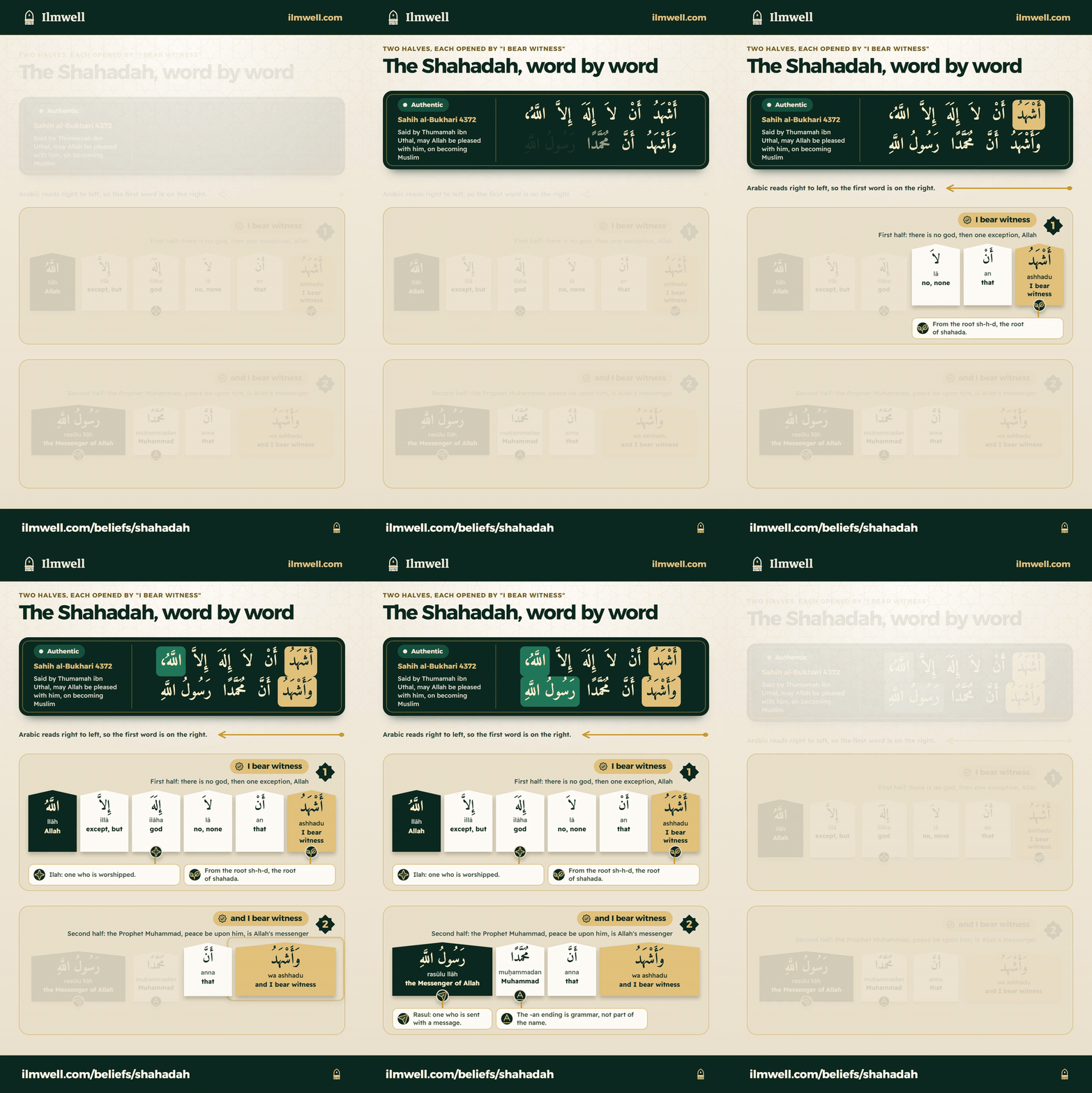
Arabic reads right to left, so the first word is on the right.
- أَشْهَدُashhaduI bear witnessFrom the root sh-h-d, the root of shahada.
- أَنْanthat
- لاَlāno, none
- إِلَهَilāhagodIlah: one who is worshipped.
- إِلاَّillāexcept, but
- اللَّهُllāhAllah
- وَأَشْهَدُwa ashhaduand I bear witness
- أَنَّannathat
- مُحَمَّدًاmuḥammadanMuhammadThe -an ending is grammar, not part of the name.
- رَسُولُ اللَّهِrasūlu llāhthe Messenger of AllahRasul: one who is sent with a message.
What does the shahada mean?
The shahada has two halves. The first, la ilaha illallah, says there is no god, then makes one exception: Allah. The second says that Muhammad is Allah's messenger, sent by Him. To learn who he was, read The Prophet Muhammad: who he was.
In a hadith narrated by Ibn 'Umar, may Allah be pleased with him, the shahada is the first of the five things the Prophet said Islam is built on, before prayer, zakat, Hajj and fasting in Ramadan. Each is explained in the five pillars of Islam.
2AuthenticSahih al-Bukhari 8
Abu Sa'id al-Khudri, may Allah be pleased with him, reported that the Prophet said to prompt the dying to say la ilaha illallah, the first half of the shahada.
3AuthenticSahih Muslim 916
How do you say the shahada?
ashhaduanlāilāhaillallāhwaashhaduannamuḥammadarrasūlullāh
- ash-hadu: sh is one sound, as in ship, then a separate h.
- illallah and anna have doubled letters: hold them a moment longer.
- ḥ in Muhammad is a breathy h from the throat, stronger than an English h.
- The syllables run the n of Muhammadan into the r: Muhammadar-rasulullah.
If the doubled letters trip you up at first, slow down and say it one syllable at a time.
Listen and repeat. A recording by a fluent reciter is coming.
Is the shahada in the Quran?
Both halves are, in separate verses. La ilaha illallah is in Muhammad 47:19 and As-Saffat 37:35; Muhammadun rasulullah opens Al-Fath 48:29. The Ilmwell team's search of the Tanzil Quran text on 22 October 2026 found no verse holding both halves together.
فَٱعْلَمْ أَنَّهُۥ لَآ إِلَـٰهَ إِلَّا ٱللَّهُ
مُّحَمَّدٌ رَّسُولُ ٱللَّهِ
How do you take shahada to become Muslim?
- Learn what the words mean, with the cards above.
- Say them in your own language, then in Arabic (the preference of AMJA, a scholarly body named below), with the transliteration in the scroll.
- If you will need proof of your Islam, for marriage or pilgrimage, AMJA notes a document is needed; ask a scholar or mosque you trust how to get one.
AMJA says there is no particular timetable for teaching a new Muslim the faith: what to learn is weighed by need and ability. Start at Alif is a calm first route through the basics.
These are the positions of one scholarly body, the Assembly of Muslim Jurists of America (AMJA), from the recommendations of its conference on new Muslims:
- AMJA holds that a person's Islam is affirmed by the testimony of faith, spoken or written, or signed by someone who cannot speak. It must come with knowledge of its meaning, acceptance of what it implies and the intention of entering Islam, distancing oneself from all that contradicts the faith.
- It need not be in Arabic for someone not proficient in it; AMJA prefers saying it in your own language, then repeating the Arabic after someone, if that is no hardship.
- For Allah's acceptance, AMJA holds, an announcement, witnesses and a document are not conditions; they are needed for matters such as marriage, pilgrimage, inheritance and funerals.
- AMJA holds that ghusl (the full bath) is not obligatory for a new Muslim, only preferred, on the stronger of two opinions, and that a name need not change unless its meaning is non-Islamic or distasteful.
For your own situation, ask a scholar you trust.
A companion's shahada
Abu Hurayrah, may Allah be pleased with him, reported that horsemen the Prophet sent towards Najd brought back Thumamah ibn Uthal, of the tribe of Banu Hanifah, and tied him to a pillar of the mosque. On the third day the Prophet said: "Release Thumamah."
Thumamah went to some palm trees near the mosque and bathed. Then he came into the mosque and said the shahada, in the words in the scroll above. He told the Prophet that no face on earth had been more hateful to him than his, and now it had become the most beloved of faces to him. The Prophet gave him good news.
1AuthenticSahih al-Bukhari 4372
Is the shahada the first or second kalima?
Neither exactly. Mufti Muhammad ibn Adam of Darul Iftaa, Leicester, describes the kalimas as a list taught in the religious schools of the Indian subcontinent; a fatwa of Darul Uloom Deoband names six, Kalimah Tayyibah first and Kalimah Shahadah second.
- The first kalima (1st kalma, Kalima Tayyibah) carries the same two halves without "I bear witness": la ilaha illallahu Muhammadur rasulullah, "there is no god but Allah, Muhammad is the Messenger of Allah".
- Kalima Shahadat, the second kalima (2nd kalma, also written kalma shahadat), says Muhammad is "His servant and His Messenger". The Deoband fatwa words it: ashhadu an la ilaha illallah wa ashhadu anna Muhammadan 'abduhu wa rasuluh.
A wording in Sahih Muslim 234b, from 'Uqba ibn 'Amir, may Allah be pleased with him, adds wahdahu la sharika lahu, "alone, without partner". The Prophet taught it for saying after wudu (the washing before prayer):
Sahih Muslim 234b
أَشْهَدُ أَنْ لاَ إِلَهَ إِلاَّ اللَّهُ وَحْدَهُ لاَ شَرِيكَ لَهُ وَأَشْهَدُ أَنَّ مُحَمَّدًا عَبْدُهُ وَرَسُولُهُ
ashhadu an lā ilāha illā llāhu waḥdahu lā sharīka lahu wa ashhadu anna muḥammadan ʿabduhu wa rasūluh
I bear witness that there is no god but Allah, alone, without partner, and I bear witness that Muhammad is His servant and His Messenger.
4AuthenticSahih Muslim 234b
I have been at a mosque when someone took their shahada. The room went very quiet, and then everyone smiled at once. I had said those words since childhood, but that was the first time I really heard them.
Try it: five questions
Five quick questions. Pick an answer; each one explains itself.
1What does shahada mean?
Answer: Testimony. Shahada is testimony: bearing witness to something you hold true.
2What does ashhadu mean?
Answer: I bear witness. Ashhadu is "I bear witness", from the same root as shahada. Source 1
3Which word in the shahada means messenger?
Answer: Rasul. Rasul is a messenger, one who is sent. Ilah is a god; illa means except.
4Which verse opens with "Muhammad is the messenger of Allah"?
Answer: Al-Fath 48:29. Al-Fath 48:29.
5What does wahdahu la sharika lahu add?
Answer: Alone, without partner. It means "alone, without partner", in the wording of Sahih Muslim 234b for after wudu. Source 4
Questions people ask
Do you need witnesses to take shahada, or can you say it alone?
One scholarly body, the Assembly of Muslim Jurists of America, holds that witnesses are not a condition for Allah to accept a person's Islam; see "How do you take shahada to become Muslim?" above.
Why is the shahadah important?
It opens the answer to "What is Islam?" in the hadith of Jibril (the angel Gabriel, peace be upon him), Sahih Muslim 8, graded sahih.
Sources
Every claim on this page comes from one of these. Gradings are reported with the scholar's name; we do not grade hadith ourselves.
- 1
Abu Hurayrah reported that Thumamah ibn Uthal, brought back as a captive by horsemen and tied to a pillar of the mosque, was released by the Prophet, bathed, entered the mosque and said: ashhadu an la ilaha illa Allah, wa ashhadu anna Muhammadan rasulu Allah.
Sahih al-Bukhari 4372 Book 64, Hadith 398
Authentic: in Sahih al-Bukhari
- 2
Ibn 'Umar reported the Prophet saying that Islam is built on five: testifying that there is no god but Allah and that Muhammad is the Messenger of Allah, establishing the prayer, giving zakat, Hajj and fasting in Ramadan.
Sahih al-Bukhari 8 Book 2, Hadith 1
Authentic: in Sahih al-Bukhari
- 3
Abu Sa'id al-Khudri reported that the Prophet said: prompt your dying to say la ilaha illa Allah.
Sahih Muslim 916 Book 11, Hadith 1
Authentic: in Sahih Muslim
- 4
In a wording of Sahih Muslim 234 from 'Uqba ibn 'Amir, the Prophet named words to say after wudu: ashhadu an la ilaha illa Allahu wahdahu la sharika lahu wa ashhadu anna Muhammadan 'abduhu wa rasuluhu.
Sahih Muslim 234b Book 2, Hadith 21
Authentic: in Sahih Muslim
- 5
In the hadith of Jibril, a man asked the Prophet about Islam, and he answered: to testify that there is no god but Allah and that Muhammad is the Messenger of Allah, to establish the prayer, give zakat, fast Ramadan and make Hajj to the House if you are able to find a way to it; asked about iman (faith), he answered: to believe in Allah, His angels, His books, His messengers, the Last Day, and the decree, its good and its bad.
Sahih Muslim 8 Book 1, Hadith 1
Authentic: in Sahih Muslim
- Q
Quran Arabic and English for the opening words of Muhammad 47:19 and Al-Fath 48:29. As-Saffat 37:35 is referred to in our words.
Tanzil Project Uthmani text, CC BY 3.0. English: adapted from Marmaduke Pickthall's translation (1930), modernised and checked against modern translations.
- 6
The Ilmwell team's search of the Tanzil Quran text on 22 October 2026 found la ilaha illa Allah in As-Saffat 37:35 and Muhammad 47:19, Muhammadun rasulu Allah in Al-Fath 48:29, and no verse holding both. A search finding of one edition on one date.
Tanzil Quran text Record: search-shahadah-quran, with every search term and result.
- 7
AMJA holds that a person's Islam is affirmed by the testimony of faith, spoken or written, or signed by someone who cannot speak, with knowledge of its meaning, acceptance and the intention of entering Islam; that it need not be in Arabic for someone not proficient in it; that an announcement, witnesses and a document are not conditions for Allah's acceptance but are needed for matters such as marriage, pilgrimage, inheritance and funerals; that there is no particular timetable for teaching a new Muslim; that ghusl is not obligatory for a new Muslim, only preferred on the stronger of two opinions; and that a name need not change unless its meaning is non-Islamic or distasteful. One scholarly body's position.
Assembly of Muslim Jurists of America, Recommendations of the Conference on Contemporary Issues Related to New Muslims Record: scholarly-amja-new-muslims. Read on 22 October 2026.
- 8
A fatwa of Darul Uloom Deoband lists six kalimas, Kalimah Tayyibah (la ilaha illa Allah, Muhammadun rasulu Allah) first and Kalimah Shahadah (ashhadu an la ilaha illa Allah wa ashhadu anna Muhammadan abduhu wa rasuluhu) second. One fatwa body's answer.
Darul Ifta, Darul Uloom Deoband, fatwa 344/236=L/1430 Record: scholarly-deoband-six-kalimas. Read on 22 October 2026.
- 9
Mufti Muhammad ibn Adam describes the kalimas as statements taught in the religious schools of the Indian subcontinent, and the first two as bearing testimony. One mufti's answer.
Mufti Muhammad ibn Adam, Darul Iftaa, Leicester, "Teaching the Five Kalimas to the Children" Record: scholarly-ibnadam-kalimas. Read on 22 October 2026.
Next
- The five pillars of Islam explainedExplainer
- The Prophet Muhammad, peace be upon him: who he wasLife and sources
- How to become MuslimGuide
- How to perform wudu: illustrated stepsPractical guide
- Start at AlifThe hub
- Your first week as a new MuslimGuide
For your own situation, ask a scholar you trust.
Join the email list
New guides by email, now and then. No spam, and you can leave at any time.
Ilmwell is free and kept going by readers. See how to support it.